Rehnus Maik, Palme Rupert
Swiss Federal Research Institute for Forest, Snow and Landscape Research WSL, Zürcherstrasse 111, Birmensdorf, Switzerland.
WILDTIER SCHWEIZ, Winterthurerstrasse 92, Zurich, Switzerland.
PLoS One. 2017 Aug 23;12(8):e0183718. doi: 10.1371/journal.pone.0183718. eCollection 2017.
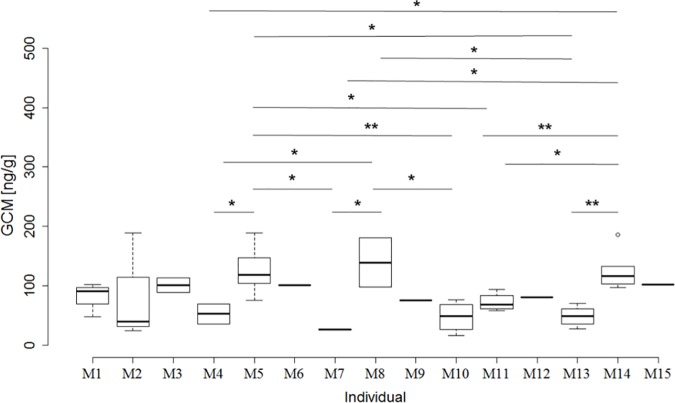
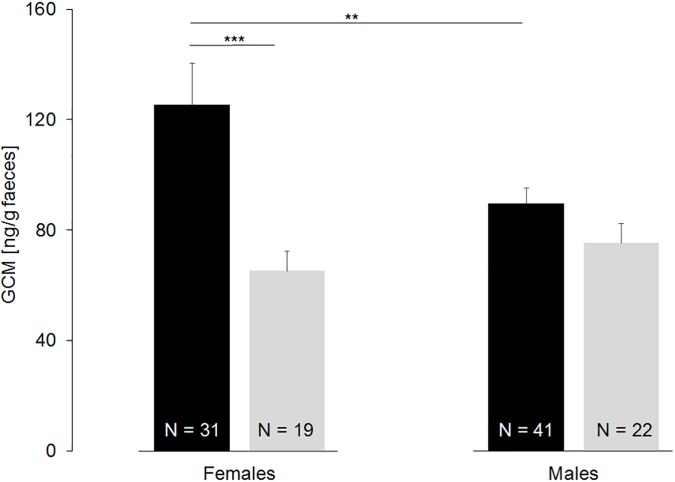
Measurement of glucocorticoid metabolites (GCM) in faeces has become a widely used and effective tool for evaluating the amount of stress experienced by animals. However, the potential sampling bias resulting from an oversampling of individuals when collecting "anonymous" (unknown sex or individual) faeces has rarely been investigated. We used non-invasive genetic sampling (NIGS) to investigate potential interpretation errors of GCM measurements in a free-living population of mountain hares during the mating and post-reproductive periods. Genetic data improved the interpretation of results of faecal GCM measurements. In general GCM concentrations were influenced by season. However, genetic information revealed that it was sex-dependent. Within the mating period, females had higher GCM levels than males, but individual differences were more expressed in males. In the post-reproductive period, GCM concentrations were neither influenced by sex nor individual. We also identified potential pitfalls in the interpretation of anonymous faecal samples by individual differences in GCM concentrations and resampling rates. Our study showed that sex- and individual-dependent GCM levels led to a misinterpretation of GCM values when collecting "anonymous" faeces. To accurately evaluate the amount of stress experienced by free-living animals using faecal GCM measurements, we recommend documenting individuals and their sex of the sampled population. In stress-sensitive and elusive species, such documentation can be achieved by using NIGS and for diurnal animals with sexual and individual variation in appearance or marked individuals, it can be provided by a detailed field protocol.
粪便中糖皮质激素代谢物(GCM)的测量已成为评估动物所经历应激量的一种广泛使用且有效的工具。然而,在收集“匿名”(性别或个体未知)粪便时因个体过度采样导致的潜在抽样偏差很少被研究。我们使用非侵入性基因采样(NIGS)来调查自由生活的山地野兔种群在交配期和繁殖后期GCM测量结果的潜在解释误差。基因数据改善了粪便GCM测量结果的解释。一般来说,GCM浓度受季节影响。然而,基因信息显示这是性别依赖性的。在交配期内,雌性的GCM水平高于雄性,但个体差异在雄性中表现得更为明显。在繁殖后期,GCM浓度既不受性别也不受个体的影响。我们还通过GCM浓度和重新采样率的个体差异确定了匿名粪便样本解释中的潜在陷阱。我们的研究表明,在收集“匿名”粪便时,性别和个体依赖性的GCM水平会导致对GCM值的错误解释。为了使用粪便GCM测量准确评估自由生活动物所经历的应激量,我们建议记录采样种群的个体及其性别。在对压力敏感且难以捉摸的物种中,这种记录可以通过使用NIGS来实现,对于外观存在性别和个体差异的昼行性动物或有标记个体的动物,可以通过详细的野外规程来提供。