Rutgers University, New Brunswick, NJ, USA.
University of North Carolina, Chapel Hill, NC, USA.
Indoor Air. 2018 Jan;28(1):198-212. doi: 10.1111/ina.12422. Epub 2017 Sep 20.
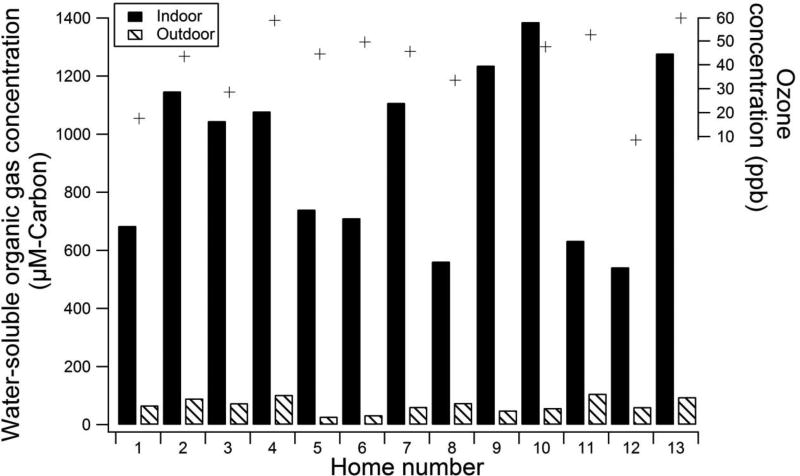
Dampness affects a substantial percentage of homes and is associated with increased risk of respiratory ailments; yet, the effects of dampness on indoor chemistry are largely unknown. We hypothesize that the presence of water-soluble gases and their aqueous processing alters the chemical composition of indoor air and thereby affects inhalation and dermal exposures in damp homes. Herein, we use the existing literature and new measurements to examine the plausibility of this hypothesis, summarize existing evidence, and identify key knowledge gaps. While measurements of indoor volatile organic compounds (VOCs) are abundant, measurements of water-soluble organic gases (WSOGs) are not. We found that concentrations of total WSOGs were, on average, 15 times higher inside homes than immediately outside (N = 13). We provide insights into WSOG compounds likely to be present indoors using peer-reviewed literature and insights from atmospheric chemistry. Finally, we discuss types of aqueous chemistry that may occur on indoor surfaces and speculate how this chemistry could affect indoor exposures. Liquid water quantities, identities of water-soluble compounds, the dominant chemistry, and fate of aqueous products are poorly understood. These limitations hamper our ability to determine the effects of aqueous indoor chemistry on dermal and inhalation exposures in damp homes.
潮湿影响了很大比例的家庭,并增加了呼吸道疾病的风险;然而,潮湿对室内化学物质的影响在很大程度上还不清楚。我们假设水溶性气体的存在及其水相处理会改变室内空气的化学成分,从而影响潮湿房屋中吸入和皮肤暴露的风险。在此,我们利用现有文献和新的测量结果来检验这一假设的合理性,总结现有证据,并确定关键的知识空白。虽然室内挥发性有机化合物(VOCs)的测量很多,但水溶性有机气体(WSOG)的测量却很少。我们发现,室内总 WSOG 的浓度平均比室外高出 15 倍(N=13)。我们利用已发表的文献和大气化学的见解,深入了解了可能存在于室内的 WSOG 化合物。最后,我们讨论了可能在室内表面发生的水相化学,并推测这种化学物质如何影响室内暴露。对液水量、水溶性化合物的身份、主要化学物质和水相产物的命运了解甚少。这些局限性限制了我们确定水相室内化学物质对潮湿房屋中皮肤和吸入暴露的影响的能力。