Bian Dan-Dan, Zhou Hai-Yang, Liu Shuang, Liu Mei, Duan Carol, Zhang Jin-Yan, Jiang Ying-Ying, Wang Ting, Chen Yu, Wang Zhao, Zheng Su-Jun, Duan Zhong-Ping
Form Artificial Liver Center, Beijing YouAn Hospital, Capital Medical University Liver Department, Wu Jieping Medical Foundation, Beijing, China.
Medicine (Baltimore). 2017 Aug;96(34):e7885. doi: 10.1097/MD.0000000000007885.
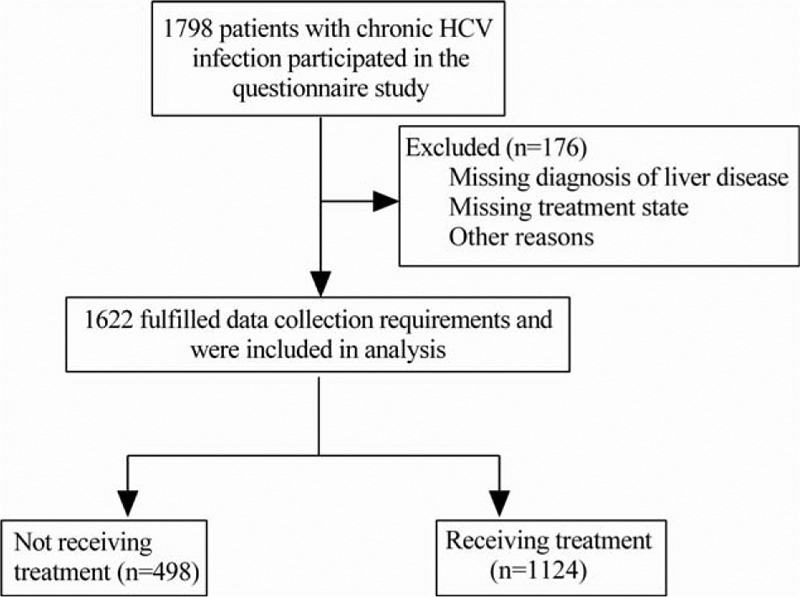
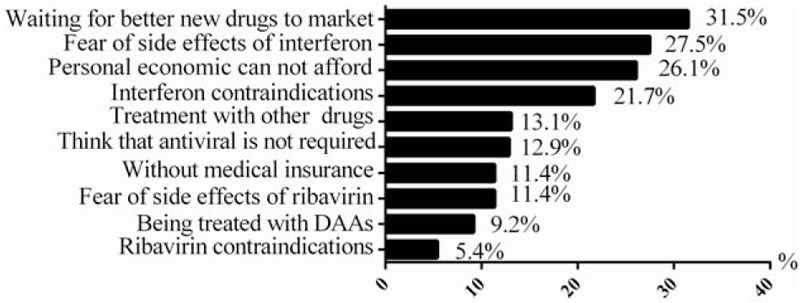
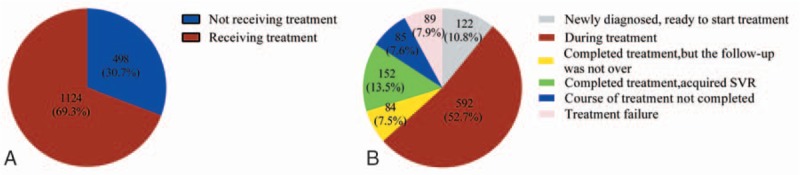
Chronic hepatitis C virus (HCV) infection is a serious public health problem worldwide. China, as the country with the largest number of HCV infections in the world, plays a significant role in eliminating hepatitis C. Due to different financial situations and education background, hepatitis C patients take different actions for their disease treatment and management. Therefore, antiviral treatment status should be attached great importance to learn the medical demand of patients. A nationwide, multicenter survey was conducted from July 2015 to June 2016. Of 1798 inpatients and outpatients with chronic HCV from 56 hospitals participated in the survey. Each patient completed the questionnaire with questions about his/her antiviral therapy status, perception of treatment barriers, and expectations for future treatment. In total 1622 patients, including 1241 with chronic hepatitis C, 344 with cirrhosis, and 37 patients with hepatocellular carcinoma, fulfilled data collection requirements and finally were included in analysis. Overall, up to 30.7% of the patients had not or currently does not intend to receive antiviral therapy. The main reason was expecting more potent and well-tolerance medication (31.5%), followed by the fear of interferon related side effects (27.5%). Multiple regression analysis showed that the patient's annual income, the severity of HCV, and comorbidity were independent predictors of not receiving antiviral therapy. The whole patients were expecting more potent and well tolerance medication available soon. In summary, Peg-IFN/RBV treatment regimen cannot meet the need of patients well, and safe and efficient direct-acting antivirals are urgently needed in mainland China.
慢性丙型肝炎病毒(HCV)感染是全球严重的公共卫生问题。中国作为世界上HCV感染人数最多的国家,在消除丙型肝炎方面发挥着重要作用。由于经济状况和教育背景不同,丙型肝炎患者对其疾病的治疗和管理采取不同行动。因此,应高度重视抗病毒治疗状况,以了解患者的医疗需求。2015年7月至2016年6月进行了一项全国性、多中心调查。来自56家医院的1798例慢性HCV住院患者和门诊患者参与了调查。每位患者完成了关于其抗病毒治疗状况、对治疗障碍的认知以及对未来治疗期望的问卷。共有1622例患者满足数据收集要求,最终纳入分析,其中包括1241例慢性丙型肝炎患者、344例肝硬化患者和37例肝细胞癌患者。总体而言,高达30.7%的患者未曾或目前不打算接受抗病毒治疗。主要原因是期望有更高效且耐受性良好的药物(31.5%),其次是担心干扰素相关副作用(27.5%)。多元回归分析表明,患者的年收入、HCV严重程度和合并症是未接受抗病毒治疗的独立预测因素。所有患者都期望尽快有更高效且耐受性良好的药物。总之,聚乙二醇干扰素/利巴韦林治疗方案不能很好地满足患者需求,中国大陆迫切需要安全有效的直接抗病毒药物。