Riis Allan, Rathleff Michael Skovdal, Jensen Cathrine Elgaard, Jensen Martin Bach
Research Unit for General Practice in Aalborg, Department of Clinical Medicine, Aalborg University, Fyrkildevej 7, 1. sal, lejl. 3, 9220, Aalborg Øst, Denmark.
Danish Center for Healthcare Improvements, Aalborg University, Fibigerstræde 11, 9220, Aalborg Øst, Denmark.
BMC Musculoskelet Disord. 2017 Aug 23;18(1):360. doi: 10.1186/s12891-017-1727-6.
Low back pain (LBP) is a common cause of contact with the primary healthcare sector. In some patients, symptoms quickly resolve, but others develop long-lasting pain and disability. To improve the care pathway for patients with LBP, the STarT Back Tool (STarT) questionnaire has been developed. It helps initial decision-making by subgrouping patients on the basis of their prognosis and helps to target treatment according to prognosis. An assumption behind the use of STarT is the ability to predict functional improvement. This assumption has never been tested in a population that consists exclusively of patients enrolled when consulting a Danish general practitioner for LBP. The aim of this study was to investigate STarT's ability to predict a 30% improvement in the Roland Morris Disability Questionnaire (RMDQ) score.
This was an ancillary analysis using data from a Danish guideline implementation study (registered at ClinicalTrials.gov NCT01699256). An inclusion criterion was age 18 to 65 years of age. Exclusion criteria were pregnancy, fractures, and signs of underlying pathology. Patient-reported STarT score and the Roland Morris Disability Questionnaire were administered at baseline and again after 4, 8, and 52 weeks.
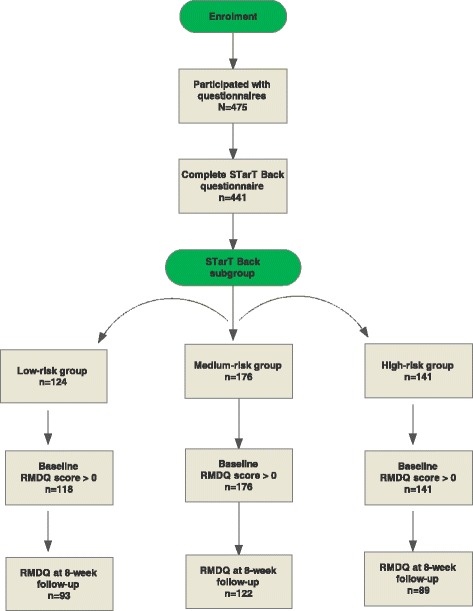
Between January 2013 and July 2014, 475 patients from the original trial participated with questionnaires. From this subpopulation, 441 (92.8%) patients provided information regarding STarT. Baseline and eight-week RMDQ data were available for 304 (64.0%) patients. After 8 weeks, 61 (65.6%) in the low-risk group, 67 (54.9%) in the medium-risk group, and 33 (37.1%) in the high-risk group had achieved a 30% improvement in the RMDQ score. After 8 weeks, high-risk patients were at 61% (95% CI: 20-125%, P < 0.001) higher risk of not achieving a 30% improvement in the RMDQ score compared with patients in either the low-risk group or the medium-risk group.
STarT was predictive for functional improvement in patients from general practice with LBP.
ClinicalTrials.gov NCT01699256 , Nov 29, 2016 (registered retrospectively).
腰痛(LBP)是患者与基层医疗保健部门接触的常见原因。在一些患者中,症状很快缓解,但另一些患者会发展为长期疼痛和残疾。为改善腰痛患者的护理途径,已开发出STarT Back工具(STarT)问卷。它通过根据患者预后进行分组来辅助初始决策,并有助于根据预后确定治疗目标。使用STarT的一个假设是能够预测功能改善情况。这一假设从未在专门由因腰痛咨询丹麦全科医生而登记的患者群体中得到检验。本研究的目的是调查STarT预测罗兰·莫里斯残疾问卷(RMDQ)评分改善30%的能力。
这是一项使用丹麦指南实施研究数据(在ClinicalTrials.gov上注册,编号NCT01699256)的辅助分析。纳入标准为年龄在18至65岁之间。排除标准为妊娠、骨折和潜在病理体征。在基线以及4周、8周和52周后,对患者进行患者报告的STarT评分和罗兰·莫里斯残疾问卷调查。
2013年1月至2014年7月,475名来自原试验的患者参与了问卷调查。在这个亚组中,441名(92.8%)患者提供了有关STarT的信息。304名(64.0%)患者有基线和8周时的RMDQ数据。8周后,低风险组中有61名(65.6%)、中等风险组中有67名(54.9%)、高风险组中有33名(37.1%)患者的RMDQ评分改善了30%。8周后,与低风险组或中等风险组的患者相比,高风险患者未实现RMDQ评分改善30%的风险高61%(95%CI:20-125%,P<0.001)。
STarT可预测基层医疗中腰痛患者的功能改善情况。
ClinicalTrials.gov NCT01699256,2016年11月29日(追溯注册)