Badrov Mark B, Barak Otto F, Mijacika Tanja, Shoemaker Leena N, Borrell Lindsay J, Lojpur Mihajlo, Drvis Ivan, Dujic Zeljko, Shoemaker J Kevin
School of Kinesiology, Western University, London, Ontario, Canada.
Department of Physiology, University of Split School of Medicine, Split, Croatia.
J Neurophysiol. 2017 Nov 1;118(5):2914-2924. doi: 10.1152/jn.00381.2017. Epub 2017 Aug 23.
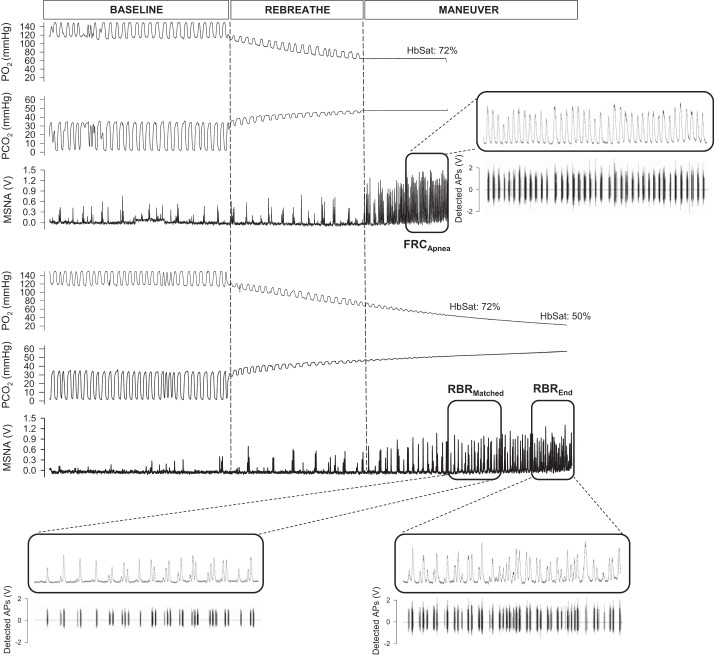
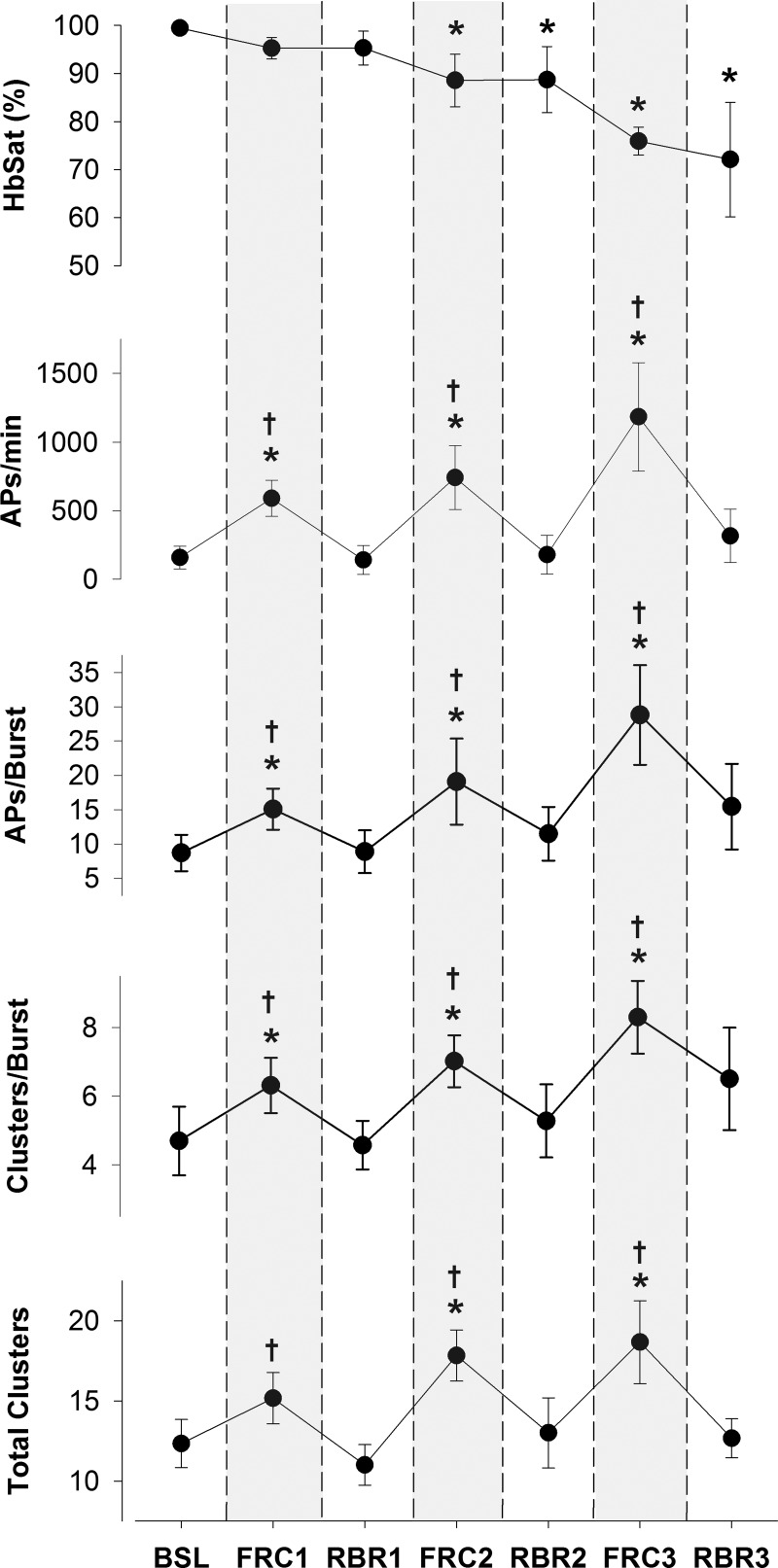
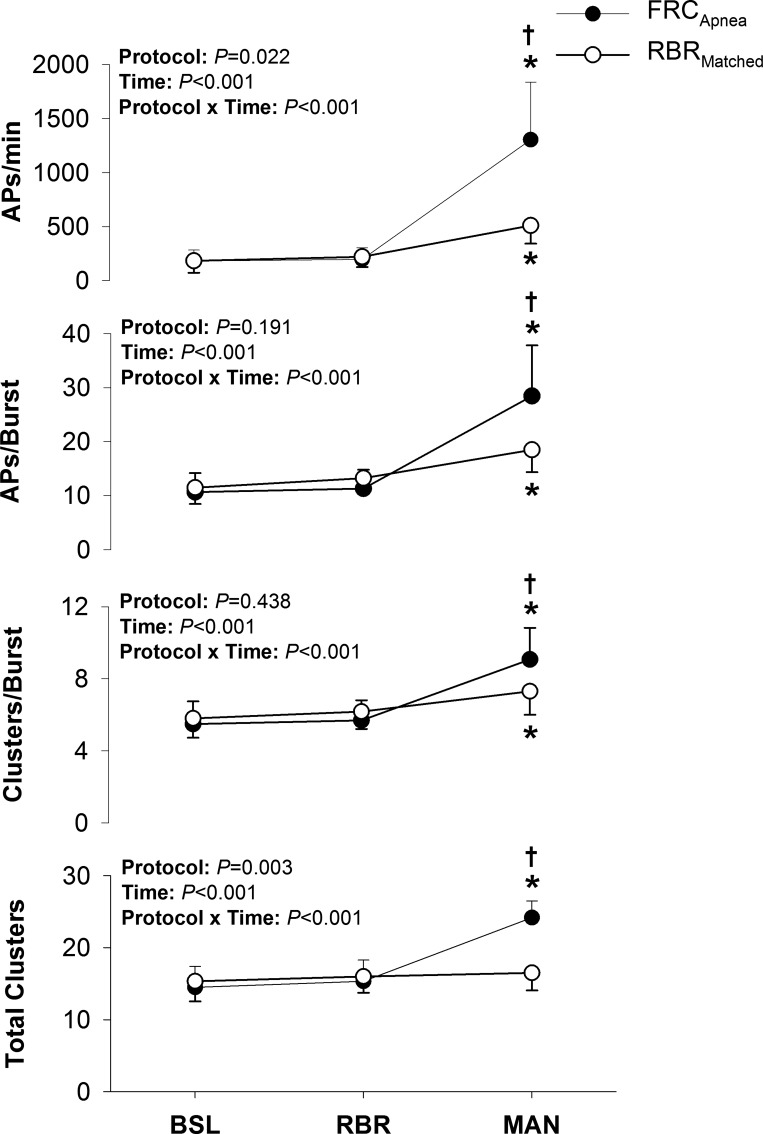
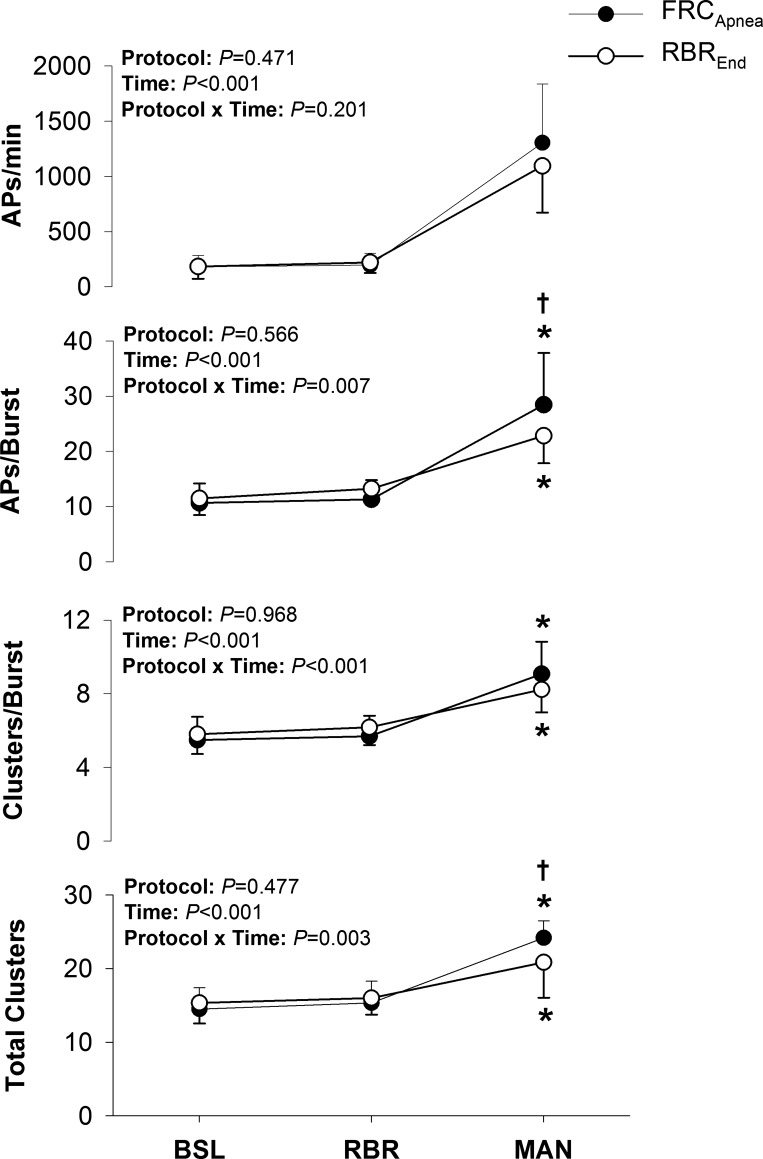
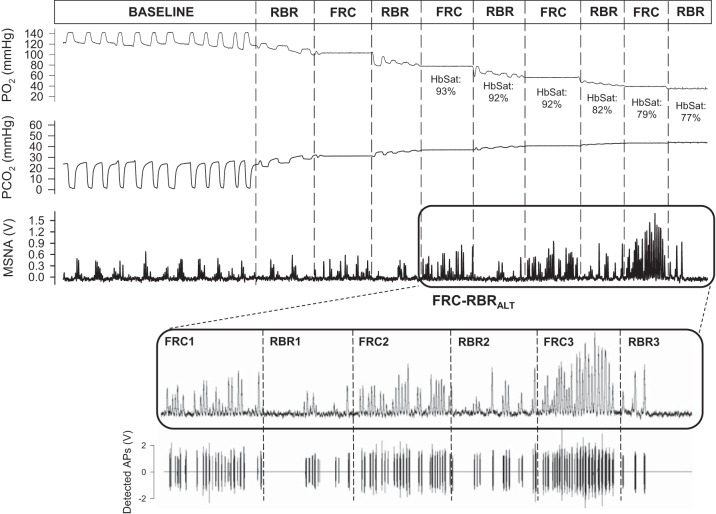
This study investigated the influence of ventilation on sympathetic action potential (AP) discharge patterns during varying levels of high chemoreflex stress. In seven trained breath-hold divers (age 33 ± 12 yr), we measured muscle sympathetic nerve activity (MSNA) at baseline, during preparatory rebreathing (RBR), and during ) functional residual capacity apnea (FRC) and ) continued RBR. Data from RBR were analyzed at matched (i.e., to FRC) hemoglobin saturation (HbSat) levels (RBR) or more severe levels (RBR). A third protocol compared alternating periods (30 s) of FRC and RBR (FRC-RBR). Subjects continued each protocol until 85% volitional tolerance. AP patterns in MSNA (i.e., providing the true neural content of each sympathetic burst) were studied using wavelet-based methodology. First, for similar levels of chemoreflex stress (both HbSat: 71 ± 6%; = NS), RBR was associated with reduced AP frequency and APs per burst compared with FRC (both < 0.001). When APs were binned according to peak-to-peak amplitude (i.e., into clusters), total AP clusters increased during FRC (+10 ± 2; < 0.001) but not during RBR (+1 ± 2; = NS). Second, despite more severe chemoreflex stress during RBR (HbSat: 56 ± 13 vs. 71 ± 6%; < 0.001), RBR was associated with a restrained increase in the APs per burst (FRC: +18 ± 7; RBR: +11 ± 5) and total AP clusters (FRC: +10 ± 2; RBR: +6 ± 4) (both < 0.01). During FRC-RBR, all periods of FRC elicited sympathetic AP recruitment (all < 0.001), whereas all periods of RBR were associated with complete withdrawal of AP recruitment (all = NS). Presently, we demonstrate that ventilation per se restrains and/or inhibits sympathetic axonal recruitment during high, and even extreme, chemoreflex stress. The current study demonstrates that the sympathetic neural recruitment patterns observed during chemoreflex activation induced by rebreathing or apnea are restrained and/or inhibited by the act of ventilation per se, despite similar, or even greater, levels of severe chemoreflex stress. Therefore, ventilation modulates not only the timing of sympathetic bursts but also the within-burst axonal recruitment normally observed during progressive chemoreflex stress.
本研究调查了在不同程度的高化学反射应激期间,通气对交感神经动作电位(AP)发放模式的影响。在7名训练有素的屏气潜水员(年龄33±12岁)中,我们在基线、预备性再呼吸(RBR)期间、功能性残气量呼吸暂停(FRC)期间以及持续RBR期间测量了肌肉交感神经活动(MSNA)。RBR的数据在匹配(即与FRC)的血红蛋白饱和度(HbSat)水平(RBR)或更严重水平(RBR)下进行分析。第三个方案比较了FRC和RBR交替期(30秒)(FRC-RBR)。受试者持续进行每个方案直至达到85%的自主耐受度。使用基于小波的方法研究了MSNA中的AP模式(即提供每个交感神经爆发的真实神经内容)。首先,对于相似程度的化学反射应激(两者HbSat:71±6%;P = 无显著性差异),与FRC相比,RBR与AP频率降低和每次爆发的AP数量减少相关(两者P < 0.001)。当根据峰峰值幅度对AP进行分组(即分成簇)时,FRC期间总的AP簇增加(+10±2;P < 0.001),但RBR期间没有增加(+1±2;P = 无显著性差异)。其次,尽管RBR期间化学反射应激更严重(HbSat:56±13 vs. 71±6%;P < 0.001),但RBR与每次爆发的AP数量(FRC:+18±7;RBR:+11±5)和总的AP簇(FRC:+10±2;RBR:+6±4)的增加受到抑制相关(两者P < 0.01)。在FRC-RBR期间,所有FRC期均引起交感神经AP募集(所有P < 0.001),而所有RBR期均与AP募集完全停止相关(所有P = 无显著性差异)。目前,我们证明在高化学反射应激甚至极端化学反射应激期间,通气本身会抑制和/或阻止交感神经轴突募集。本研究表明,尽管化学反射应激水平相似甚至更高,但在再呼吸或呼吸暂停诱导的化学反射激活期间观察到的交感神经募集模式受到通气本身的抑制和/或阻止。因此,通气不仅调节交感神经爆发的时间,还调节在渐进性化学反射应激期间通常观察到的爆发内轴突募集。