Manaaki Manawa - The Centre for Heart Research, Department of Physiology, Faculty of Medical and Health Sciences, University of Auckland, Auckland, New Zealand.
NeuroV̇ASQ̇ - Integrative Physiology Laboratory, Faculty of Physical Education, University of Brasília, Brasília, DF, Brazil.
J Physiol. 2022 Jun;600(11):2669-2689. doi: 10.1113/JP282327. Epub 2022 May 12.
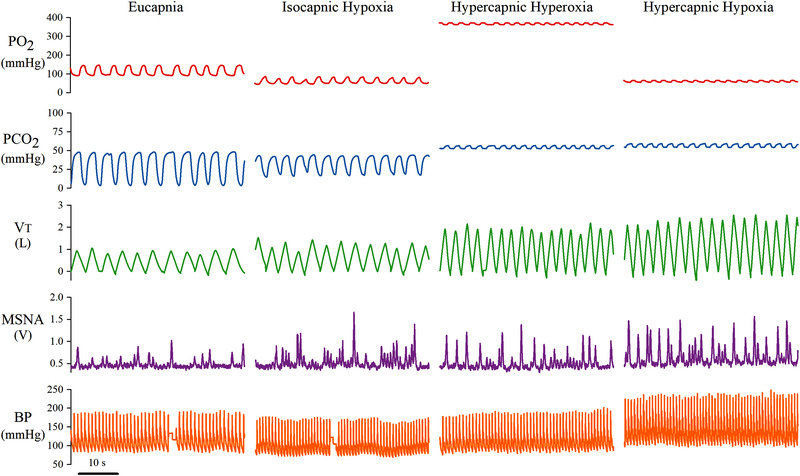
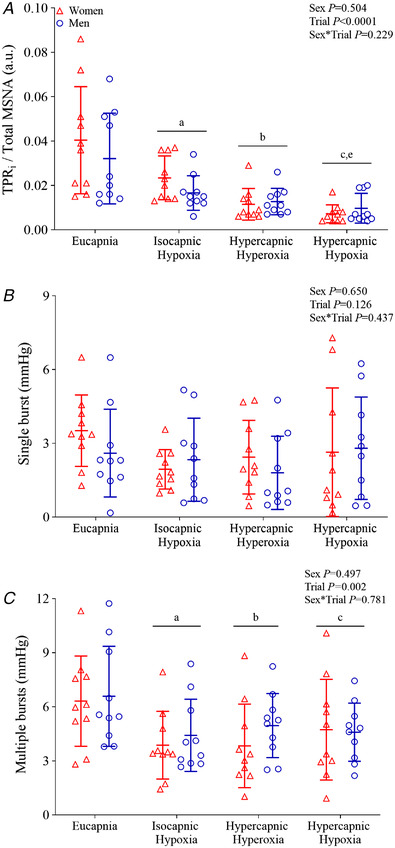
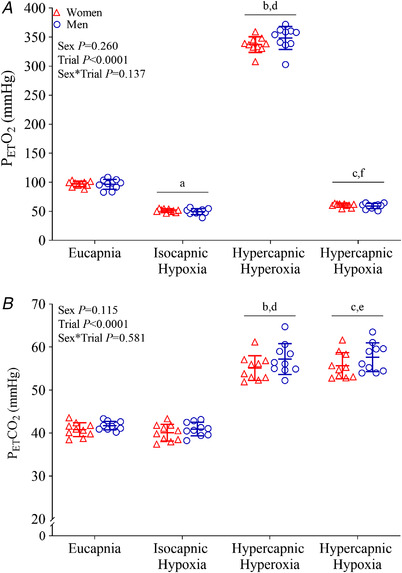
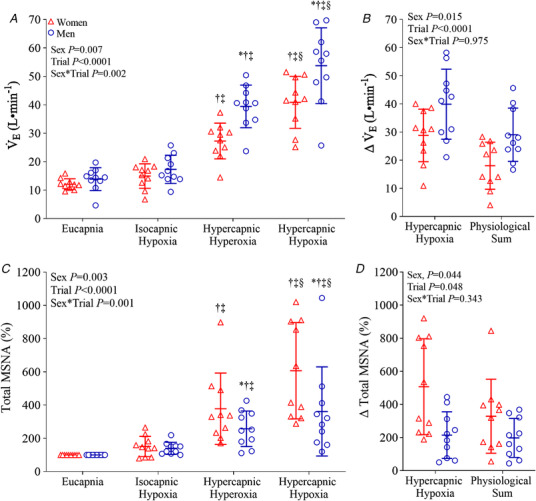
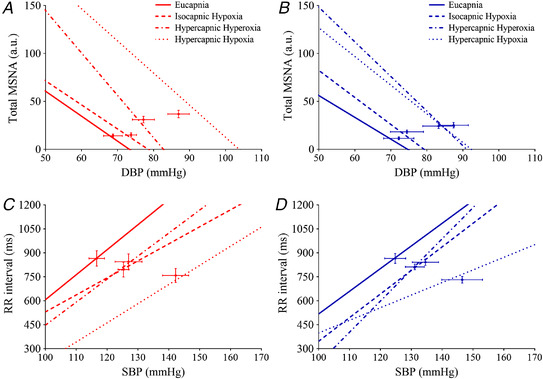
The purpose of this study was to determine whether there are sex differences in the cardiorespiratory and sympathetic neurocirculatory responses to central, peripheral, and combined central and peripheral chemoreflex activation. Ten women (29 ± 6 years, 22.8 ± 2.4 kg/m : mean ± SD) and 10 men (30 ± 7 years, 24.8 ± 3.2 kg/m ) undertook randomized 5 min breathing trials of: room air (eucapnia), isocapnic hypoxia (10% oxygen (O ); peripheral chemoreflex activation), hypercapnic hyperoxia (7% carbon dioxide (CO ), 50% O ; central chemoreflex activation) and hypercapnic hypoxia (7% CO , 10% O ; central and peripheral chemoreflex activation). Control trials of isocapnic hyperoxia (peripheral chemoreflex inhibition) and hypocapnic hyperoxia (central and peripheral chemoreflex inhibition) were also included. Muscle sympathetic nerve activity (MSNA; microneurography), mean arterial pressure (MAP; finger photoplethysmography) and minute ventilation ( ; pneumotachometer) were measured. Total MSNA (P = 1.000 and P = 0.616), MAP (P = 0.265) and (P = 0.587 and P = 0.472) were not different in men and women during eucapnia and during isocapnic hypoxia. Women exhibited attenuated increases in during hypercapnic hyperoxia (27.3 ± 6.3 vs. 39.5 ± 7.5 l/min, P < 0.0001) and hypercapnic hypoxia (40.9 ± 9.1 vs. 53.8 ± 13.3 l/min, P < 0.0001) compared with men. However, total MSNA responses were augmented in women (hypercapnic hyperoxia 378 ± 215 vs. 258 ± 107%, P = 0.017; hypercapnic hypoxia 607 ± 290 vs. 362 ± 268%, P < 0.0001). No sex differences in total MSNA, MAP or were observed during isocapnic hyperoxia and hypocapnic hyperoxia. Our results indicate that young women have augmented sympathetic responses to central chemoreflex activation, which explains the augmented MSNA response to combined central and peripheral chemoreflex activation. KEY POINTS: Sex differences in the control of breathing have been well studied, but whether there are differences in the sympathetic neurocirculatory responses to chemoreflex activation between healthy women and men is incompletely understood. We observed that, compared with young men, young women displayed augmented increases in muscle sympathetic nerve activity during both hypercapnic hyperoxia (central chemoreflex activation) and hypercapnic hypoxia (central and peripheral chemoreflex activation) but had attenuated increases in minute ventilation. In contrast, no sex differences were found in either muscle sympathetic nerve activity or minute ventilation responses to isocapnic hypoxia (peripheral chemoreceptor stimulation). Young women have blunted ventilator, but augmented sympathetic responses, to central (hypercapnic hyperoxia) and combined central and peripheral chemoreflex activation (hypercapnic hypoxia), compared with young men. The possible causative association between the reduced ventilation and heightened sympathetic responses in young women awaits validation.
这项研究的目的是确定在中枢、外周和中枢与外周化学感受器激活的情况下,心肺和交感神经循环反应是否存在性别差异。 10 名女性(29±6 岁,22.8±2.4kg/m :均值±标准差)和 10 名男性(30±7 岁,24.8±3.2kg/m )接受了随机 5 分钟呼吸试验:空气(eucapnia)、等碳酸血症缺氧(10%氧气(O );外周化学感受器激活)、高碳酸血症高氧(7%二氧化碳(CO ),50%O ;中枢化学感受器激活)和高碳酸血症缺氧(7%CO ,10%O ;中枢和外周化学感受器激活)。还包括等碳酸血症高氧(外周化学感受器抑制)和低碳酸血症高氧(中枢和外周化学感受器抑制)的对照试验。肌肉交感神经活动(MSNA;微神经记录)、平均动脉压(MAP;手指光体积描记法)和分钟通气量( ;气动计)均进行了测量。在 eucapnia 和等碳酸血症缺氧期间,男性和女性的总 MSNA(P=1.000 和 P=0.616)、MAP(P=0.265)和 (P=0.587 和 P=0.472)没有差异。与男性相比,女性在高碳酸血症高氧(27.3±6.3 与 39.5±7.5l/min,P<0.0001)和高碳酸血症缺氧(40.9±9.1 与 53.8±13.3l/min,P<0.0001)期间通气量的增加幅度较小。然而,女性的总 MSNA 反应增强(高碳酸血症高氧 378±215 与 258±107%,P=0.017;高碳酸血症缺氧 607±290 与 362±268%,P<0.0001)。在等碳酸血症高氧和低碳酸血症高氧期间,总 MSNA、MAP 或 没有观察到性别差异。我们的研究结果表明,年轻女性对中枢化学感受器激活的交感神经反应增强,这解释了她们对中枢和外周化学感受器联合激活时的 MSNA 反应增强。关键点:呼吸控制方面的性别差异已经得到了很好的研究,但健康女性和男性之间对化学感受器激活的交感神经循环反应是否存在差异尚不完全清楚。我们观察到,与年轻男性相比,年轻女性在高碳酸血症高氧(中枢化学感受器激活)和高碳酸血症缺氧(中枢和外周化学感受器激活)期间肌肉交感神经活动的增加幅度更大,但通气量的增加幅度较小。相比之下,在等碳酸血症缺氧(外周化学感受器刺激)时,无论是肌肉交感神经活动还是通气量反应,均未发现性别差异。与年轻男性相比,年轻女性对中枢(高碳酸血症高氧)和中枢与外周联合化学感受器激活(高碳酸血症缺氧)的通气反应减弱,但交感神经反应增强。年轻女性通气反应减弱而交感神经反应增强的可能因果关系尚待验证。