Cobey Sarah, Baskerville Edward B, Colijn Caroline, Hanage William, Fraser Christophe, Lipsitch Marc
Department of Ecology and Evolution, University of Chicago, Chicago, IL, USA
Department of Ecology and Evolution, University of Chicago, Chicago, IL, USA.
J R Soc Interface. 2017 Aug;14(133). doi: 10.1098/rsif.2017.0295.
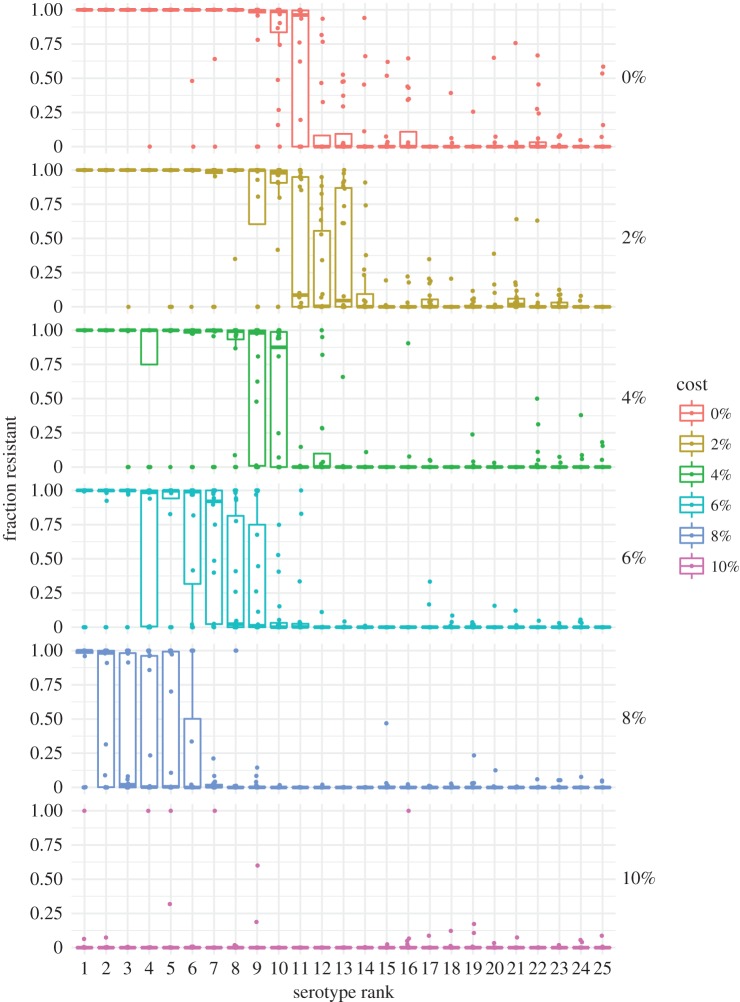
It is a truism that antimicrobial drugs select for resistance, but explaining pathogen- and population-specific variation in patterns of resistance remains an open problem. Like other common commensals, has demonstrated persistent coexistence of drug-sensitive and drug-resistant strains. Theoretically, this outcome is unlikely. We modelled the dynamics of competing strains of to investigate the impact of transmission dynamics and treatment-induced selective pressures on the probability of stable coexistence. We find that the outcome of competition is extremely sensitive to structure in the host population, although coexistence can arise from age-assortative transmission models with age-varying rates of antibiotic use. Moreover, we find that the selective pressure from antibiotics arises not so much from the rate of antibiotic use but from the frequency of treatment: frequent antibiotic therapy disproportionately impacts the fitness of sensitive strains. This same phenomenon explains why serotypes with longer durations of carriage tend to be more resistant. These dynamics may apply to other potentially pathogenic, microbial commensals and highlight how population structure, which is often omitted from models, can have a large impact.
抗菌药物会选择出耐药性,这是不言而喻的,但要解释病原体和种群特异性的耐药模式差异仍是一个悬而未决的问题。与其他常见共生菌一样,已证明药物敏感菌株和耐药菌株能持续共存。从理论上讲,这种结果不太可能。我们对的竞争菌株动态进行了建模,以研究传播动态和治疗诱导的选择压力对稳定共存概率的影响。我们发现,竞争结果对宿主种群结构极其敏感,尽管年龄分层传播模型(抗生素使用率随年龄变化)可能导致共存。此外,我们发现抗生素的选择压力并非主要源于抗生素使用率,而是源于治疗频率:频繁的抗生素治疗对敏感菌株的适应性有不成比例的影响。同样的现象解释了为什么携带时间较长的血清型往往更具耐药性。这些动态可能适用于其他潜在致病性微生物共生菌,并突出了模型中经常被忽略的种群结构如何产生重大影响。