Center for Immunology and Inflammation, The Feinstein Institute for Medical Research, Manhasset, NY, 11030, USA.
Department of Surgery, Hofstra Northwell School of Medicine, Manhasset, NY, 11030, USA.
Sci Rep. 2017 Aug 23;7(1):9235. doi: 10.1038/s41598-017-08711-6.
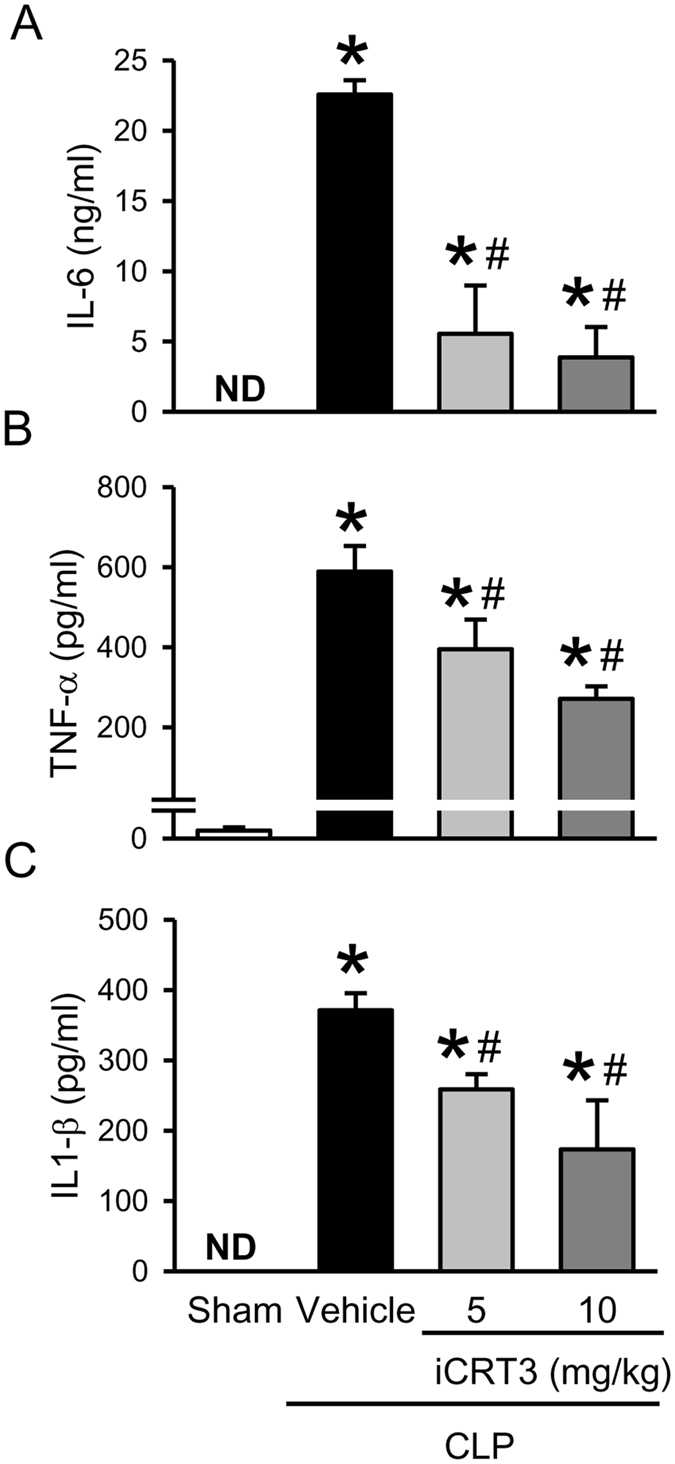
The Wnt/β-catenin pathway has been involved in regulating inflammation in various infectious and inflammatory diseases. Sepsis is a life-threatening condition caused by dysregulated inflammatory response to infection with no effective therapy available. Recently elevated Wnt/β-catenin signaling has been detected in sepsis. However, its contribution to sepsis-associated inflammatory response remains to be explored. In this study, we show that inhibition of Wnt/β-catenin signaling reduces inflammation and mitigates sepsis-induced organ injury. Using in vitro LPS-stimulated RAW264.7 macrophages, we demonstrate that a small-molecule inhibitor of β-catenin responsive transcription, iCRT3, significantly reduces the LPS-induced Wnt/β-catenin activity and also inhibits TNF-α production and IκB degradation in a dose-dependent manner. Intraperitoneal administration of iCRT3 to C57BL/6 mice, subjected to cecal ligation and puncture-induced sepsis, decreases the plasma levels of proinflammatory cytokines and organ injury markers in a dose-dependent manner. The histological integrity of the lungs is improved with iCRT3 treatment, along with reduced lung collagen deposition and apoptosis. In addition, iCRT3 treatment also decreases the expression of the cytokines, neutrophil chemoattractants, as well as the MPO activity in the lungs of septic mice. Based on these findings we conclude that targeting the Wnt/β-Catenin pathway may provide a potential therapeutic approach for treatment of sepsis.
Wnt/β-catenin 通路参与调节各种感染性和炎症性疾病中的炎症。败血症是一种危及生命的病症,由感染引起的炎症反应失调引起,目前尚无有效的治疗方法。最近在败血症中检测到升高的 Wnt/β-catenin 信号。然而,其对败血症相关炎症反应的贡献仍有待探索。在这项研究中,我们表明抑制 Wnt/β-catenin 信号通路可减轻炎症并减轻败血症引起的器官损伤。使用体外 LPS 刺激的 RAW264.7 巨噬细胞,我们证明了一种β-catenin 反应转录的小分子抑制剂 iCRT3,可显著降低 LPS 诱导的 Wnt/β-catenin 活性,并以剂量依赖性方式抑制 TNF-α的产生和 IκB 的降解。腹腔给予 iCRT3 可使接受盲肠结扎和穿刺诱导的败血症的 C57BL/6 小鼠,以剂量依赖性方式降低血浆中促炎细胞因子和器官损伤标志物的水平。用 iCRT3 治疗可改善肺的组织完整性,同时减少肺胶原蛋白沉积和细胞凋亡。此外,iCRT3 治疗还可降低败血症小鼠肺中的细胞因子、嗜中性粒细胞趋化因子以及 MPO 活性的表达。基于这些发现,我们得出结论,靶向 Wnt/β-Catenin 通路可能为败血症的治疗提供一种潜在的治疗方法。