Insect-Virus Interactions Group, Department of Genomes and Genetics, Institut Pasteur, CNRS URA 3012, Paris, France.
MIVEGEC, UMR IRD 224-CNRS 5290-UM, Montpellier, France.
Sci Adv. 2017 Aug 16;3(8):e1700585. doi: 10.1126/sciadv.1700585. eCollection 2017 Aug.
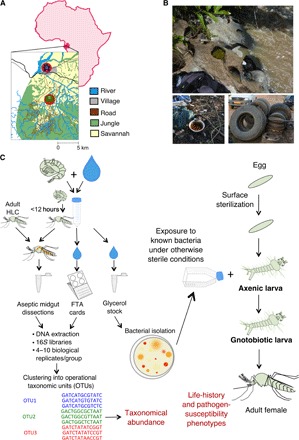
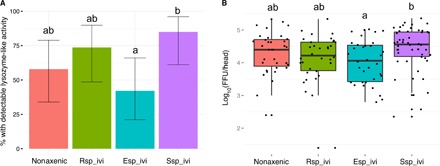
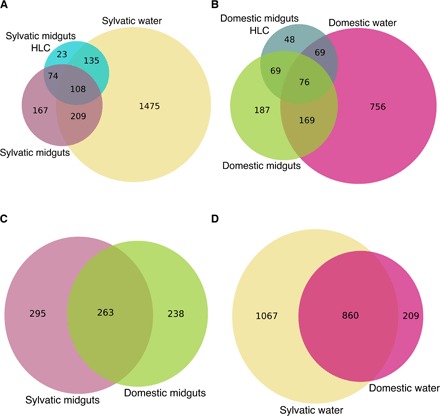
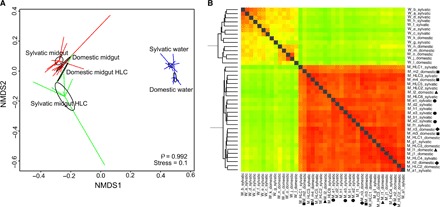
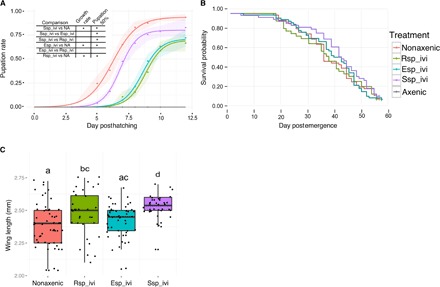
Conditions experienced during larval development of holometabolous insects can affect adult traits, but whether differences in the bacterial communities of larval development sites contribute to variation in the ability of insect vectors to transmit human pathogens is unknown. We addressed this question in the mosquito , a major arbovirus vector breeding in both sylvatic and domestic habitats in Sub-Saharan Africa. Targeted metagenomics revealed differing bacterial communities in the water of natural breeding sites in Gabon. Experimental exposure to different native bacterial isolates during larval development resulted in significant differences in pupation rate and adult body size but not life span. Larval exposure to an Enterobacteriaceae isolate resulted in decreased antibacterial activity in adult hemolymph and reduced dengue virus dissemination titer. Together, these data provide the proof of concept that larval exposure to different bacteria can drive variation in adult traits underlying vectorial capacity. Our study establishes a functional link between larval ecology, environmental microbes, and adult phenotypic variation in a holometabolous insect vector.
在完全变态昆虫的幼虫发育过程中经历的条件会影响成虫特征,但幼虫发育场所的细菌群落差异是否有助于昆虫传播媒介传播人类病原体的能力的变化尚不清楚。我们在冈比亚的森林和家庭栖息地都有繁殖的蚊子中解决了这个问题,蚊子是主要的虫媒病毒传播媒介。靶向宏基因组学揭示了加蓬自然繁殖地水中不同的细菌群落。在幼虫发育过程中实验性地暴露于不同的本地细菌分离株会导致化蛹率和成虫体型显著差异,但不影响寿命。幼虫暴露于肠杆菌科分离株会导致成虫血淋巴中的抗菌活性降低,并降低登革热病毒传播滴度。这些数据共同提供了概念验证,即幼虫暴露于不同的细菌会导致与媒介能力相关的成虫特征的变异。我们的研究在完全变态昆虫媒介中建立了幼虫生态学、环境微生物和成虫表型变异之间的功能联系。