Yang Huan, Li Jianxing, Long Gang, Wang Shaogang
Dartment of Urology, Tongji Hospital,Tongji Medical School, Huazhong University of Science and Technology, Wuhan, 430030, China.
Department of Urology, Beijing Tsinghua changgung Hospital, Beijing, China.
BMC Urol. 2017 Aug 24;17(1):67. doi: 10.1186/s12894-017-0257-8.
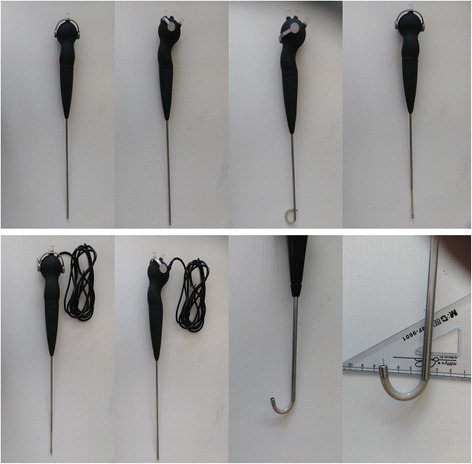
Renal staghorn stones are challenging for urologists to ensure maximum stone clearance and minimal morbidity. Percutaneous nephrolithotomy (PCNL) has become the gold standard treatment for renal staghorn stones. To assess the safety and efficacy of a novel integrated rigid and flexible percutaneous nephroscope(Rigi-flex nephroscope) in PCNL for renal staghorn stones.We present our initial experience with this new technique.
From March to July 2016, a prospective analysis of 3 patients with staghorn stones treated with Rigi-flex nephroscope in PCNLunder totally ultrasound guidance by paravertebral block (PVB) anesthesia was done. PCNL was performed with the rigid section of a 13-Fr Rigi-flex nephroscope firstly and the stones were disintegrated into fragments by holmium laser.Then the stones were removed by active flushout, followed by a search for residual stones in other inaccessible calyces with the flexible section. Finally, the residual stones were disintegrated into small fractions by holmium laser in situ or repositioned with a set of disposable retrieval baskets to pelvic or other accessible areas. The whole procedure was accomplished via only one nephrostomy tract. The operating time, stone-free rates (SFR), postoperative hemoglobin drop, complications, length of hospitalization, were recorded.
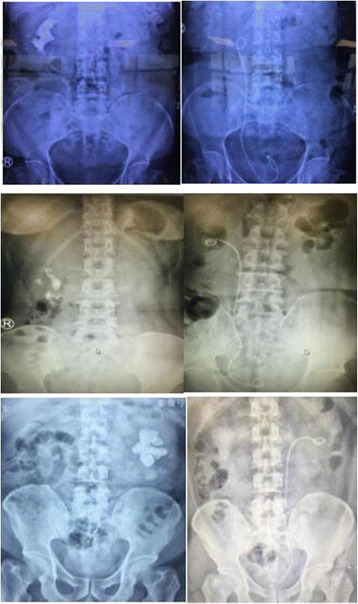
The operation time were 89, 62 and 45 min, respectively, the postoperative hemoglobin drop was 1, 0.8 and 0.9 mg/dl, respectively.The postoperative Kidney-Ureter-Bladder (KUB) radiograph of the three patients showed no residual fragment >3 mm. No patients needed blood transfusion and suffered significant complications. The length of hospitalization was 9, 6 and 4 days, respectively. No patient needed multiple tracts PCNL or staged auxiliary measures one month after the operation.
The application of Rigi-flex nephroscope in PCNL under ultrasound guidance for staghorn stones has its unique advantages as monotherapy with increasing procedural stone free rate (SFR) via single nephrostomy tract, hence there is less morbidity as it does not require additional tracts dilation and staged auxiliary procedures combination. However, SFR should also be evaluated at a longer follow-up, particularly for staghorn stone, further large-scale multicenter prospective clinical trial are needed to verify its feasibility.
鹿角形肾结石对泌尿外科医生来说是一项挑战,要确保最大程度的结石清除率和最小的发病率。经皮肾镜取石术(PCNL)已成为鹿角形肾结石的金标准治疗方法。为了评估一种新型的集成刚性和柔性的经皮肾镜(Rigi-flex肾镜)在PCNL治疗鹿角形肾结石中的安全性和有效性。我们展示了我们对这项新技术的初步经验。
2016年3月至7月,对3例鹿角形肾结石患者在椎旁阻滞(PVB)麻醉下完全超声引导下使用Rigi-flex肾镜进行PCNL治疗进行前瞻性分析。首先使用13F Rigi-flex肾镜的刚性部分进行PCNL,并用钬激光将结石粉碎成碎片。然后通过主动冲洗清除结石,随后用柔性部分在其他难以到达的肾盏中寻找残留结石。最后,残留结石在原位用钬激光粉碎成小碎片,或用一套一次性取石篮重新定位到盆腔或其他可到达的区域。整个手术仅通过一个肾造瘘通道完成。记录手术时间、无石率(SFR)、术后血红蛋白下降情况、并发症、住院时间。
手术时间分别为89、62和45分钟,术后血红蛋白下降分别为1、0.8和0.9mg/dl。三名患者术后的肾脏-输尿管-膀胱(KUB)X线片显示无残留碎片>3mm。无患者需要输血且未发生严重并发症。住院时间分别为9、6和4天。术后一个月无患者需要多通道PCNL或分期辅助措施。
超声引导下Rigi-flex肾镜在PCNL治疗鹿角形肾结石中的应用具有独特优势,作为单一疗法,通过单个肾造瘘通道可提高手术无石率(SFR),因此发病率较低,因为它不需要额外的通道扩张和分期辅助程序联合。然而,SFR还应在更长的随访期进行评估,特别是对于鹿角形结石,需要进一步的大规模多中心前瞻性临床试验来验证其可行性。