Robinson-Garcia Nicolas, Costas Rodrigo, Isett Kimberley, Melkers Julia, Hicks Diana
INGENIO (CSIC-UPV), Universitat Politècnica de València, Valencia, Spain.
Centre for Science and Technology Studies (CWTS), Leiden University, Leiden, The Netherlands.
PLoS One. 2017 Aug 24;12(8):e0183551. doi: 10.1371/journal.pone.0183551. eCollection 2017.
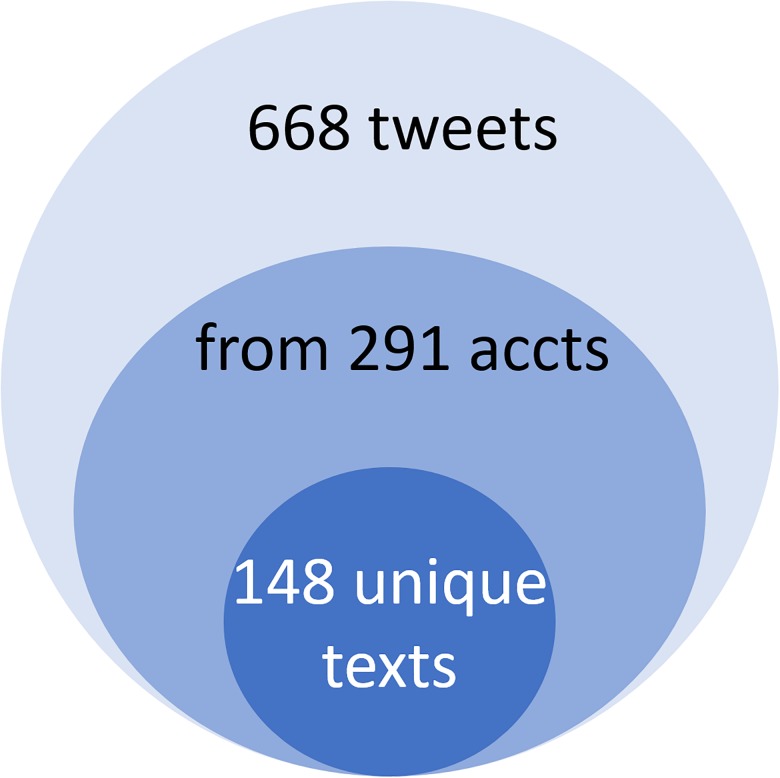
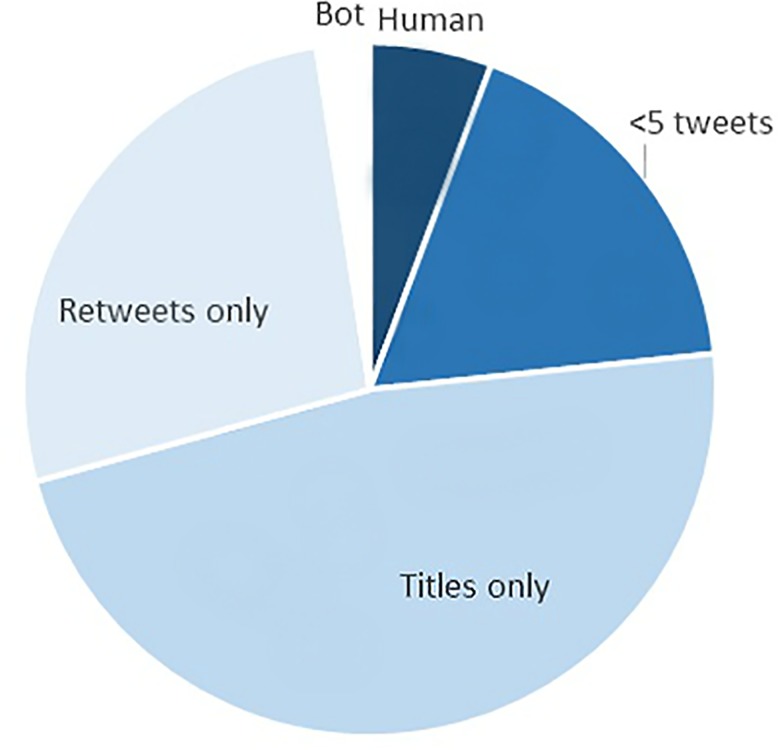
Enthusiasm for using Twitter as a source of data in the social sciences extends to measuring the impact of research with Twitter data being a key component in the new altmetrics approach. In this paper, we examine tweets containing links to research articles in the field of dentistry to assess the extent to which tweeting about scientific papers signifies engagement with, attention to, or consumption of scientific literature. The main goal is to better comprehend the role Twitter plays in scholarly communication and the potential value of tweet counts as traces of broader engagement with scientific literature. In particular, the pattern of tweeting to the top ten most tweeted scientific dental articles and of tweeting by accounts is examined. The ideal that tweeting about scholarly articles represents curating and informing about state-of-the-art appears not to be realized in practice. We see much presumably human tweeting almost entirely mechanical and devoid of original thought, no evidence of conversation, tweets generated by monomania, duplicate tweeting from many accounts under centralized professional management and tweets generated by bots. Some accounts exemplify the ideal, but they represent less than 10% of tweets. Therefore, any conclusions drawn from twitter data is swamped by the mechanical nature of the bulk of tweeting behavior. In light of these results, we discuss the compatibility of Twitter with the research enterprise as well as some of the financial incentives behind these patterns.
在社会科学领域,将推特用作数据来源的热情延伸到了利用推特数据衡量研究影响力,推特数据是新的替代计量方法的关键组成部分。在本文中,我们研究了包含牙科领域研究文章链接的推文,以评估推文提及科学论文在多大程度上意味着对科学文献的参与、关注或阅读。主要目标是更好地理解推特在学术交流中所起的作用,以及推文计数作为更广泛参与科学文献的痕迹的潜在价值。特别是,我们研究了转发量最高的十篇牙科科学文章的推文模式以及账户的推文情况。关于学术文章的推文代表着对最新技术的整理和传播这一理想情况在实际中似乎并未实现。我们看到许多推文大概是人为操作但几乎完全机械,缺乏原创思想,没有对话迹象,由偏执狂产生的推文,在集中专业管理下多个账户的重复推文以及由机器人生成的推文。一些账户体现了理想情况,但它们在推文中所占比例不到10%。因此,从推特数据得出的任何结论都被大量推文行为的机械性所掩盖。鉴于这些结果,我们讨论了推特与研究事业的兼容性以及这些模式背后的一些经济激励因素。