Saar Maya, Gilad Tomer, Kilon-Kallner Tal, Rosenfeld Adar, Subach Aziz, Scharf Inon
School of Zoology, Faculty of Life Sciences, Tel Aviv University, Tel Aviv, Israel.
PLoS One. 2017 Aug 24;12(8):e0183753. doi: 10.1371/journal.pone.0183753. eCollection 2017.
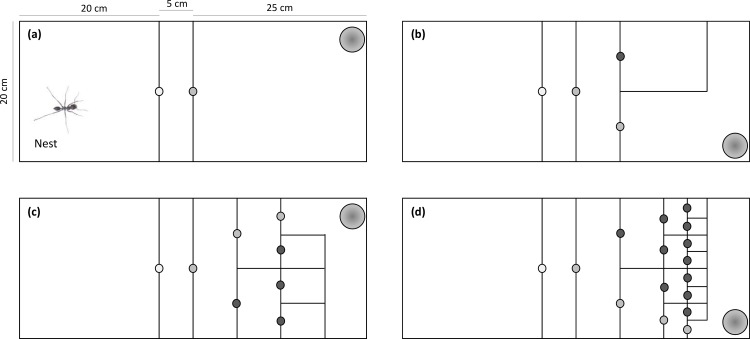
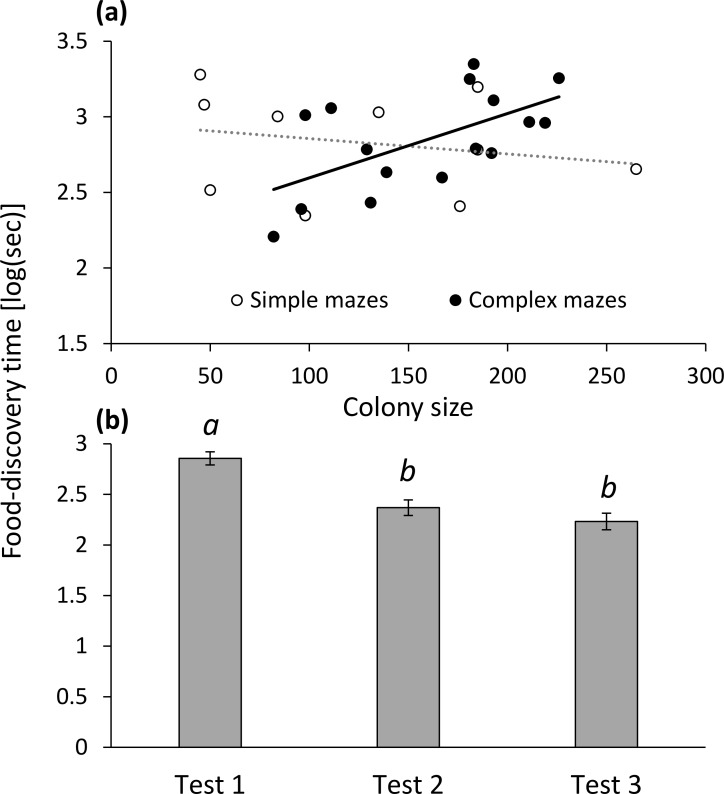
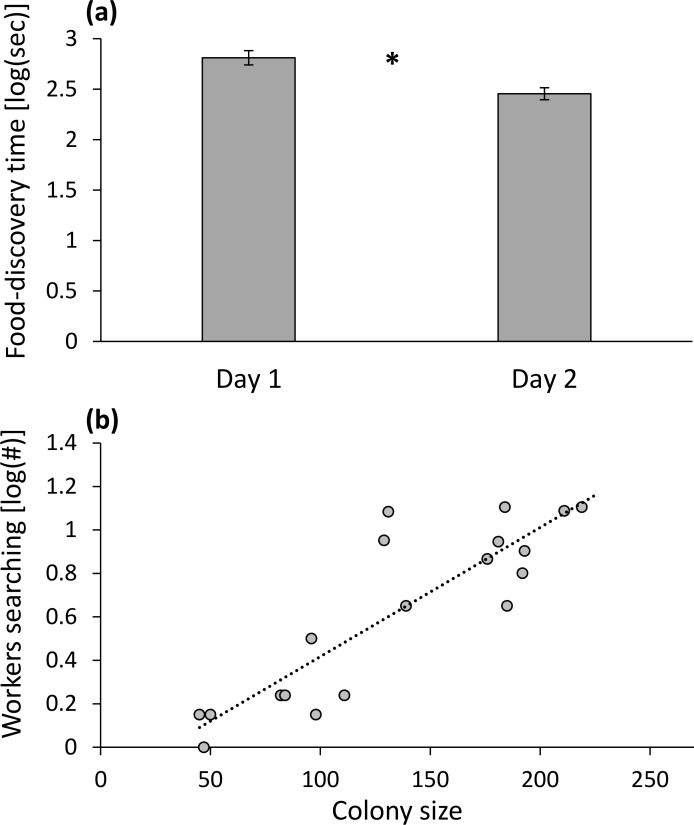
Central-place foragers need to explore their immediate habitat in order to reach food. We let colonies of the individually foraging desert ant Cataglyphis niger search for a food reward in a maze. We did so for three tests per day over two successive days and an additional test after a time interval of 4-20 days (seven tests in total). We examined whether the colonies reached the food reward faster, consumed more food and changed the number of workers searching over time, within and between days. Colonies' food-discovery time shortened within and between days, indicating that some workers learnt and became more efficient in moving through the maze. Such workers, however, also forgot and deteriorated in their food-discovery time, leveling off back to initial performance after about two weeks. We used mazes of increasing complexity levels, differing in the potential number of wrong turns. The number of workers searching increased with colony size. Food-discovery time also increased with colony size in complex mazes but not in simple ones, perhaps due to the more frequent interactions among workers in large colonies having to move through narrow routes. Finally, the motivation to solve the maze was probably not only the food reward, because food consumption did not change over time.
中心地觅食者需要探索其周边栖息地以获取食物。我们让单独觅食的沙漠蚁猫蚁(Cataglyphis niger)群体在迷宫中寻找食物奖励。我们在连续两天内每天进行三次测试,并在间隔4至20天(总共七次测试)后再进行一次测试。我们研究了蚁群是否能更快找到食物奖励、消耗更多食物,以及随着时间推移、在同一天内和不同天之间搜索的工蚁数量是否发生变化。蚁群找到食物的时间在同一天内和不同天之间都缩短了,这表明一些工蚁学会了如何更高效地在迷宫中穿行。然而,这些工蚁也会遗忘,其找到食物的时间会变差,在大约两周后又恢复到初始表现水平。我们使用了复杂度不断增加的迷宫,其潜在的错误转弯数量各不相同。搜索的工蚁数量随着蚁群规模的增大而增加。在复杂迷宫中,找到食物的时间也随着蚁群规模的增大而增加,但在简单迷宫中并非如此,这可能是因为大型蚁群中的工蚁在通过狭窄路径时相互之间的互动更为频繁。最后,解决迷宫的动机可能不仅仅是食物奖励,因为食物消耗量并未随时间变化。