Hsu Wan-Tseng, Lai Chih-Cheng, Wang Ya-Hui, Tseng Ping-Huei, Wang Kun, Wang Cheng-Yi, Chen Likwang
School of Pharmacy, National Taiwan University, Taipei, Taiwan.
Department of Intensive Care Medicine, Chi Mei Medical Center, Liouying, Tainan, Taiwan.
PLoS One. 2017 Aug 24;12(8):e0183808. doi: 10.1371/journal.pone.0183808. eCollection 2017.
The prevalence of gastroesophagel reflux disease (GERD) has steadily increased. However, the association between GERD itself and the risk of pneumonia remains unclear. This study aimed to investigate the association between GERD and long-term risk of pneumonia and to identify the major risk factors for pneumonia in GERD patients.
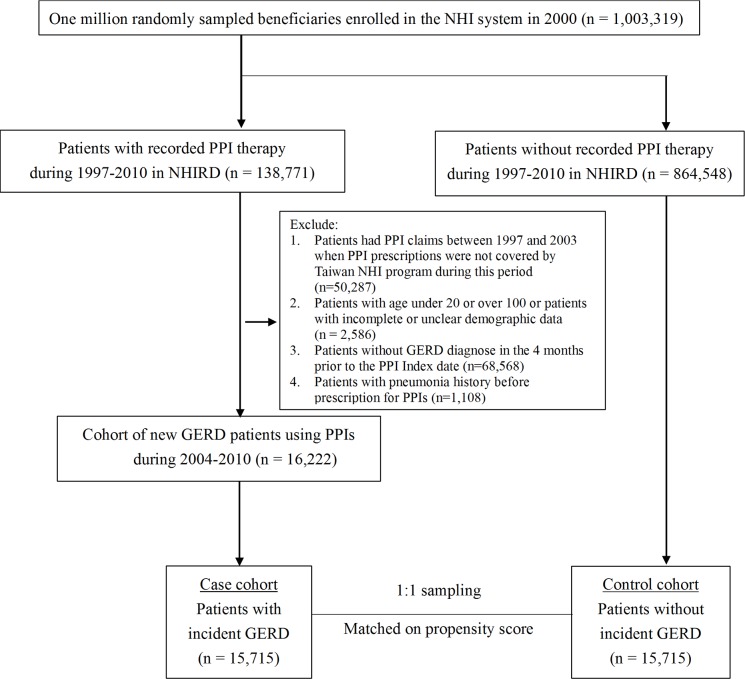
Using the Taiwan National Health Insurance Research Database, we identified patients who were newly diagnosed with GERD and treated with proton pump inhibitors (PPIs) from January 1, 2004 through December 31, 2010. Two groups comprising 15,715 GERD cases and 15,715 non-GERD matched controls were generated using propensity score matching, thereby making the differences in basic demographics, concomitant medication use, and comorbidities between the two groups inconsiderable.
Cumulative incidence of pneumonia was significantly higher in the patients with GERD than that in the non-GERD matched controls, with an adjusted HR of 1.48 (95% confidence interval [CI] = 1.31-1.67; P < 0.001) within 6-year follow-ups. Multivariate stratified analyses revealed similar results in many subgroups, with a highest risk in individuals younger than 40 years of age (HR = 2.17, 95% CI = 1.48-3.19). Crucially, patients with GERD using PPIs longer than 4 months were at a significantly increased risk of pneumonia than those who did not use PPIs or took PPIs less than 4 months.
GERD was significantly associated with long-term risk of pneumonia, especially in GERD with PPI use longer than 4 months or in the young population. Further prospective longitudinal studies should be conducted for validation and implementing clinical practice guidelines.
胃食管反流病(GERD)的患病率一直在稳步上升。然而,GERD本身与肺炎风险之间的关联仍不明确。本研究旨在探讨GERD与肺炎长期风险之间的关联,并确定GERD患者肺炎的主要危险因素。
利用台湾国民健康保险研究数据库,我们识别出2004年1月1日至2010年12月31日期间新诊断为GERD并接受质子泵抑制剂(PPI)治疗的患者。通过倾向评分匹配生成了两组,包括15715例GERD病例和15715例非GERD匹配对照,从而使两组在基本人口统计学、伴随用药和合并症方面的差异微不足道。
GERD患者肺炎的累积发病率显著高于非GERD匹配对照,在6年随访期间调整后的风险比(HR)为1.48(95%置信区间[CI]=1.31-1.67;P<0.001)。多变量分层分析在许多亚组中显示了类似结果,40岁以下个体风险最高(HR=2.17,95%CI=1.48-3.19)。至关重要的是,使用PPI超过4个月的GERD患者患肺炎的风险显著高于未使用PPI或使用PPI少于4个月的患者。
GERD与肺炎的长期风险显著相关,尤其是使用PPI超过4个月的GERD患者或年轻人群。应进行进一步的前瞻性纵向研究以验证并实施临床实践指南。