Wu An, Ye Xia, Huang Qiang, Dai Wei-Min, Zhang Jian-Min
Department of Neurosurgery, Second Affiliated Hospital of Zhejiang University, School of Medicine, Hangzhou 310009, P.R. China.
Department of Neurosurgery, People's Hospital of Quzhou City, Quzhou 324000, P.R. China.
Pharmacogn Mag. 2017 Jul-Sep;13(51):512-516. doi: 10.4103/0973-1296.211027. Epub 2017 Jul 19.
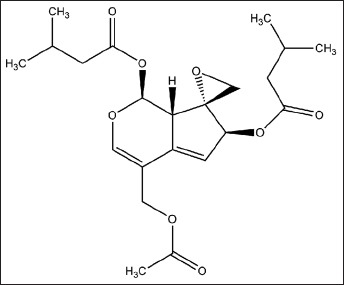
This work aimed to investigate the anti-epileptic effects of valepotriate isolated from Jones and studied its possible mechanisms.
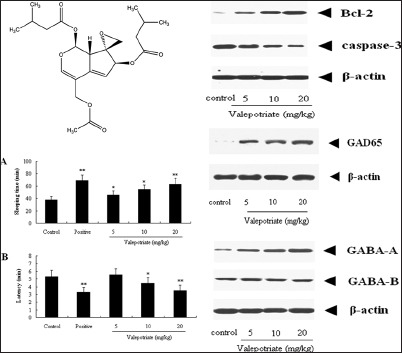
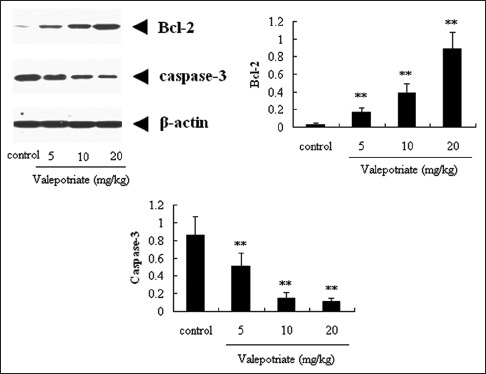
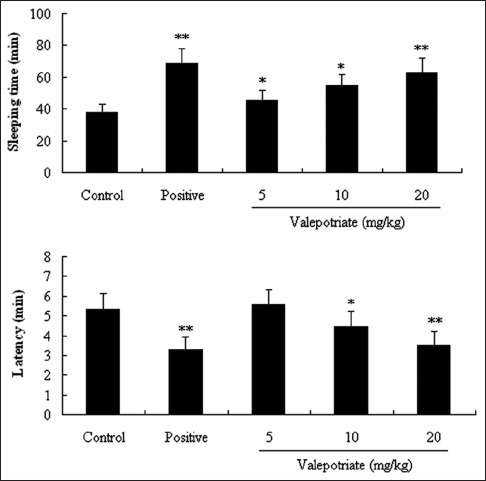
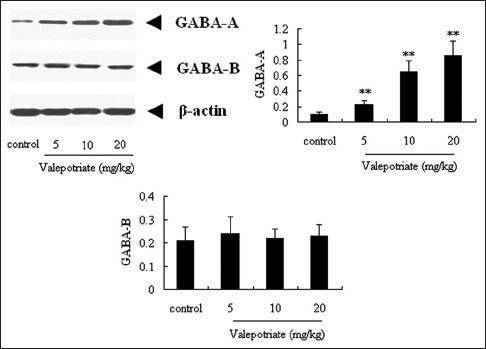
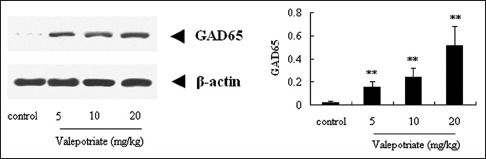
The anti-epileptic effects of valepotriate were studied using maximal electroshock-induced seizure (MES), pentylenetetrazole (PTZ)-induced epilepsy, and pentobarbital sodium-induced sleeping model in mice. The possible anti-epileptic mechanisms of valepotriate were investigated by analyzing the expressions of GABA, GABA, glutamic acid decarboxylase (GAD65), Bcl-2, and caspase-3 in the brain using Western blot assay.
The results indicated that valepotriate showed significant anti-epileptic activity against MES- and PTZ-induced epilepsy at doses of 5, 10, and 20 mg/kg, and ED values for MES- and PTZ-induced epilepsy were 7.84 and 7.19 mg/kg, respectively. Furthermore, valepotriate (10 and 20 mg/kg) can significantly prolong sleeping time and shorten the latency time on the pentobarbital sodium-induced sleeping time test. Furthermore, valepotriate (5, 10, and 20 mg/kg) could significantly up-regulate the expression of GABA, GAD65, and Bcl-2 and down-regulate the expression of caspase-3, but had no significant effect on the expression of GABA.
The results indicated that valepotriate had anti-epileptic activity and the mechanisms might be associated with regulation of GABA and inhibition of neuronal apoptosis.
Anti-epileptic effect of valepotriate was investigated for the 1 timeValepotriate showed notable anti-epileptic activityValepotriate can significantly increase the expression of GABA, glutamic acid decarboxylase 65, and Bcl-2 and reduce the expression of caspase-3.
本研究旨在探讨从缬草中分离得到的缬草三酯的抗癫痫作用,并研究其可能的作用机制。
采用最大电休克诱导惊厥(MES)、戊四氮(PTZ)诱导癫痫和戊巴比妥钠诱导睡眠模型,研究缬草三酯的抗癫痫作用。通过蛋白质免疫印迹法分析大脑中γ-氨基丁酸(GABA)、谷氨酸脱羧酶(GAD65)、Bcl-2和半胱天冬酶-3(caspase-3)的表达,探讨缬草三酯可能的抗癫痫机制。
结果表明,缬草三酯在5、10和20mg/kg剂量下对MES和PTZ诱导的癫痫具有显著的抗癫痫活性,MES和PTZ诱导癫痫的半数有效剂量(ED)分别为7.84和7.19mg/kg。此外,缬草三酯(10和20mg/kg)能显著延长戊巴比妥钠诱导睡眠时间试验中的睡眠时间,缩短潜伏期。此外,缬草三酯(5、10和20mg/kg)能显著上调GABA、GAD65和Bcl-2的表达,下调caspase-3的表达,但对GABA的表达无显著影响。
结果表明,缬草三酯具有抗癫痫活性,其机制可能与调节GABA和抑制神经元凋亡有关。
首次研究了缬草三酯的抗癫痫作用。缬草三酯显示出显著的抗癫痫活性。缬草三酯能显著增加GABA、谷氨酸脱羧酶65和Bcl-2的表达,降低caspase-3的表达。