Tamas Tornai, Zsuzsanna Vitalis, Istvan Tornai, Eszter Palyu, Maria Papp, Institute of Internal Medicine, Department of Gastroenterology, University of Debrecen, Faculty of Medicine, Debrecen, Hungary, H-4032 Debrecen, Hungary.
World J Gastroenterol. 2017 Aug 7;23(29):5412-5421. doi: 10.3748/wjg.v23.i29.5412.
To assess the prevalence of a panel of serologic markers that reflect gut barrier dysfunction in a mixed cohort of pediatric and adult primary sclerosing cholangitis (PSC) patients.
Sera of 67 PSC patients [median age (range): 32 (5-79) years, concomitant IBD: 67% and cirrhosis: 20%] were assayed for the presence of antibodies against to F-actin (AAA IgA/IgG) and gliadin (AGA IgA/IgG)] and for serum level of intestinal fatty acid-binding protein (I-FABP) by ELISA. Markers of lipopolysaccharide (LPS) exposure [LPS binding protein (LBP)] and various anti-microbial antibodies [anti-OMP Plus IgA and endotoxin core IgA antibody (EndoCAb)] were also determined. Poor disease outcome was defined as orthotopic liver transplantation and/or liver-related death during the follow-up [median: 99 (14-106) mo]. One hundred and fifty-three healthy subjects (HCONT) and 172 ulcerative colitis (UC) patients were the controls.
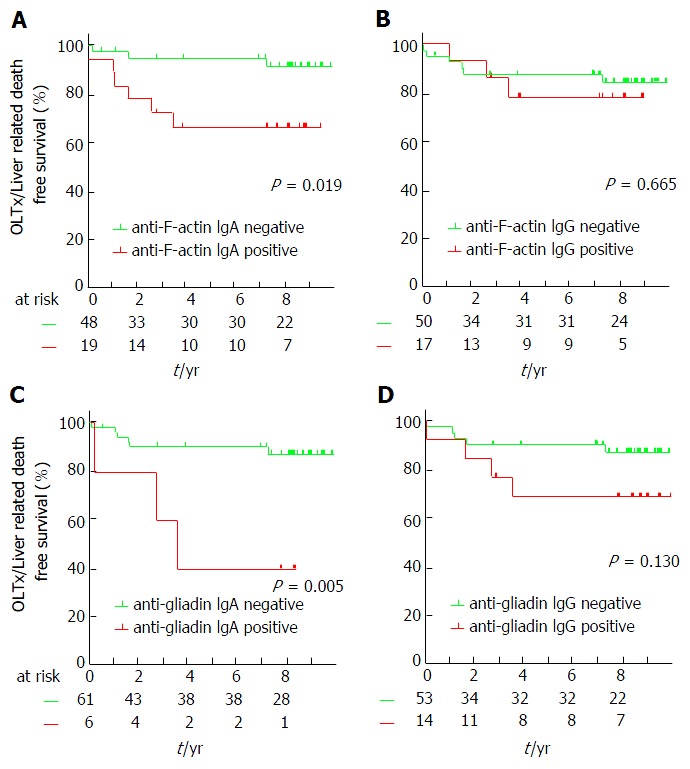
A total of 28.4%, 28.0%, 9% and 20.9% of PSC patients were positive for AAA IgA, AAA IgG, AGA IgA and AGA IgG, respectively. Frequencies of AAA IgA and AAA IgG ( < 0.001, for both) and AGA IgG ( = 0.01, for both) but not AGA IgA were significantly higher compared to both of the HCONT and the UC groups. In survival analysis, AAA IgA-positivity was revealed as an independent predictor of poor disease outcome after adjusting either for the presence of cirrhosis [HR = 5.15 (1.27-20.86), = 0.022 or for the Mayo risk score (HR = 4.24 (0.99-18.21), = 0.052]. AAA IgA-positivity was significantly associated with higher frequency of anti-microbial antibodies ( < 0.001 for EndoCab IgA and = 0.012 for anti-OMP Plus IgA) and higher level of the enterocyte damage marker (median I-FABP: 365 166 pg/mL, = 0.011), but not with serum LBP level.
Presence of IgA type AAA identified PSC patients with progressive disease. Moreover, it is associated with enhanced mucosal immune response to various microbial antigens and enterocyte damage further highlighting the importance of the gut-liver interaction in PSC.
评估反映肠道屏障功能障碍的一组血清学标志物在混合队列的儿科和成人原发性硬化性胆管炎(PSC)患者中的流行情况。
通过酶联免疫吸附试验(ELISA)检测 67 例 PSC 患者(中位年龄(范围):32(5-79)岁,同时患有 IBD:67%和肝硬化:20%)血清中抗 F-肌动蛋白(AAA IgA/IgG)和麦胶(AGA IgA/IgG))以及血清肠脂肪酸结合蛋白(I-FABP)水平。还测定了脂多糖(LPS)暴露的标志物[LPS 结合蛋白(LBP)]和各种抗微生物抗体[抗 OMP Plus IgA 和内毒素核心 IgA 抗体(EndoCAb)]。不良疾病结局定义为随访期间进行原位肝移植和/或与肝脏相关的死亡[中位时间:99(14-106)个月]。153 名健康对照者(HCONT)和 172 名溃疡性结肠炎(UC)患者为对照组。
28.4%、28.0%、9%和 20.9%的 PSC 患者分别为 AAA IgA、AAA IgG、AGA IgA 和 AGA IgG 阳性。与 HCONT 和 UC 两组相比,AAA IgA 和 AAA IgG(均<0.001)和 AGA IgG(均=0.01)的频率显著更高,但 AGA IgA 无显著差异。在生存分析中,AAA IgA 阳性在调整肝硬化(HR=5.15(1.27-20.86),=0.022)或 Mayo 风险评分(HR=4.24(0.99-18.21),=0.052)后,被揭示为不良疾病结局的独立预测因子。AAA IgA 阳性与更高频率的抗微生物抗体(EndoCab IgA 为<0.001,抗 OMP Plus IgA 为=0.012)和更高的肠细胞损伤标志物水平(中位数 I-FABP:365 166 pg/mL,=0.011)显著相关,但与血清 LBP 水平无关。
IgA 型 AAA 的存在确定了患有进行性疾病的 PSC 患者。此外,它与对各种微生物抗原和肠细胞损伤的粘膜免疫反应增强有关,进一步强调了肠道-肝脏相互作用在 PSC 中的重要性。