Division of Gastroenterology, Department of Internal Medicine, Faculty of Medicine, University of Debrecen, Debrecen H-4032, Hajdu-Bihar, Hungary.
The First Department of Medicine, Division of Gastroenterology, University of Pécs, Pécs H-7624, Baranya, Hungary.
World J Gastroenterol. 2022 Jun 7;28(21):2291-2301. doi: 10.3748/wjg.v28.i21.2291.
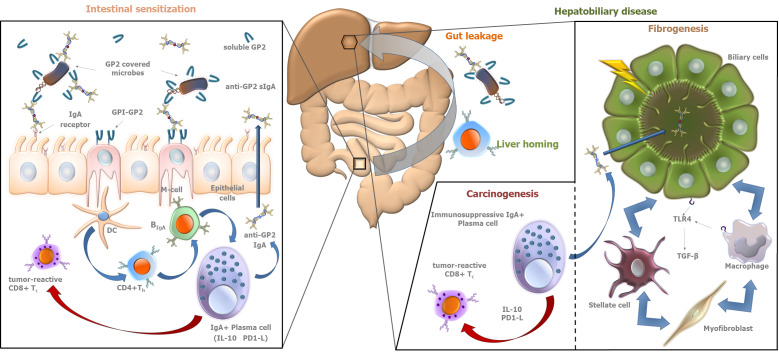
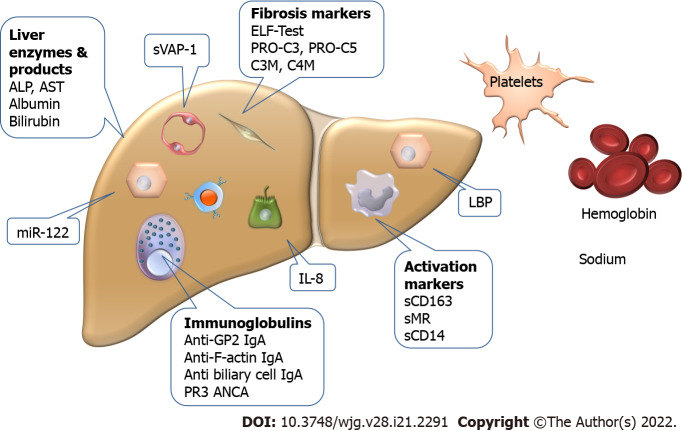
Clinical manifestations and progression of primary sclerosing cholangitis (PSC) are heterogeneous, and its pathogenesis is poorly understood. The importance of gut-liver interactions in the pathogenesis has been clinically confirmed and highlighted in different theories. Recent advances regarding biomarkers of biliary-gut crosstalk may help to identify clinically relevant PSC subgroups assisting everyday clinical work-up (, diagnosis, disease stratification, or surveillance) and the exploration of potential therapeutic targets. Alkaline phosphatase produced by the biliary epithelium is consistently associated with prognosis. However, its level shows natural fluctuation limiting its use in individual patients. Inflammatory, cell activation, and tissue remodeling markers have been reported to predict clinical outcome. Elevated immunoglobulin (Ig) G4 level is associated with a shorter transplantation-free survival. IgG type atypical perinuclear anti-neutrophil cytoplasmic antibodies (P-ANCAs) are non-specific markers of various autoimmune liver diseases and may reflect an abnormal B-cell response to gut microbial antigens. IgG type atypical P-ANCA identifies PSC patients with particular clinical and genetic (for human leukocyte antigens) characteristics. The presence of IgA type anti-F-actin antibody (AAA) may predict a progressive disease course, and it is associated with enhanced mucosal immune response to various microbial antigens and enterocyte damage. IgA type anti-glycoprotein 2 (GP2) antibodies identify patients with a severe disease phenotype and poor survival due to enhanced fibrogenesis or development of cholangiocarcinoma. Elevated soluble vascular adhesion protein-1 (sVAP-1) level is associated with adverse disease outcomes in PSC. High sVAP-1 levels correlate with mucosal addressin cell adhesion molecule-1 (MAdCAM-1) expression in the liver that contributes to gut activated T-cell homing to the hepatobiliary tract. In the present paper, we review the evidence on these possible serological markers that could potentially help address the unmet clinical needs in PSC.
原发性硬化性胆管炎(PSC)的临床表现和进展具有异质性,其发病机制尚未完全阐明。肠道-肝脏相互作用在发病机制中的重要性已在临床上得到证实,并在不同的理论中得到强调。关于胆道-肠道相互作用生物标志物的最新进展可能有助于识别具有临床相关性的 PSC 亚组,辅助日常临床评估(诊断、疾病分层或监测)和探索潜在的治疗靶点。胆管上皮产生的碱性磷酸酶与预后始终相关。然而,其水平存在自然波动,限制了其在个体患者中的应用。炎症、细胞激活和组织重塑标志物已被报道可预测临床结局。免疫球蛋白(Ig)G4 水平升高与无移植生存时间缩短相关。IgG 型非典型核周抗中性粒细胞胞质抗体(P-ANCAs)是非特异性的各种自身免疫性肝病标志物,可能反映了肠道微生物抗原异常的 B 细胞反应。IgG 型非典型 P-ANCA 可识别具有特定临床和遗传(人类白细胞抗原)特征的 PSC 患者。IgA 型抗肌动蛋白抗体(AAA)的存在可能预示疾病进展,并且与对各种微生物抗原的黏膜免疫反应增强和肠细胞损伤相关。IgA 型抗糖蛋白 2(GP2)抗体可识别疾病表型严重和生存不良的患者,原因是纤维化增强或发生胆管癌。可溶性血管黏附蛋白-1(sVAP-1)水平升高与 PSC 不良疾病结局相关。sVAP-1 水平升高与肝脏中黏膜地址素细胞黏附分子-1(MAdCAM-1)表达相关,后者有助于肠道激活的 T 细胞归巢至肝胆管。本文综述了这些可能的血清学标志物的证据,这些标志物可能有助于满足 PSC 中的未满足的临床需求。