Department of Medical Physics and Clinical Engineering, Royal Liverpool University Hospital, Liverpool, UK.
Department of Eye and Vision Science, Institute of Ageing and Chronic Disease, University of Liverpool, William Henry Duncan Building, 6, West Derby Street, Liverpool, L7 8TX, UK.
Diabetologia. 2017 Nov;60(11):2174-2182. doi: 10.1007/s00125-017-4386-0. Epub 2017 Aug 24.
AIMS/HYPOTHESIS: Individualised variable-interval risk-based screening offers better targeting and improved cost-effectiveness in screening for diabetic retinopathy. We developed a generalisable risk calculation engine (RCE) to assign personalised intervals linked to local population characteristics, and explored differences in assignment compared with current practice.
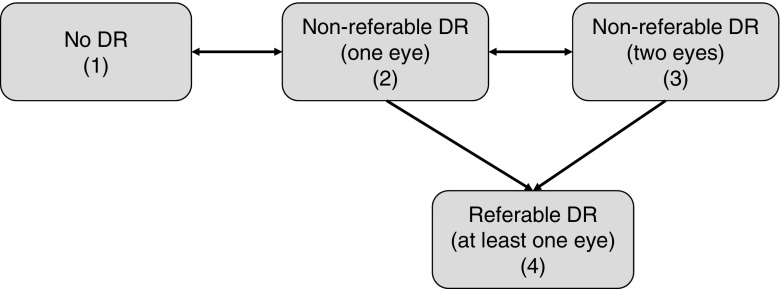
Data from 5 years of photographic screening and primary care for people with diabetes, screen negative at the first of > 1 episode, were combined in a purpose-built near-real-time warehouse. Covariates were selected from a dataset created using mixed qualitative/quantitative methods. Markov modelling predicted progression to screen-positive (referable diabetic retinopathy) against the local cohort history. Retinopathy grade informed baseline risk and multiple imputation dealt with missing data. Acceptable intervals (6, 12, 24 months) and risk threshold (2.5%) were established with patients and professional end users.
Data were from 11,806 people with diabetes (46,525 episodes, 388 screen-positive). Covariates with sufficient predictive value were: duration of known disease, HbA, age, systolic BP and total cholesterol. Corrected AUC (95% CIs) were: 6 months 0.88 (0.83, 0.93), 12 months 0.90 (0.87, 0.93) and 24 months 0.91 (0.87, 0.94). Sensitivities/specificities for a 2.5% risk were: 6 months 0.61, 0.93, 12 months 0.67, 0.90 and 24 months 0.82, 0.81. Implementing individualised RCE-based intervals would reduce the proportion of people becoming screen-positive before the allocated screening date by > 50% and the number of episodes by 30%.
CONCLUSIONS/INTERPRETATION: The Liverpool RCE shows sufficient performance for a local introduction into practice before wider implementation, subject to external validation. This approach offers potential enhancements of screening in improved local applicability, targeting and cost-effectiveness.
目的/假设:个体化可变间隔基于风险的筛查为糖尿病视网膜病变的筛查提供了更好的针对性,并提高了成本效益。我们开发了一种通用风险计算引擎(RCE),用于分配与当地人群特征相关的个性化间隔,并探讨了与当前实践相比分配的差异。
将 5 年的摄影筛查和糖尿病患者的初级保健数据合并到一个专门构建的近实时仓库中,这些数据来自于使用混合定性/定量方法创建的数据集。使用来自该数据集的协变量进行了 Markov 建模,以预测当地队列史中进展为筛查阳性(可检出的糖尿病视网膜病变)的情况。视网膜病变分级提供了基线风险,而多重插补处理了缺失数据。与患者和专业终端用户一起确定了可接受的间隔(6、12、24 个月)和风险阈值(2.5%)。
数据来自 11806 名糖尿病患者(46525 个病例,388 个筛查阳性)。具有足够预测价值的协变量是:已知疾病的持续时间、HbA、年龄、收缩压和总胆固醇。校正后的 AUC(95%CI)为:6 个月为 0.88(0.83,0.93),12 个月为 0.90(0.87,0.93),24 个月为 0.91(0.87,0.94)。2.5%风险的敏感性/特异性为:6 个月为 0.61,0.93,12 个月为 0.67,0.90,24 个月为 0.82,0.81。实施基于个体化 RCE 的间隔将使在分配的筛查日期之前成为筛查阳性的人数减少>50%,并减少 30%的病例数。
结论/解释:利物浦 RCE 的性能足以在更广泛的实施之前在当地引入实践,前提是需要进行外部验证。这种方法为提高筛查的当地适用性、针对性和成本效益提供了潜在的增强。