Chen Chao, Yu Li, Tang Xin, Liu Mo-Zhen, Sun Li-Zhong, Liu Changjian, Zhang Zhen, Li Chang-Zhou
Department of Orthopedics, The First Affiliated Hospital of Dalian Medical University, Dalian 116011, China.
Department of Orthopedics, The First Affiliated Hospital of Dalian Medical University, Dalian 116011, China.
Acta Orthop Traumatol Turc. 2017 Oct;51(5):381-387. doi: 10.1016/j.aott.2017.07.006. Epub 2017 Aug 26.
The aim of this study was to compare clinical outcomes of patients with femoral neck fractures treated with the dynamic hip system blade (DHS-BLADE) or cannulated compression screws.
Eighty-six patients with femoral neck fractures were treated by closed reduction internal fixation with a DHS-BLADE (n = 42; 18 males and 24 females; mean age: 56.3 years (37-87)) or cannulated compression screws (n = 44; 20 males and 24 females; mean age: 53.8 years (26-83)) between March 2011 and August 2013. The groups were compared with Harris hip score, operation time, surgical blood loss, incision size, hospital stay, and related complications.
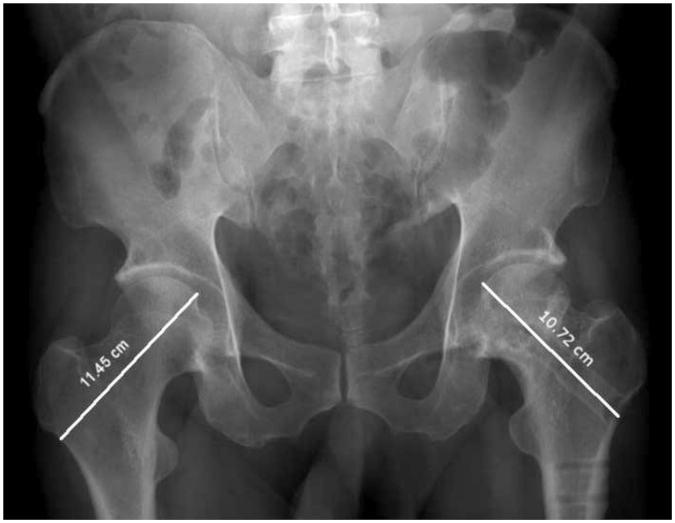
The average follow-up time was 27 months (range, 24-36 months). There was no significant difference for the operation time, incision size, hospital stay, and Harris hip score between the groups. Also, no statistically significant differences in the rates of nonunion (4.5% vs. 0) and avascular necrosis of the femoral head (9.1% vs. 7.1%) were observed. However, the screw group experienced significantly less surgical blood loss (32.4 ± 24.7 ml) than the blade group (87.2 ± 46.6 ml; P = 0.041). The incidence of femoral neck shortening above 10 mm in the screw group was significantly higher than that in the blade group (15.9% vs. 2.4%, P = 0.031). The blade group had a significantly lower incidence of screw migration than the screw group (4.8% vs. 22.7%, P = 0.016).
The DHS-BLADE and cannulated compression screws might be equally effective in terms of postoperative fracture union. However, the DHS-BLADE has advantages over cannulated compression screws for preventing femoral neck shortening, screw migration, and cut-out.
Level III, Therapeutic study.
本研究旨在比较采用动力髋系统刀片(DHS - 刀片)或空心加压螺钉治疗的股骨颈骨折患者的临床疗效。
2011年3月至2013年8月期间,86例股骨颈骨折患者接受了闭合复位内固定治疗,其中42例采用DHS - 刀片(18例男性,24例女性;平均年龄:56.3岁(37 - 87岁)),44例采用空心加压螺钉(20例男性,24例女性;平均年龄:53.8岁(26 - 83岁))。对两组患者的Harris髋关节评分、手术时间、术中失血量、切口大小、住院时间及相关并发症进行比较。
平均随访时间为27个月(范围24 - 36个月)。两组患者的手术时间、切口大小、住院时间及Harris髋关节评分无显著差异。此外,未观察到骨不连发生率(4.5%对0)和股骨头缺血性坏死发生率(9.1%对7.1%)有统计学显著差异。然而,螺钉组的术中失血量(32.4 ± 24.7 ml)明显少于刀片组(87.2 ± 46.6 ml;P = 0.041)。螺钉组股骨颈缩短超过10 mm的发生率显著高于刀片组(15.9%对2.4%,P = 0.031)。刀片组螺钉移位发生率明显低于螺钉组(4.8%对22.7%,P = 0.016)。
就术后骨折愈合而言,DHS - 刀片和空心加压螺钉可能同样有效。然而,在预防股骨颈缩短、螺钉移位和穿出方面,DHS - 刀片优于空心加压螺钉。
三级,治疗性研究。