Alexopoulou Alexandra, Agiasotelli Danai, Vasilieva Larisa E, Dourakis Spyros P
2 Department of Internal Medicine, Medical School, National and Kapodistrian University of Athens, "Hippokration" Hospital, Athens, Greece.
Ann Gastroenterol. 2017;30(5):486-497. doi: 10.20524/aog.2017.0178. Epub 2017 Jul 25.
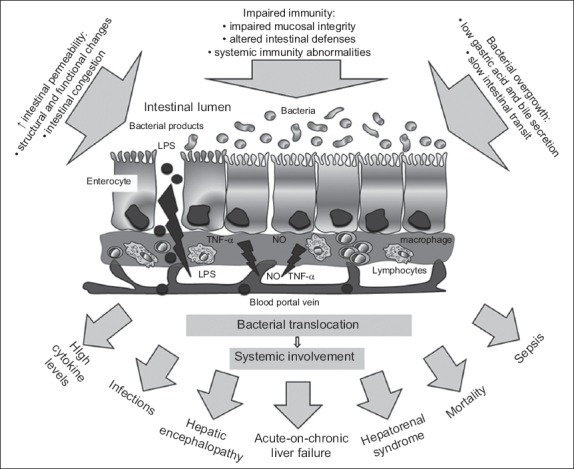
Bacterial translocation (BT) is an important mechanism in the development of infection in liver cirrhosis. The migration and colonization of bacteria and/or bacterial products from the bowel to mesenteric lymph nodes is a controlled process in healthy persons. Increased intestinal permeability, bacterial overgrowth and defect of gut-associated lymphatic tissue promote impaired BT in cirrhotics. We reviewed the reports on markers used for the evaluation of BT published between 1987 and 2016. We focused on the clinical consequences of BT in cirrhosis, as indicated by the values of the BT markers. Patients with cirrhosis are reported to have elevated levels of surrogate markers associated with BT compared with controls. The most widely used BT parameters are C-reactive protein, procalcitonin, bacterial DNA, endotoxin or lipopolysaccharide, lipopolysaccharide binding protein, calprotectin, and bactericidal/permeability increasing protein. High levels of these factors in serum and/or ascitic fluid in humans may be associated with advanced liver disease, hemodynamic instability, high levels of proinflammatory cytokines, susceptibility to the development of severe or recurrent infections, acute-on-chronic liver failure, hepatic encephalopathy, hepatorenal syndrome and poor prognosis during follow up. In conclusion, high levels of BT markers are associated with a high inflammatory response, increased complications of liver cirrhosis and occasionally high fatality rates.
细菌易位(BT)是肝硬化感染发生发展的重要机制。在健康个体中,细菌和/或细菌产物从肠道迁移至肠系膜淋巴结并定殖是一个受调控的过程。肠道通透性增加、细菌过度生长以及肠道相关淋巴组织缺陷会促使肝硬化患者的细菌易位受损。我们回顾了1987年至2016年间发表的关于用于评估细菌易位的标志物的报告。我们关注细菌易位标志物数值所表明的细菌易位在肝硬化中的临床后果。据报道,与对照组相比,肝硬化患者与细菌易位相关的替代标志物水平升高。最常用的细菌易位参数是C反应蛋白、降钙素原、细菌DNA、内毒素或脂多糖、脂多糖结合蛋白、钙卫蛋白以及杀菌/通透性增加蛋白。人类血清和/或腹水中这些因子的高水平可能与晚期肝病、血流动力学不稳定、促炎细胞因子水平升高、发生严重或复发性感染的易感性、慢加急性肝衰竭、肝性脑病、肝肾综合征以及随访期间的不良预后相关。总之,细菌易位标志物的高水平与高炎症反应、肝硬化并发症增加以及偶尔的高死亡率相关。