Pruteanu Ciprian G, Ackland Graeme J, Poon Wilson C K, Loveday John S
SUPA, School of Physics Astronomy Centre for Science at Extreme Conditions, The University of Edinburgh, Edinburgh, EH9 3JZ, UK.
Sci Adv. 2017 Aug 23;3(8):e1700240. doi: 10.1126/sciadv.1700240. eCollection 2017 Aug.
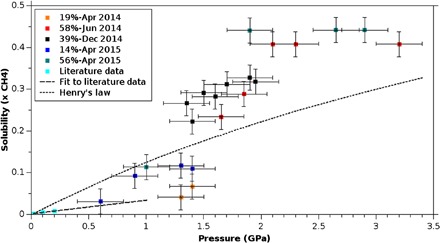
At low pressures, the solubility of gases in liquids is governed by Henry's law, which states that the saturated solubility of a gas in a liquid is proportional to the partial pressure of the gas. As the pressure increases, most gases depart from this ideal behavior in a sublinear fashion, leveling off at pressures in the 1- to 5-kbar (0.1 to 0.5 GPa) range with solubilities of less than 1 mole percent (mol %). This contrasts strikingly with the well-known marked increase in solubility of simple gases in water at high temperature associated with the critical point (647 K and 212 bar). The solubility of the smallest hydrocarbon, the simple gas methane, in water under a range of pressure and temperature is of widespread importance, because it is a paradigmatic hydrophobe and occurs widely in terrestrial and extraterrestrial geology. We report measurements up to 3.5 GPa of the pressure dependence of the solubility of methane in water at 100°C-well below the latter's critical temperature. Our results reveal a marked increase in solubility between 1 and 2 GPa, leading to a state above 2 GPa where the maximum solubility of methane in water exceeds 35 mol %.
在低压下,气体在液体中的溶解度受亨利定律支配,该定律指出气体在液体中的饱和溶解度与气体的分压成正比。随着压力增加,大多数气体以亚线性方式偏离这种理想行为,在1至5千巴(0.1至0.5吉帕)的压力范围内趋于平稳,溶解度小于1摩尔百分比(mol%)。这与众所周知的简单气体在与临界点(647K和212巴)相关的高温下在水中溶解度显著增加形成鲜明对比。最小的碳氢化合物——简单气体甲烷——在一系列压力和温度下在水中的溶解度具有广泛的重要性,因为它是典型的疏水物,广泛存在于地球和地球外地质中。我们报告了在100°C(远低于其临界温度)下甲烷在水中溶解度随压力变化的测量结果,压力高达3.5吉帕。我们的结果表明,在1至2吉帕之间溶解度显著增加,导致在高于2吉帕的状态下,甲烷在水中的最大溶解度超过35 mol%。