Grgic Jozo, Mikulic Pavle, Podnar Hrvoje, Pedisic Zeljko
Institute of Sport, Exercise and Active Living (ISEAL), Victoria University, Melbourne, Australia.
University of Zagreb, Faculty of Kinesiology, Zagreb, Croatia.
PeerJ. 2017 Aug 22;5:e3695. doi: 10.7717/peerj.3695. eCollection 2017.
Periodization is an important component of resistance training programs. It is meant to improve adherence to the training regimen, allow for constant progression, help in avoiding plateaus, and reduce occurrence and severity of injuries. Previous findings regarding the effects of different periodization models on measures of muscle hypertrophy are equivocal. To provide a more in-depth look at the topic, we undertook a systematic review of the literature and a meta-analysis of intervention trials comparing the effects of linear periodization (LP) and daily undulating periodization (DUP) resistance training programs on muscle hypertrophy.
A comprehensive literature search was conducted through PubMed/MEDLINE, Scopus, Web of Science, SPORTDiscus, Networked Digital Library of Theses and Dissertations (NDLTD) and Open Access Theses and Dissertations (OATD).
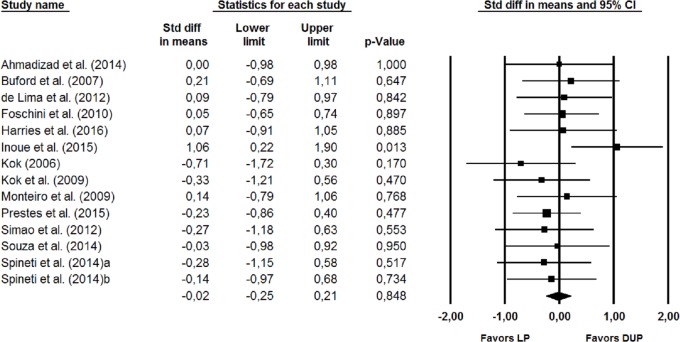
The pooled standardized mean difference (Cohen's d) from 13 eligible studies for the difference between the periodization models on muscle hypertrophy was -0.02 (95% confidence interval [-0.25, 0.21], = 0.848).
The meta-analysis comparing LP and DUP indicated that the effects of the two periodization models on muscle hypertrophy are likely to be similar. However, more research is needed in this area, particularly among trained individuals and clinical populations. Future studies may benefit from using instruments that are more sensitive for detecting changes in muscle mass, such as ultrasound or magnetic resonance imaging.
周期化训练是阻力训练计划的重要组成部分。它旨在提高对训练方案的依从性,实现持续进步,帮助避免训练平台期,并减少损伤的发生和严重程度。先前关于不同周期化模型对肌肉肥大测量指标影响的研究结果并不明确。为了更深入地探讨这个话题,我们对文献进行了系统综述,并对比较线性周期化(LP)和每日波动周期化(DUP)阻力训练计划对肌肉肥大影响的干预试验进行了荟萃分析。
通过PubMed/MEDLINE、Scopus、科学网、SPORTDiscus、学位论文网络数字图书馆(NDLTD)和开放获取学位论文(OATD)进行了全面的文献检索。
13项符合条件的研究中,周期化模型对肌肉肥大影响差异的合并标准化均值差(科恩d值)为-0.02(95%置信区间[-0.25, 0.21],P = 0.848)。
比较LP和DUP的荟萃分析表明,两种周期化模型对肌肉肥大的影响可能相似。然而,该领域需要更多研究,特别是在受过训练的个体和临床人群中。未来的研究可能会受益于使用对检测肌肉质量变化更敏感的仪器,如超声或磁共振成像。