Department of Endocrinology, First Affiliated Hospital of Harbin Medical University, Harbin, Heilongjiang 150001, P.R. China.
Mol Med Rep. 2017 Nov;16(5):5787-5792. doi: 10.3892/mmr.2017.7350. Epub 2017 Aug 24.
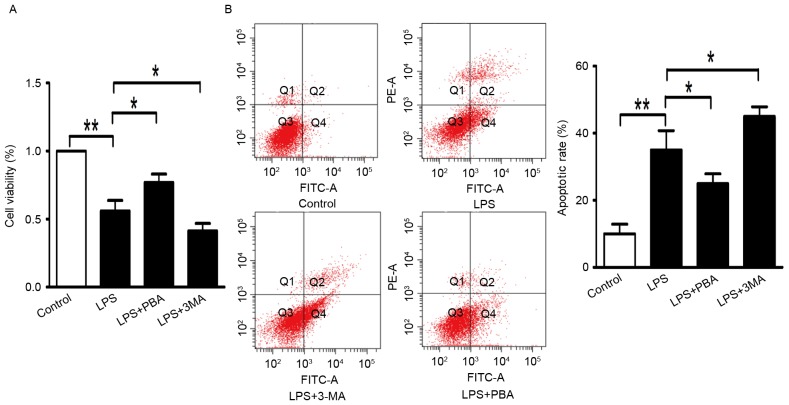
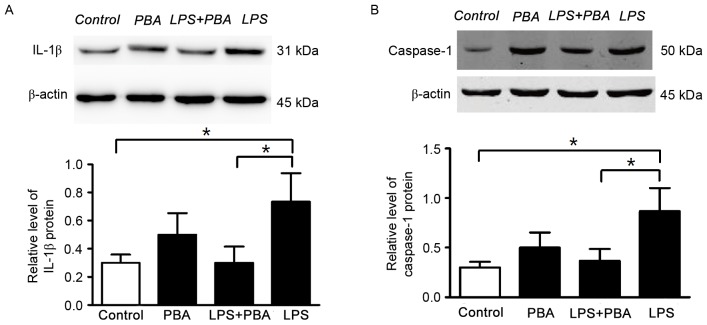
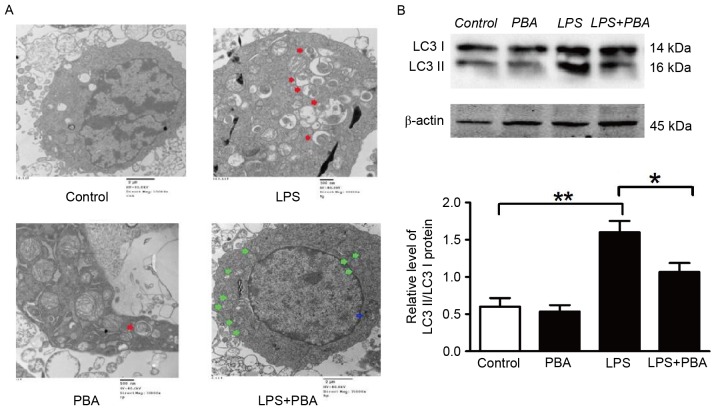
Type 2 diabetes is a chronic inflammatory disease. Autophagy, the dynamic process of lysosomal degradation of damaged organelles and proteins, may protect β‑cells from destruction by inflammation in type 2 diabetes. The present study investigated the role of autophagy, inflammation and endoplasmic reticulum (ER) stress in type 2 diabetes. INS‑1 cells were incubated with lipopolysaccharide. The chemical chaperone 4‑phenylbutyric acid was used to inhibit ER stress, and 3‑methyadenine (3‑MA) was used to inhibit autophagy. Apoptosis was detected by flow cytometry and cell proliferation using Cell Counting kit‑8 solution. Light chain‑3B, interleukin (IL) 1β, caspase‑1 and C/EBP homologous protein production were assessed by western blotting, and rat activating transcription factor 4 and rat binding immunoglobulin heavy chain protein gene expression were determined by real‑time reverse transcription‑polymerase chain reaction. The results showed that inhibiting autophagy with 3‑MA unexpectedly contributed to cell death in β‑cells. This response was associated with an increase in inflammatory cytokines, including IL1β and caspase‑1. Inhibiting ER stress with 4‑phenylbutyric acid led to a decrease in cell apoptosis. These results showed that autophagy may have a protective effect by reducing inflammatory cytokines in β‑cells. In addition, the inositol‑requiring enzyme 1 pathway mediated the ER stress associated with autophagy and inflammatory cytokines (IL1β and caspase‑1). Therefore, inflammatory cytokines may be critical signalling nodes, which are associated with ER stress‑mediated β‑cell death.
2 型糖尿病是一种慢性炎症性疾病。自噬是溶酶体降解受损细胞器和蛋白质的动态过程,它可能保护β细胞免受 2 型糖尿病炎症的破坏。本研究探讨了自噬、炎症和内质网(ER)应激在 2 型糖尿病中的作用。将 INS-1 细胞与脂多糖孵育。使用化学伴侣 4-苯丁酸抑制 ER 应激,使用 3-甲基腺嘌呤(3-MA)抑制自噬。通过流式细胞术检测细胞凋亡,使用 Cell Counting kit-8 溶液检测细胞增殖。通过 Western blot 检测 LC3B、白细胞介素(IL)1β、半胱天冬酶-1 和 C/EBP 同源蛋白的产生,通过实时逆转录-聚合酶链反应测定大鼠激活转录因子 4 和大鼠结合免疫球蛋白重链蛋白基因的表达。结果表明,用 3-MA 抑制自噬出乎意料地促进了β细胞的死亡。这种反应与炎症细胞因子(如 IL1β 和半胱天冬酶-1)的增加有关。用 4-苯丁酸抑制 ER 应激导致细胞凋亡减少。这些结果表明,自噬可能通过减少β细胞中的炎症细胞因子来发挥保护作用。此外,肌醇需求酶 1 途径介导了与自噬和炎症细胞因子(IL1β 和半胱天冬酶-1)相关的 ER 应激。因此,炎症细胞因子可能是与 ER 应激介导的β细胞死亡相关的关键信号节点。