Zhang Boxun, Yue Rensong, Chen Yuan, Huang Xiaoying, Yang Maoyi, Shui Jiacheng, Peng Yuliang
Hospital of Chengdu University of Traditional Chinese Medicine, Chengdu 610075, China.
Shaanxi University of Chinese Medicine, Xianyang 712046, China.
Evid Based Complement Alternat Med. 2020 Nov 8;2020:4568629. doi: 10.1155/2020/4568629. eCollection 2020.
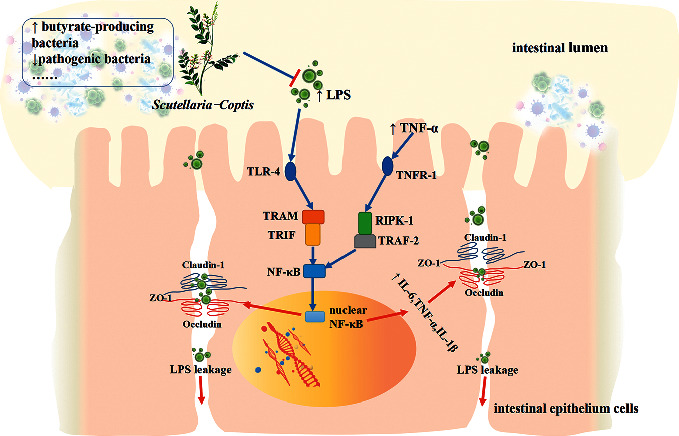
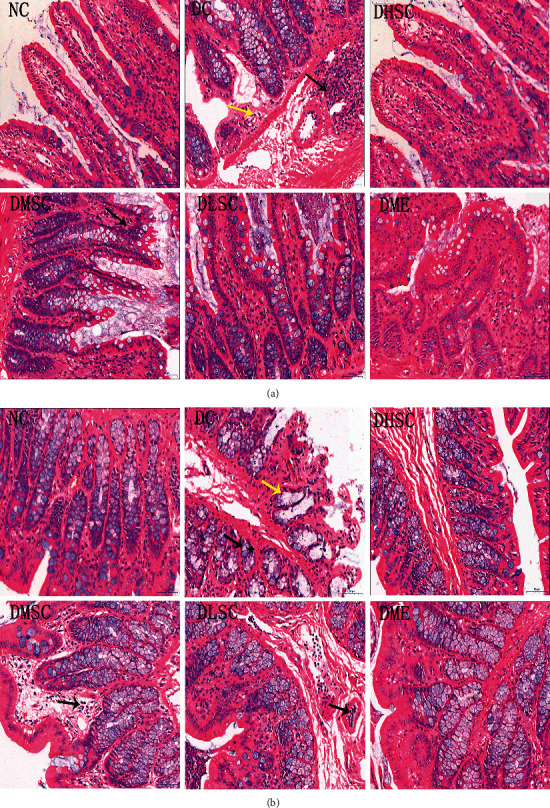
Recent studies have confirmed that increased intestinal permeability and gut-origin lipopolysaccharide (LPS) translocation are important causes of metabolic inflammation in type 2 diabetes (T2D), but there are no recognized therapies for targeting this pathological state. and are a classic herbal pair often used to treat diabetes and various intestinal diseases, and repair of intestinal barrier damage may be at the core of their therapeutic mechanism. This study investigated the effects of oral administration of (SC) on the intestinal mucosal barrier in diabetic rats and explored the underlying mechanism from the perspective of anti-inflammatory and gut microbiota-modulatory effects. The main results showed that, in addition to regulating glycolipid metabolism disorders and inhibiting serum inflammatory factors, SC could also upregulate the expression levels of the tight junction proteins claudin-1, occludin, and zonula occludens (ZO-1), significantly improve intestinal epithelial damage, and inhibit excessive LPS translocation into the blood circulation. Furthermore, it was found that SC could reduce the levels of the inflammatory factors interleukin-1 (IL-1), IL-6, and tumour necrosis factor- (TNF-) in intestinal tissue and that the anti-inflammatory effects involved the TLR-4/TRIF and TNFR-1/NF-B signalling pathways. Moreover, SC had a strong inhibitory effect on some potential enteropathogenic bacteria and LPS-producing bacteria, such as Proteobacteria, Enterobacteriaceae, , , and , and could also promote the proliferation of butyrate-producing bacteria, such as Lachnospiraceae and Prevotellaceae. Taken together, the hypoglycaemic effects of SC were related to the protection of the intestinal mucosal barrier, and the mechanisms might be related to the inhibition of intestinal inflammation and the regulation of the gut microbiota.
最近的研究证实,肠道通透性增加和肠道源性脂多糖(LPS)易位是2型糖尿病(T2D)代谢性炎症的重要原因,但目前尚无针对这种病理状态的公认疗法。黄连和肉桂是一对经典的药对,常用于治疗糖尿病和各种肠道疾病,修复肠道屏障损伤可能是其治疗机制的核心。本研究探讨了口服黄连肉桂药对(SC)对糖尿病大鼠肠道黏膜屏障的影响,并从抗炎和调节肠道微生物群的角度探讨了其潜在机制。主要结果表明,SC除了调节糖脂代谢紊乱和抑制血清炎症因子外,还可以上调紧密连接蛋白claudin-1、occludin和闭锁小带蛋白(ZO-1)的表达水平,显著改善肠道上皮损伤,并抑制过量的LPS易位进入血液循环。此外,研究发现SC可以降低肠道组织中炎症因子白细胞介素-1(IL-1)、IL-6和肿瘤坏死因子-(TNF-)的水平,且抗炎作用涉及TLR-4/TRIF和TNFR-1/NF-κB信号通路。此外,SC对一些潜在的肠道致病菌和产LPS细菌,如变形菌门、肠杆菌科、大肠杆菌、肺炎克雷伯菌和阴沟肠杆菌有很强的抑制作用,还可以促进产丁酸细菌,如毛螺菌科和普雷沃氏菌科的增殖。综上所述,SC的降血糖作用与保护肠道黏膜屏障有关,其机制可能与抑制肠道炎症和调节肠道微生物群有关。