Harari Yaniv, Zadok-Laviel Shira, Kupiec Martin
Department of Molecular Microbiology and Biotechnology, Tel Aviv University, Ramat Aviv, Israel.
Department of Molecular Microbiology and Biotechnology, Tel Aviv University, Ramat Aviv, Israel
mBio. 2017 Aug 29;8(4):e01314-17. doi: 10.1128/mBio.01314-17.
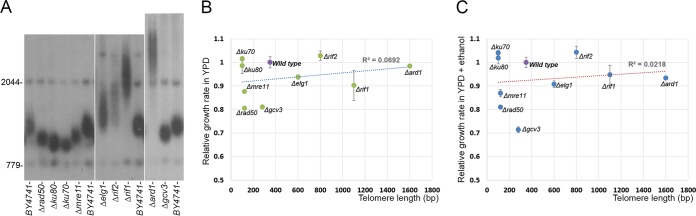
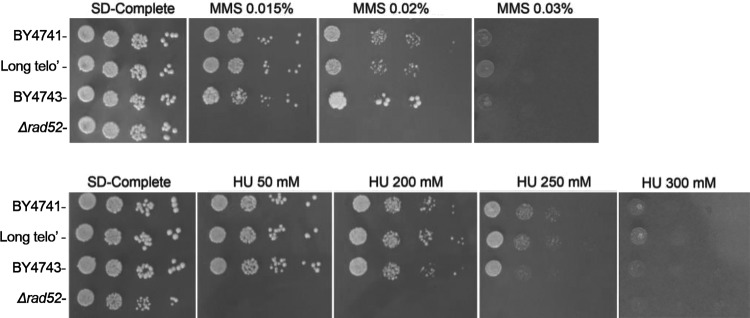
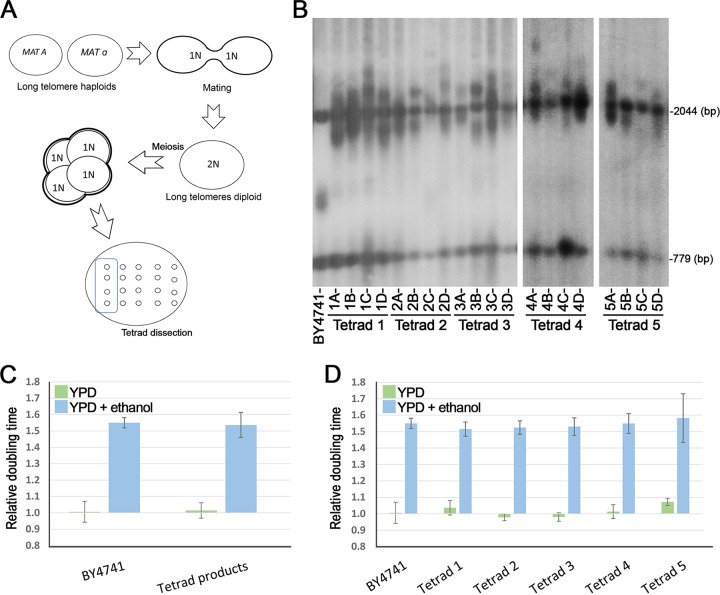
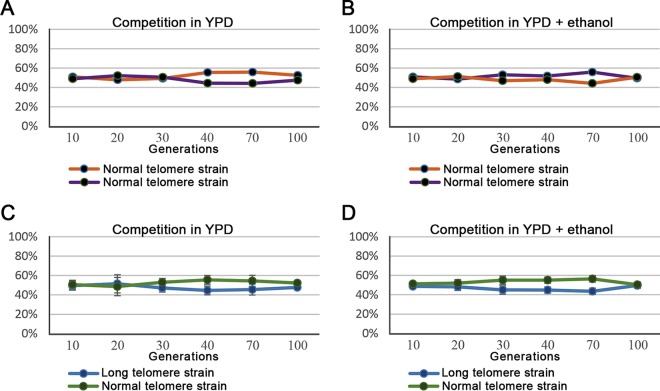
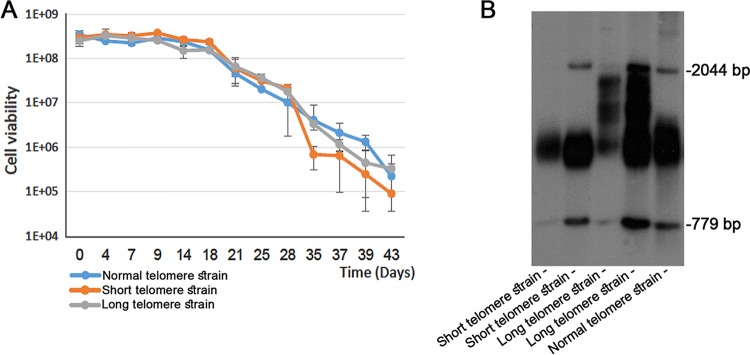
Telomeres, the ends of the eukaryotic chromosomes, help to maintain the genome's integrity and thus play important roles in aging and cancer. Telomere length is strictly controlled in all organisms. In humans, telomeres shorten with age, and it has been proposed that telomere shortening may play a causal role in aging. We took advantage of the availability of yeast strains with genetically or physiologically generated differences in telomere length to measure the effect that telomere length may have on cellular growth. By comparing the growth rates affecting telomere length of various yeast mutants we show that there is no correlation between their telomere length and cellular fitness. We also show that wild-type yeast cells carrying extremely long telomeres (5 times longer than the average) showed no signs of mitotic or meiotic defects, and competition experiments found no differences in growth between strains with normal telomeres and strains with long telomeres. No advantage or disadvantage of cells with long telomeres was detected under stress conditions either. Finally, telomere length had no effect in a chronological life span assay, which measures survival of post-mitotic-stage cells. We conclude that extreme telomere length has no effects (positive or negative) on the fitness of yeast cells. Telomeres protect the chromosomal ends from fusion, degradation, and unwanted repair. Therefore, telomeres preserve genome stability and cell viability. In humans, telomeres shorten with each cell duplication event and with age. It has thus been proposed that telomere shortening may be responsible for human aging and that elongation of telomeres may be a way to rejuvenate cells and to combat aging. However, it is difficult to prove this hypothesis in human cells. Yeasts are easy to manipulate and have telomeres whose length is strictly maintained. Here we show that yeast cells manipulated to have extremely long telomeres (5-fold those of normal cells) did not show any improvement or reduction in fitness compared to otherwise identical cells with telomeres of normal length under all the conditions tested. Moreover, an assay that measures cell aging showed no effect of the presence of extremely long telomeres. We thus conclude that extreme telomere length, at least in yeast cells, does not affect cellular fitness, aging, or senescence.
端粒是真核染色体的末端,有助于维持基因组的完整性,因此在衰老和癌症中发挥重要作用。端粒长度在所有生物体中都受到严格控制。在人类中,端粒会随着年龄的增长而缩短,有人提出端粒缩短可能在衰老过程中起因果作用。我们利用了端粒长度在遗传或生理上存在差异的酵母菌株,来测量端粒长度可能对细胞生长产生的影响。通过比较影响各种酵母突变体端粒长度的生长速率,我们发现它们的端粒长度与细胞适应性之间没有相关性。我们还表明,携带极长端粒(约为平均长度的5倍)的野生型酵母细胞没有显示出有丝分裂或减数分裂缺陷的迹象,竞争实验发现正常端粒菌株和长端粒菌株之间在生长方面没有差异。在应激条件下也未检测到长端粒细胞有任何优势或劣势。最后,在测量有丝分裂后阶段细胞存活情况的时序寿命测定中,端粒长度没有影响。我们得出结论,极端的端粒长度对酵母细胞的适应性没有影响(无论是正面还是负面)。端粒保护染色体末端不发生融合、降解和不必要的修复。因此,端粒维持基因组稳定性和细胞活力。在人类中,端粒会随着每次细胞复制事件和年龄的增长而缩短。因此有人提出端粒缩短可能是人类衰老的原因,而端粒延长可能是使细胞恢复活力和对抗衰老的一种方式。然而,在人类细胞中很难证明这一假设。酵母易于操作,其端粒长度能得到严格维持。在这里我们表明,与在所有测试条件下具有正常长度端粒的相同细胞相比,经过处理具有极长端粒(约为正常细胞的5倍)的酵母细胞在适应性方面没有任何改善或降低。此外,一项测量细胞衰老的测定表明,极长端粒的存在没有影响。因此我们得出结论,极端的端粒长度,至少在酵母细胞中,不会影响细胞适应性、衰老或衰老过程。