Center for Cognitive Neurology and Department of Neurology, New York University School of Medicine, New York, New York, USA.
Department of Pathology, New York University School of Medicine, New York, New York, USA.
Sci Rep. 2017 Aug 29;7(1):9881. doi: 10.1038/s41598-017-10393-z.
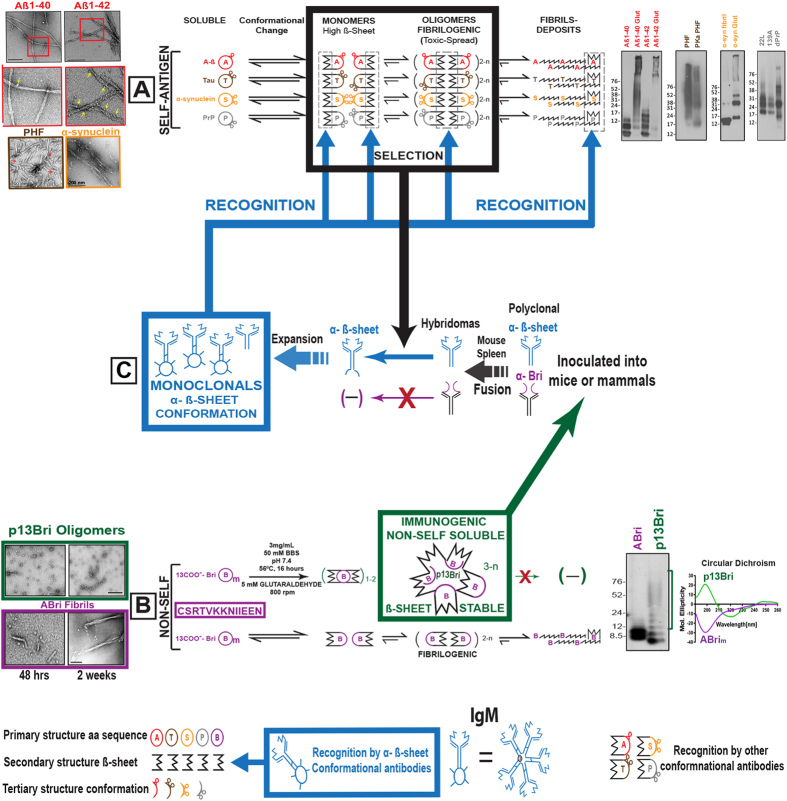
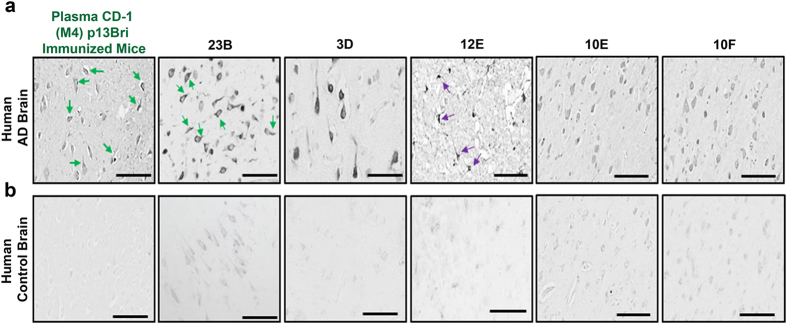
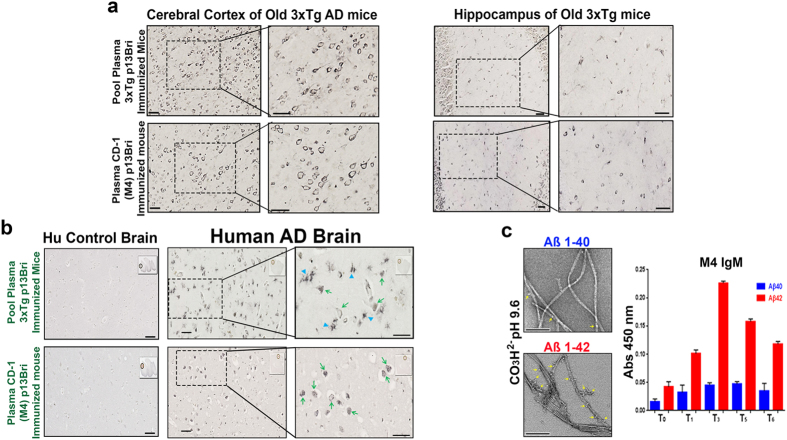
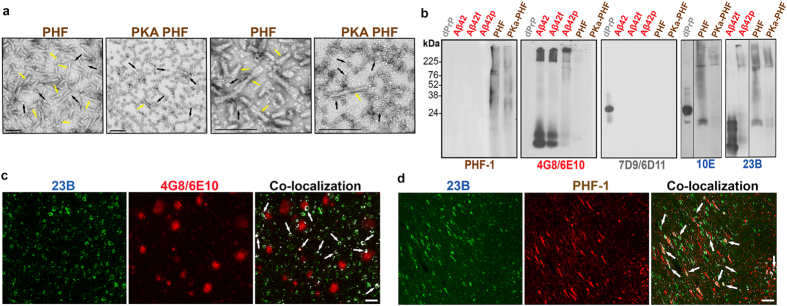
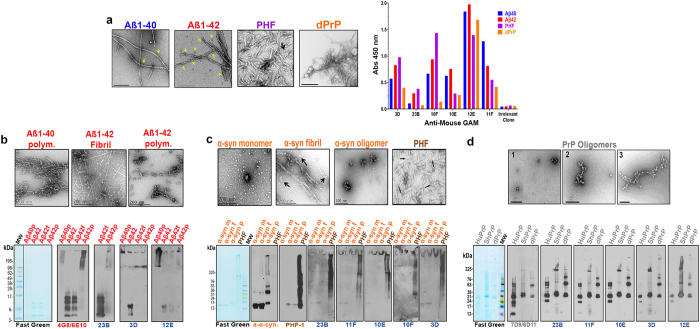
We describe a novel approach to produce conformational monoclonal antibodies selected to specifically react with the β-sheet secondary structure of pathological oligomeric conformers, characteristic of many neurodegenerative diseases. Contrary to past and current efforts, we utilize a mammalian non-self-antigen as an immunogen. The small, non-self peptide selected was covalently polymerized with glutaraldehyde until it reached a high β-sheet secondary structure content, and species between 10-100kDa that are immunogenic, stable and soluble (p13Bri). Inoculation of p13Bri in mice elicited antibodies to the peptide and the β-sheet secondary structure conformation. Hybridomas were produced and clones selected for their reactivity with at least two different oligomeric conformers from Alzheimer's, Parkinson and/or Prion diseases. The resulting conformational monoclonals are able to detect pathological oligomeric forms in different human neurodegenerative diseases by ELISA, immunohistochemistry and immunoblots. This technological approach may be useful to develop tools for detection, monitoring and treatment of multiple misfolding disorders.
我们描述了一种生产构象单克隆抗体的新方法,这些抗体是针对许多神经退行性疾病特征的病理性寡聚构象的β-折叠二级结构特异性反应的。与过去和当前的努力不同,我们利用哺乳动物的非自身抗原作为免疫原。选择的小非自身肽与戊二醛共价聚合,直到达到高β-折叠二级结构含量,以及具有免疫原性、稳定性和可溶性的 10-100 kDa 物质(p13Bri)。p13Bri 接种到小鼠中会引发针对肽和β-折叠二级结构构象的抗体。产生杂交瘤,并选择对来自阿尔茨海默病、帕金森病和/或朊病毒病的至少两种不同寡聚构象具有反应性的克隆。由此产生的构象单克隆抗体能够通过 ELISA、免疫组织化学和免疫印迹法检测不同人类神经退行性疾病中的病理性寡聚形式。这种技术方法可能有助于开发用于检测、监测和治疗多种错误折叠疾病的工具。