Jalan Anushka Lalit, Warhadpande Manjusha M, Dakshindas Darshan M
Department of Conservative Dentistry and Endodontics, Government Dental College, Nagpur, Maharashtra, India.
J Conserv Dent. 2017 Mar-Apr;20(2):129-133. doi: 10.4103/0972-0707.212247.
Direct pulp capping involves the placement of a biocompatible agent on pulp tissue that has been inadvertently exposed from traumatic injury or by iatrogenic means.
To compare the human pulp response to calcium hydroxide and Biodentine as direct pulp-capping agents.
Pulp exposures were performed on the pulpal floor of forty human permanent premolars. The exposure sites were dressed with either Dycal or Biodentine as pulp-capping materials. After 45 days, teeth were extracted and processed for histological examination.
The histological data were subjected to Wilcoxon rank-sum test.
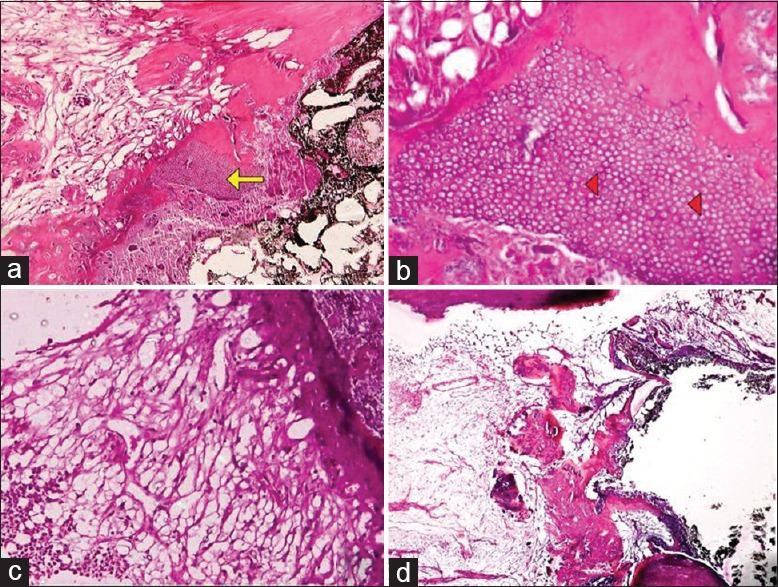
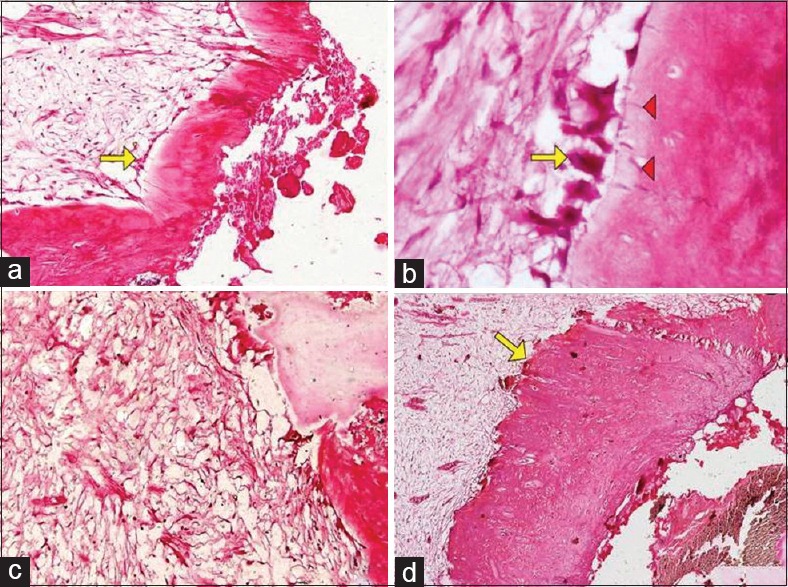
The dentinal bridges in teeth that were capped with Biodentine were significantly thicker ( < 0.0001) and more continuous ( = 0.0001) with less pulpal inflammation ( = 0.0044) in comparison to Dycal.
Based on the result of this study, Biodentine can be suggested as the material of choice for direct pulp capping procedure instead of Dycal. However, further long-term follow-up human studies using Biodentine on cariously exposed pulpal teeth are warranted to derive a definite conclusion.
直接盖髓术是将生物相容性材料放置于因外伤或医源性因素意外暴露的牙髓组织上。
比较氢氧化钙和生物活性玻璃陶瓷作为直接盖髓剂时人体牙髓的反应。
在40颗人类恒牙前磨牙的髓室底进行牙髓暴露。暴露部位分别用Dycal或生物活性玻璃陶瓷作为盖髓材料进行处理。45天后,拔除牙齿并进行组织学检查。
组织学数据采用Wilcoxon秩和检验。
与Dycal相比,用生物活性玻璃陶瓷盖髓的牙齿形成的牙本质桥明显更厚(<0.0001)且更连续(=0.0001),牙髓炎症更少(=0.0044)。
基于本研究结果,可建议将生物活性玻璃陶瓷作为直接盖髓术的首选材料,而非Dycal。然而,需要进一步对龋源性暴露牙髓的牙齿进行长期的人体随访研究,以得出明确结论。