New York University School of Medicine, New York, New York.
Mayo Clinic, Rochester, Minnesota.
Arthritis Rheumatol. 2017 Dec;69(12):2328-2337. doi: 10.1002/art.40304. Epub 2017 Nov 9.
Systemic lupus erythematosus (SLE) is frequently characterized by activation of the type I interferon (IFN) pathway. We previously observed that a missense single-nucleotide polymorphism (rs1049564) in the purine nucleoside phosphorylase (PNP) gene was associated with high levels of IFN in SLE. PNP is a key enzyme involved in purine metabolism. In this study, we performed functional follow-up of this polymorphism in human cells.
Type I IFN was measured in patient sera, using a reporter cell assay. Structural modeling of the PNP variant was performed using PyMOL software. PNP messenger RNA (mRNA) and protein levels and type I IFN-induced gene expression were measured in lymphoblastoid cell lines with known PNP rs1049564 genotypes. The cell cycle was assayed using flow cytometry.
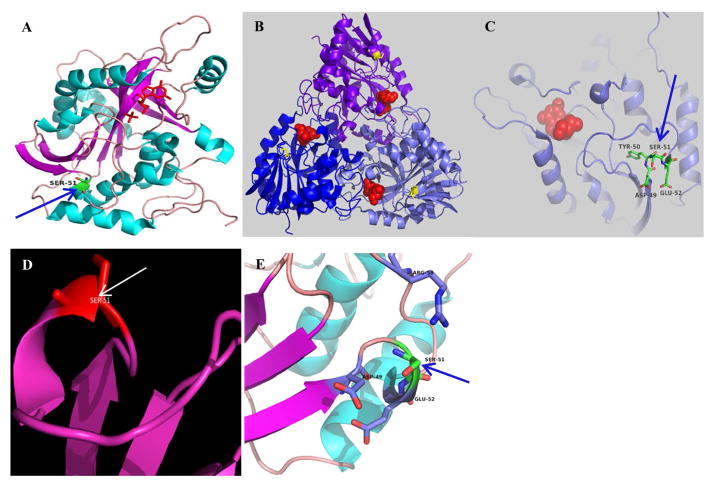
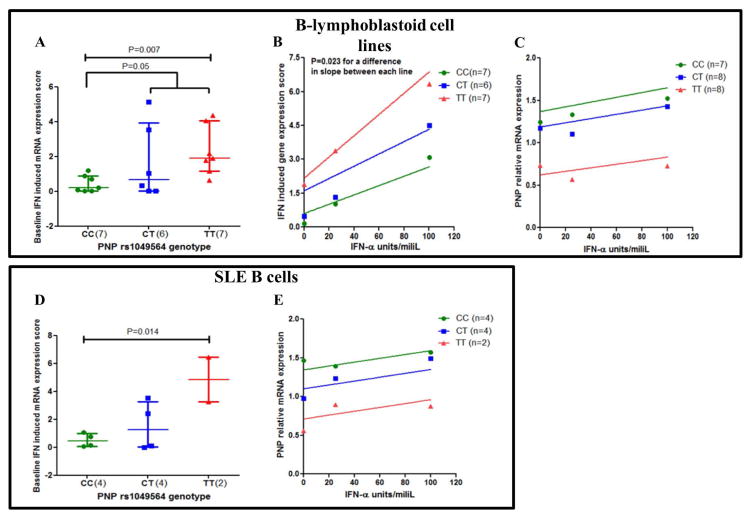
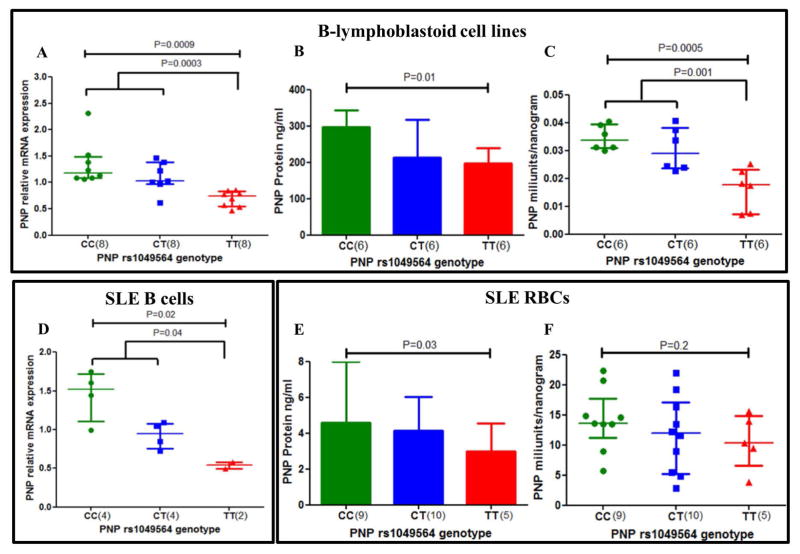
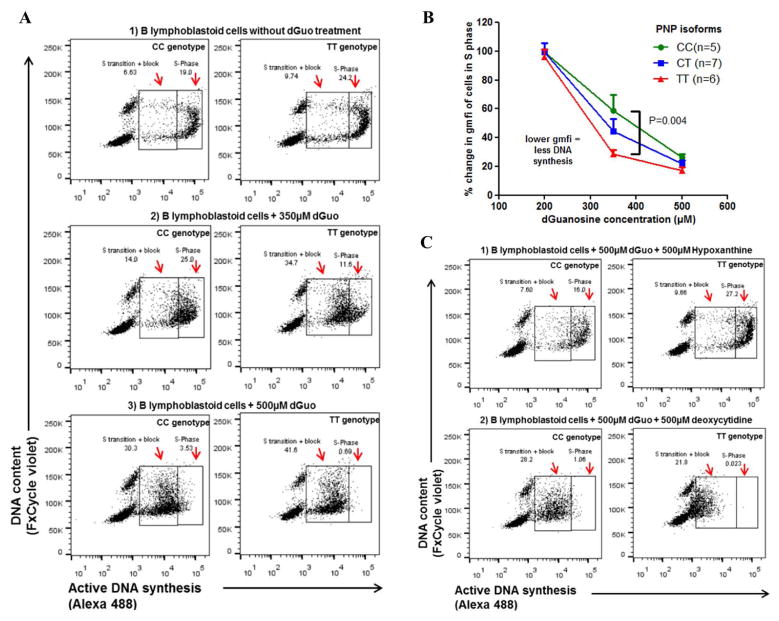
Structural modeling indicated no major disruption in folding related to rs1049564. We observed that homozygous rs1049564 TT lymphoblastoid cells had decreased PNP mRNA expression and protein levels, and that cells with the TT genotype had reduced PNP enzymatic activity even when the amount of PNP was controlled. Cells with the TT genotype had a 2-fold increase in S-phase block as compared with cells with the homozygous CC phenotype. The S-phase block could be pharmacologically reversed with hypoxanthine and adenosine, supporting the notion that relative PNP deficiency is the cause of the S-phase block. Type I IFN-induced transcripts were increased in a dose-response manner related to the rs1049564 T allele, at both baseline and after type I IFN stimulation.
The PNP rs1049564 T allele is a loss-of-function variant that induces S-phase block and IFN pathway activation in lymphocytes. The S-phase block could be rescued in our in vitro experiments, suggesting the potential for personalized treatment.
系统性红斑狼疮(SLE)常伴有 I 型干扰素(IFN)通路的激活。我们先前观察到嘌呤核苷磷酸化酶(PNP)基因中的一个错义单核苷酸多态性(rs1049564)与 SLE 中 IFN 水平升高有关。PNP 是嘌呤代谢中的关键酶。在这项研究中,我们在人类细胞中对该多态性进行了功能随访。
使用报告细胞测定法测量患者血清中的 I 型 IFN。使用 PyMOL 软件对 PNP 变异体进行结构建模。使用已知 PNP rs1049564 基因型的淋巴母细胞系测量 PNP mRNA 和蛋白水平以及 I 型 IFN 诱导的基因表达。使用流式细胞术检测细胞周期。
结构建模表明,与 rs1049564 相关的折叠没有重大破坏。我们观察到,纯合 rs1049564 TT 淋巴母细胞系的 PNP mRNA 表达和蛋白水平降低,即使控制 PNP 量,TT 基因型的细胞也具有降低的 PNP 酶活性。与纯合 CC 表型的细胞相比,TT 基因型的细胞 S 期阻滞增加了 2 倍。用次黄嘌呤和腺苷可以在药理学上逆转 S 期阻滞,这支持相对 PNP 缺乏是 S 期阻滞的原因的观点。与 rs1049564 T 等位基因相关,在基线和 I 型 IFN 刺激后,IFN 诱导的转录物呈剂量反应性增加。
PNP rs1049564 T 等位基因是一种失能变体,可诱导淋巴细胞的 S 期阻滞和 IFN 通路激活。我们的体外实验可以挽救 S 期阻滞,提示有个性化治疗的潜力。