Department of Obstetrics and Gynaecology, The University of Hong Kong, Queen Mary Hospital, Hong Kong, HKSAR, China.
Department of Pathology, The University of Hong Kong - Shenzhen Hospital, Shenzhen, China.
BMC Cancer. 2017 Aug 31;17(1):606. doi: 10.1186/s12885-017-3601-1.
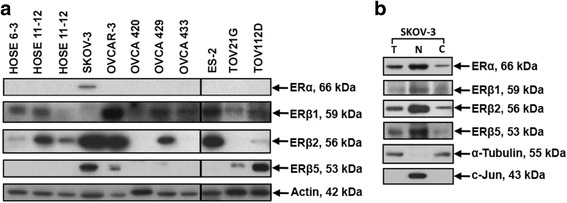
Due to the presence of both classical estrogen receptor (ERα) and another ER subtype (ERβ) in ovarian cancer, hormonal treatment is an attractive option. However, response to tamoxifen in ovarian cancer is modest. The presence of ERβ variants further complicated the issue. We have recently shown that specifically targeting ER subtypes using selective ER modulators showed opposing functions of ER subtypes on cell growth. In the present study, the clinical significance of ERα and ERβ variants (β1, β2 and β5) and the functional effects of ERβ2 and ERβ5 in ovarian cancer was investigated.
ERα, ERβ1, ERβ2 and ERβ5 expression were evaluated by immunohistochemistry in 106 ovarian cancer tissues. The association between ERs expression and clinicopathological parameters or prognosis was analyzed. Ectopic expression of ERβ2 and ERβ5 followed by functional assays were performed in ovarian cancer cell lines in order to detect their effects on cell invasion and proliferation.
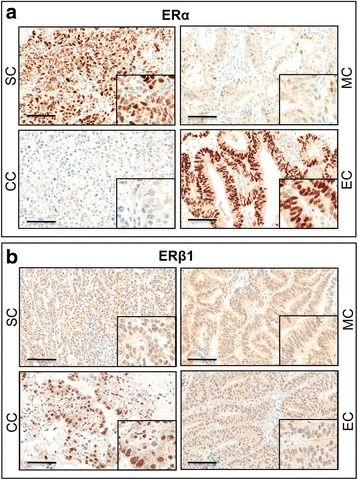
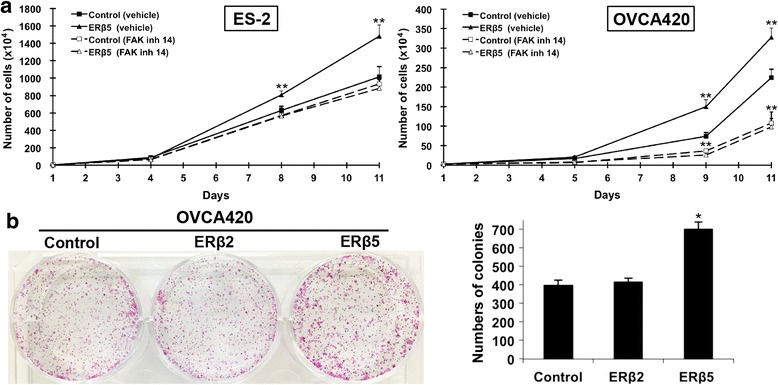
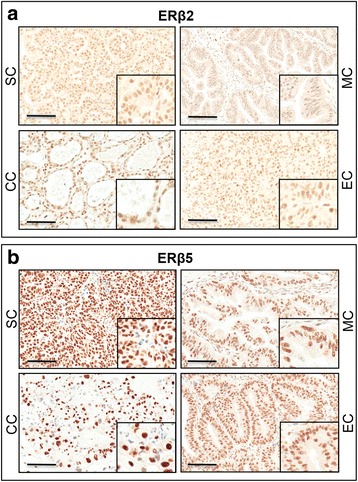
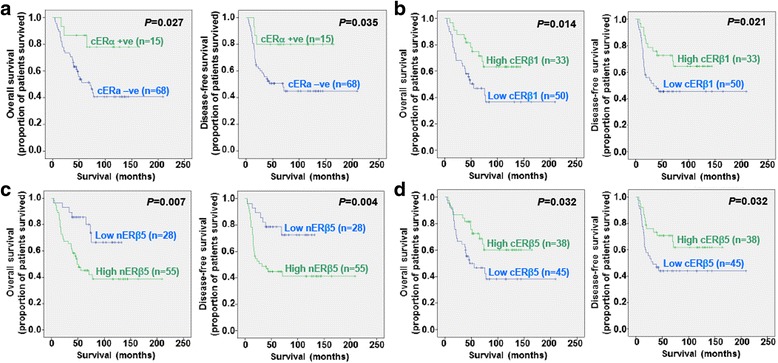
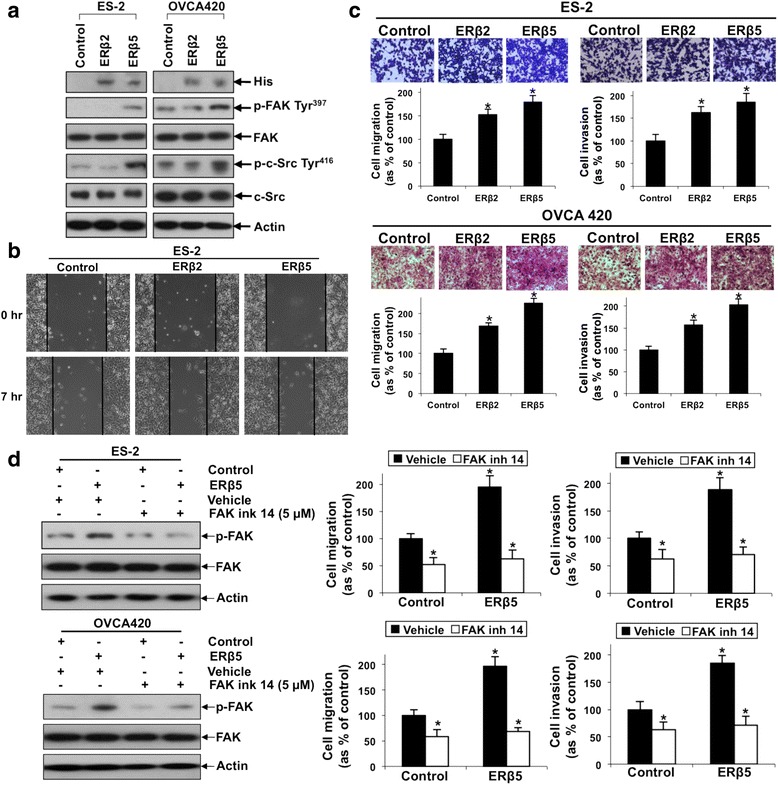
We found significantly higher nuclear (n)ERα and nERβ5 and lower cytoplasmic (c)ERα expression in advanced cancers. Significantly lower ERβ1 expression was also detected in high grade cancers. Significant loss of nERα and cERβ2 expression were observed in clear cell histological subtypes. Higher nERβ5 and lower cERβ5 expression were associated with serous/clear cell subtypes, poor disease-free and overall survival. Positive cERα and higher cERβ1 expression were significantly associated with better disease-free and overall survival. Furthermore, we found nERβ5 as an independent prognostic factor for overall survival. Functionally, overexpression of ERβ5 enhanced ovarian cancer cell migration, invasion and proliferation via FAK/c-Src activation whereas ERβ2 induced cell migration and invasion.
Since tamoxifen binds to both ERα and ERβ1 which appear to bear opposing oncogenic roles, the histotypes-specific expression pattern of ERs indicates that personalized treatment for women based on ERs expression using selective estrogen receptor modulators may improve response rate. This study also suggests nERβ5 as a potential prognostic marker and therapeutic target in ovarian cancer.
由于卵巢癌中既有经典的雌激素受体(ERα)又有另一种 ER 亚型(ERβ),因此激素治疗是一种有吸引力的选择。然而,卵巢癌对他莫昔芬的反应并不理想。ERβ 变体的存在使问题更加复杂。我们最近的研究表明,使用选择性雌激素受体调节剂特异性靶向 ER 亚型会对细胞生长产生相反的 ER 亚型功能。在本研究中,研究了 ERα 和 ERβ 变体(β1、β2 和 β5)的临床意义以及 ERβ2 和 ERβ5 在卵巢癌中的功能作用。
用免疫组织化学法检测 106 例卵巢癌组织中 ERα、ERβ1、ERβ2 和 ERβ5 的表达。分析 ERs 表达与临床病理参数或预后的关系。在卵巢癌细胞系中异位表达 ERβ2 和 ERβ5,然后进行功能测定,以检测其对细胞侵袭和增殖的影响。
我们发现晚期癌症中核(n)ERα和 nERβ5 的表达显著升高,而细胞质(c)ERα 的表达降低。高分级癌症中 ERβ1 的表达也显著降低。透明细胞组织学亚型中观察到 nERα 和 cERβ2 的表达明显丢失。nERβ5 表达升高和 cERβ5 表达降低与浆液性/透明细胞亚型相关,与无病生存和总生存不良相关。cERα 阳性和 cERβ1 高表达与无病生存和总生存明显相关。此外,我们发现 nERβ5 是总生存的独立预后因素。功能上,ERβ5 通过 FAK/c-Src 激活增强卵巢癌细胞迁移、侵袭和增殖,而 ERβ2 诱导细胞迁移和侵袭。
由于他莫昔芬与 ERα 和 ERβ1 结合,而 ERα 和 ERβ1 似乎具有相反的致癌作用,因此 ERs 的组织特异性表达模式表明,基于 ERs 表达使用选择性雌激素受体调节剂对女性进行个体化治疗可能会提高反应率。本研究还表明 nERβ5 可能是卵巢癌的一个潜在预后标志物和治疗靶点。