Rural Clinical School, University of New South Wales, Sydney, 2052, Australia.
Discipline of Pathology and Bosch Institute, University of Sydney, Sydney, Australia.
J Biomed Sci. 2017 Sep 1;24(1):65. doi: 10.1186/s12929-017-0372-6.
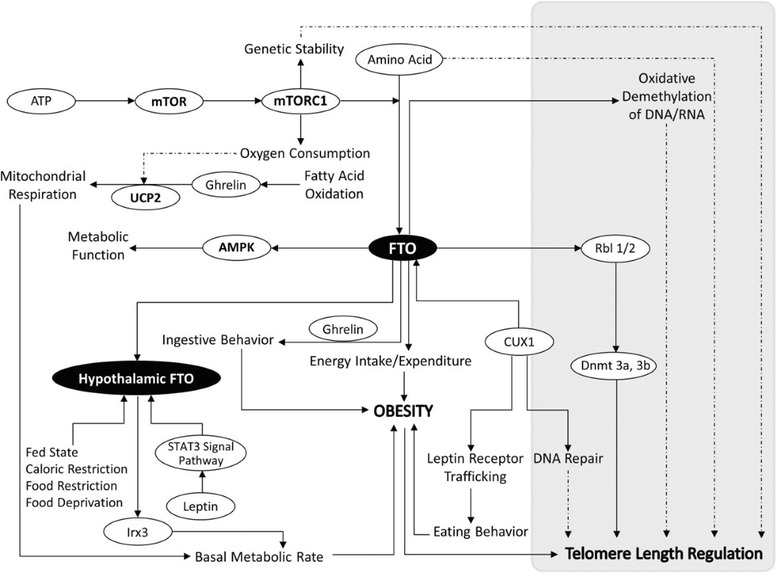
This review examines the biology of the Fat mass- and obesity-associated gene (FTO), and the implications of genetic association of FTO SNPs with obesity and genetic aging. Notably, we focus on the role of FTO in the regulation of methylation status as possible regulators of weight gain and genetic aging. We present a theoretical review of the FTO gene with a particular emphasis on associations with UCP2, AMPK, RBL2, IRX3, CUX1, mTORC1 and hormones involved in hunger regulation. These associations are important for dietary behavior regulation and cellular nutrient sensing via amino acids. We suggest that these pathways may also influence telomere regulation. Telomere length (TL) attrition may be influenced by obesity-related inflammation and oxidative stress, and FTO gene-involved pathways. There is additional emerging evidence to suggest that telomere length and obesity are bi-directionally associated. However, the role of obesity risk-related genotypes and associations with TL are not well understood. The FTO gene may influence pathways implicated in regulation of TL, which could help to explain some of the non-consistent relationship between weight phenotype and telomere length that is observed in population studies investigating obesity.
本综述探讨了脂肪量和肥胖相关基因(FTO)的生物学特性,以及 FTO SNP 与肥胖和遗传衰老的遗传关联的意义。值得注意的是,我们专注于 FTO 在调节甲基化状态方面的作用,因为它可能是体重增加和遗传衰老的调节剂。我们对 FTO 基因进行了理论综述,特别强调了与 UCP2、AMPK、RBL2、IRX3、CUX1、mTORC1 和参与饥饿调节的激素的关联。这些关联对于通过氨基酸调节饮食行为和细胞营养感应非常重要。我们认为这些途径也可能影响端粒调节。端粒长度(TL)损耗可能受肥胖相关炎症和氧化应激以及 FTO 基因相关途径的影响。还有越来越多的证据表明,端粒长度和肥胖呈双向关联。然而,肥胖风险相关基因型的作用及其与 TL 的关联尚不清楚。FTO 基因可能影响端粒调节途径,这有助于解释在研究肥胖的人群研究中观察到的体重表型和端粒长度之间一些不一致的关系。