Department of Physiology, University of Munich, Munich, Germany.
Department of Physiology, Biomedical Center Munich (BMC), University of Munich, Planegg-Martinsried, D-82152, Germany.
Biol Sex Differ. 2017 Sep 1;8(1):29. doi: 10.1186/s13293-017-0147-5.
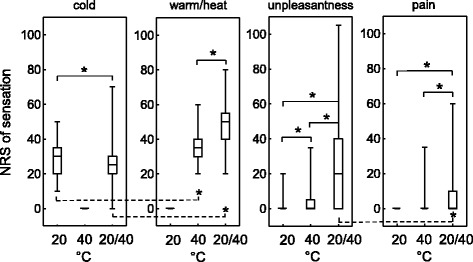
Sex-related differences in human thermal and pain sensitivity are the subject of controversial discussion. The goal of this study in a large number of subjects was to investigate sex differences in thermal and thermal pain perception and the thermal grill illusion (TGI) as a phenomenon reflecting crosstalk between the thermoreceptive and nociceptive systems. The thermal grill illusion is a sensation of strong, but not necessarily painful, heat often preceded by transient cold upon skin contact with spatially interlaced innocuous warm and cool stimuli.
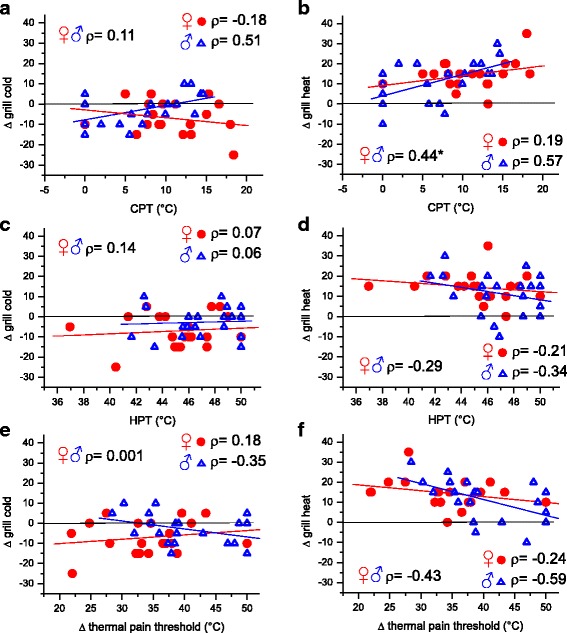
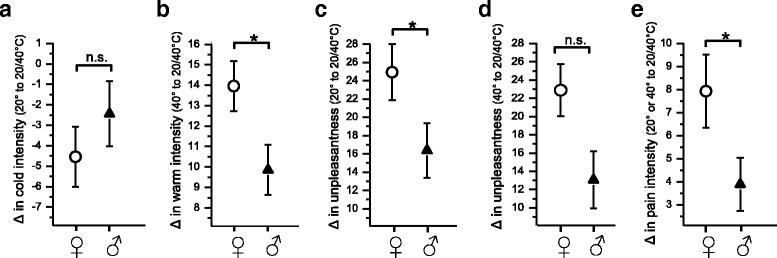
The TGI was studied in a group of 78 female and 58 male undergraduate students and was evoked by placing the palm of the right hand on the thermal grill (20/40 °C interleaved stimulus). Sex-related thermal perception was investigated by a retrospective analysis of thermal detection and thermal pain threshold data that had been measured in student laboratory courses over 5 years (776 female and 476 male undergraduate students) using the method of quantitative sensory testing (QST). To analyse correlations between thermal pain sensitivity and the TGI, thermal pain threshold and the TGI were determined in a group of 20 female and 20 male undergraduate students.
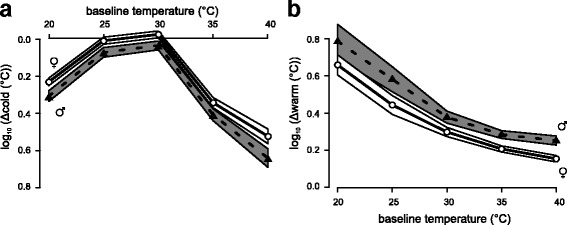
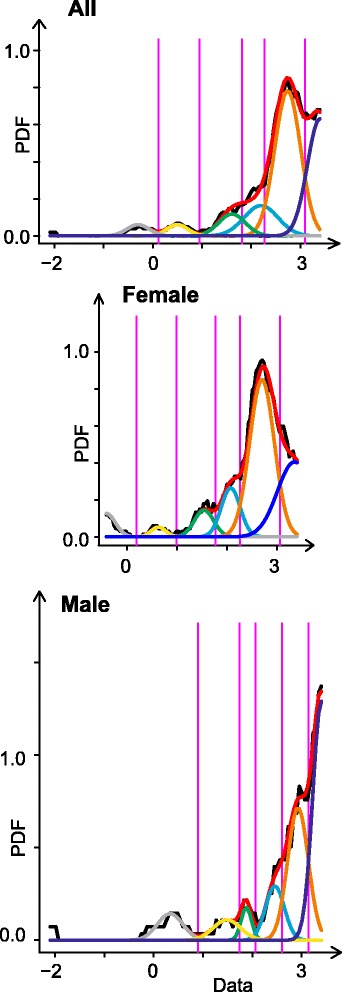
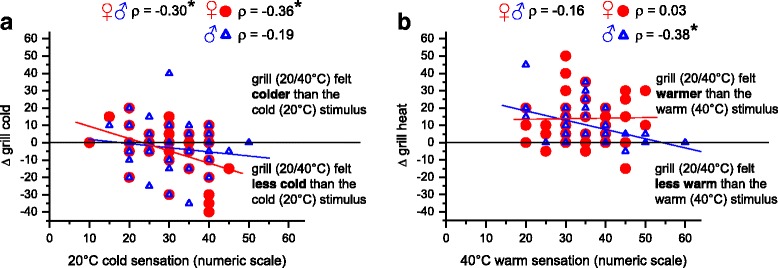
The TGI was more pronounced in females than males. Females were more sensitive with respect to thermal detection and thermal pain thresholds. Independent of sex, thermal detection thresholds were dependent on the baseline temperature with a specific progression of an optimum curve for cold detection threshold versus baseline temperature. The distribution of cold pain thresholds was multi-modal and sex-dependent. The more pronounced TGI in females correlated with higher cold sensitivity and cold pain sensitivity in females than in males.
Our finding that thermal detection threshold not only differs between the sexes but is also dependent on the baseline temperature reveals a complex processing of "cold" and "warm" inputs in thermal perception. The results of the TGI experiment support the assumption that sex differences in cold-related thermoreception are responsible for sex differences in the TGI.
人类热感觉和痛觉的性别差异是一个备受争议的话题。本研究的目的是在大量被试中,调查性别差异对热感觉和热痛觉的影响,以及热刺痛觉错觉(TGI)作为反映温度觉和伤害性感觉系统之间串扰的现象。TGI 是指在皮肤接触到空间交错的无害热和冷刺激时,会产生强烈但不一定疼痛的热感,这种热感通常会先出现短暂的冷感。
本研究共纳入 78 名女性和 58 名男性大学生,将右手手掌置于热刺痛觉仪(20/40°C 交错刺激)上以研究 TGI。通过对过去 5 年在学生实验室课程中使用定量感觉测试(QST)方法测量的热感觉阈值和热痛觉阈值数据进行回顾性分析,研究性别差异对热感觉的影响。为了分析热痛觉敏感与 TGI 之间的相关性,本研究还在 20 名女性和 20 名男性大学生中分别测量了热痛觉阈值和 TGI。
女性的 TGI 比男性更明显。女性在热感觉和热痛觉阈值方面更为敏感。独立于性别,热感觉阈值与基线温度有关,冷感觉阈值与基线温度之间存在特定的最优曲线。冷痛觉阈值的分布呈多模态,且与性别有关。女性 TGI 更明显与女性的冷觉敏感度和冷痛觉敏感度高于男性有关。
本研究发现,热感觉阈值不仅存在性别差异,而且还依赖于基线温度,这揭示了热感觉中“冷”和“暖”输入的复杂处理过程。TGI 实验的结果支持这样一种假设,即与冷相关的温度觉的性别差异是导致 TGI 性别差异的原因。