Totté Joan, de Wit Jill, Pardo Luba, Schuren Frank, van Doorn Martijn, Pasmans Suzanne
Department of Dermatology, Erasmus MC University Medical Center Rotterdam, Wytemaweg 80, 3015 CN, Rotterdam, The Netherlands.
TNO, Microbiology and Systems Biology Group, Utrechtseweg 48, PO Box 360, 3700 AJ, Zeist, The Netherlands.
Trials. 2017 Aug 31;18(1):404. doi: 10.1186/s13063-017-2118-x.
Atopic dermatitis (AD) is associated with reduced skin microbial diversity and overgrowth of Staphylococcus (S.) aureus. However, the importance of S. aureus colonisation in the complex pathogenesis remains unclear and studies on the effect of anti-staphylococcal therapy in non-infected AD show contradictory results. Long-term interventions against S. aureus might be needed to restore the microbial balance, but carry the risk of bacterial resistance induction. Staphefekt, an engineered bacteriophage endolysin, specifically kills S. aureus leaving other skin commensals unharmed. Bacterial resistance towards endolysins has not been reported, nor is it expected, which allows us to study its effect as long-term anti-staphylococcal treatment in non-infected AD.
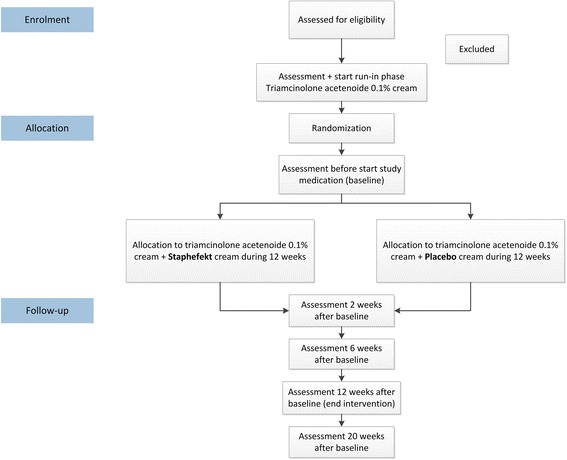
This is a multi-centre, placebo-controlled, double-blinded and randomized superiority trial with a parallel group design. A total of 100 participants, aged 18 years or older, diagnosed with moderate to severe AD and using a topical corticosteroid in the weeks before enrolment are included in the study. The study is executed in the Erasmus MC University Medical Centre Rotterdam in collaboration with the Havenziekenhuis Rotterdam. After a 2-week run-in period to standardize the corticosteroid use with triamcinolone acetonide 0.1% cream, participants will be randomized to either treatment with Staphefekt in a cetomacrogol-based cream or a placebo for 12 weeks, followed by an 8-week follow-up period. The primary objective is to assess the difference in the need for corticosteroid co-therapy between the Staphefekt and the placebo group, measuring the number of days per week of corticosteroid cream (triamcinolone) use. Secondary outcomes include the difference in use of corticosteroid cream measured in grams, differences in clinical efficacy, quality of life (QoL), microbial composition (includi23ng S. aureus) between the Staphefekt and the placebo group, and the safety and tolerability.
The results of this trial will provide data about the effect of long-term anti-staphylococcal therapy with Staphefekt on corticosteroid use, clinical symptoms and QoL in patients with moderate to severe AD. Additional data about growth characteristics of the skin microbiome, including S. aureus, will give insight into the role of the microbiome as a factor in the pathophysiology of AD.
ClinicalTrials.gov, NCT02840955 . Registered on 11 July 2016.
特应性皮炎(AD)与皮肤微生物多样性降低及金黄色葡萄球菌(S. aureus)过度生长有关。然而,金黄色葡萄球菌定植在复杂发病机制中的重要性仍不清楚,且关于抗葡萄球菌治疗对未感染AD患者疗效的研究结果相互矛盾。可能需要长期干预金黄色葡萄球菌以恢复微生物平衡,但存在诱导细菌耐药性的风险。葡萄球菌溶素(Staphefekt)是一种经过改造的噬菌体溶素,能特异性杀死金黄色葡萄球菌,而不伤害其他皮肤共生菌。尚未有关于细菌对溶素产生耐药性的报道,预计也不会出现,这使我们能够研究其作为未感染AD患者长期抗葡萄球菌治疗的效果。
这是一项多中心、安慰剂对照、双盲且随机的优效性试验,采用平行组设计。共有100名18岁及以上、被诊断为中度至重度AD且在入组前几周使用外用糖皮质激素的参与者纳入本研究。该研究由鹿特丹伊拉斯姆斯大学医学中心与鹿特丹港湾医院合作开展。在使用0.1%曲安奈德乳膏进行为期2周的磨合期以使糖皮质激素使用标准化后,参与者将被随机分为两组,一组使用含葡萄球菌溶素的鲸蜡醇基乳膏治疗,另一组使用安慰剂治疗,为期12周,随后进行8周的随访期。主要目的是评估葡萄球菌溶素组与安慰剂组在糖皮质激素联合治疗需求上的差异,通过测量每周使用糖皮质激素乳膏(曲安奈德)的天数来衡量。次要结局包括以克为单位测量的糖皮质激素乳膏使用差异、临床疗效差异、生活质量(QoL)差异、葡萄球菌溶素组与安慰剂组之间的微生物组成差异(包括金黄色葡萄球菌)以及安全性和耐受性。
本试验结果将提供关于长期使用葡萄球菌溶素进行抗葡萄球菌治疗对中度至重度AD患者糖皮质激素使用、临床症状和生活质量影响的数据。关于皮肤微生物群生长特征的其他数据,包括金黄色葡萄球菌,将有助于深入了解微生物群在AD病理生理学中的作用。
ClinicalTrials.gov,NCT02840955。于2016年7月11日注册。