Huang Hsien-Hao, Chen Liang-Yu, Doong Ming-Luen, Chang Shi-Chuan, Chen Chih-Yen
Institute of Clinical Medicine, National Yang-Ming University of Medicine.
Department of Emergency Medicine, Taipei Veterans General Hospital.
Drug Des Devel Ther. 2017 Aug 16;11:2377-2386. doi: 10.2147/DDDT.S143749. eCollection 2017.
Acyl ghrelin-induced intake depends on hypothalamic neuropeptide Y and agouti-related protein (AgRP) neurotransmitters. Intracerebroventricular (ICV) injection of AgRP increases feeding through competitive antagonism at melanocortin receptors. ICV administration of α-melanocyte stimulating hormone (α-MSH), a natural antagonist of AgRP, may modulate the acyl ghrelin-induced orexigenic effect.
This study aimed to investigate the modulating effect of α-MSH on the central acyl ghrelin-induced food intake, gastrointestinal motility, and colonic secretion in rats.
We examined the effects of α-MSH and acyl ghrelin on food intake, gastric emptying, small intestinal transit, colonic motility, and secretion in conscious rats with a chronic implant of ICV catheters.
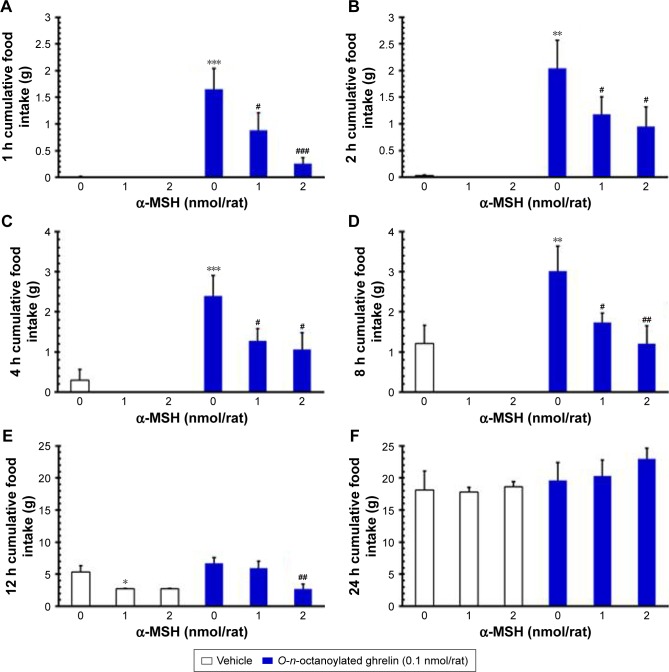
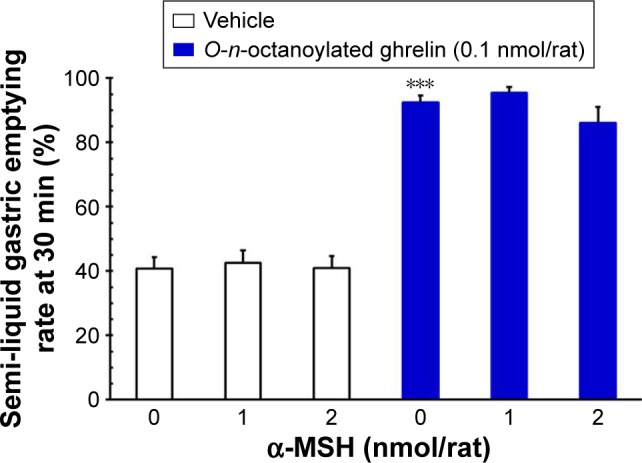
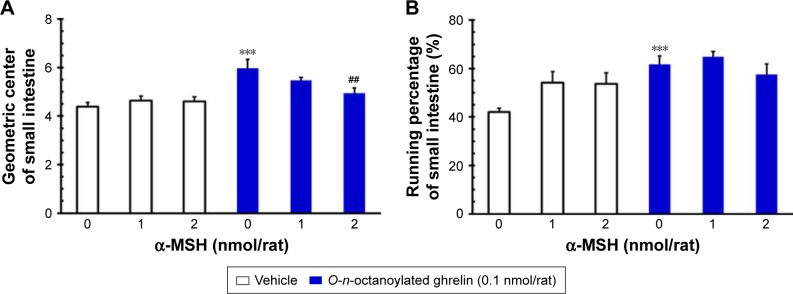
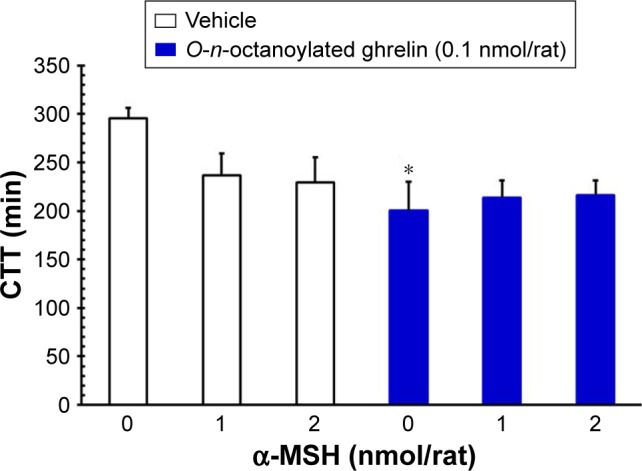
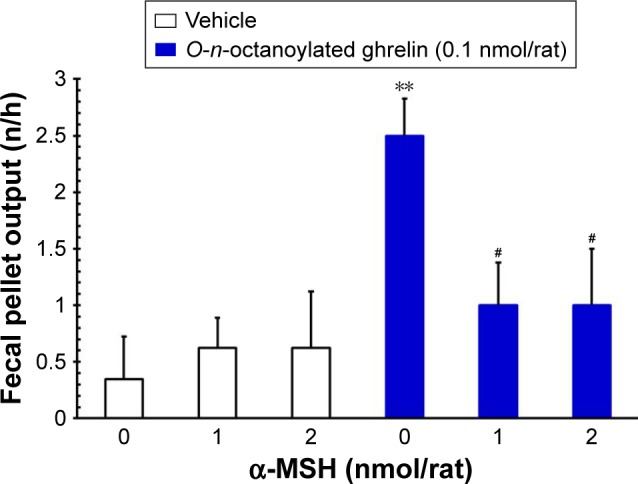
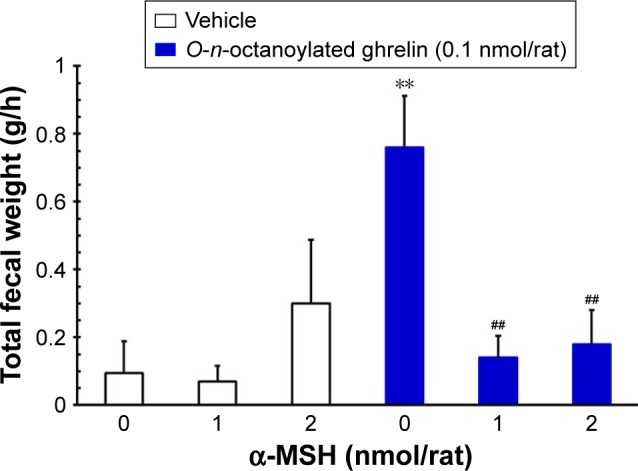
ICV injection of --octanoylated ghrelin (0.1 nmol/rat) significantly increased the cumulative food intake up to 8 h (<0.01), enhanced non-nutrient semi-liquid gastric emptying (<0.001), increased the geometric center and running percentage of small intestinal transit (<0.001), accelerated colonic transit time (<0.05), and increased fecal pellet output (<0.01) and total fecal weight (<0.01). Pretreatment with ICV injection of α-MSH (1.0 and 2.0 nmol/rat) attenuated the acyl ghrelin-induced hyperphagic effect, fecal pellet output, and total fecal weight, while higher dose of α-MSH (2.0 nmol/rat) attenuated the increase in the geometric center of small intestinal transit (<0.01). However, neither dose of α-MSH altered acyl ghrelin-stimulated gastroprokinetic effect, increase in the running percentage of small intestinal transit, nor accelerated colonic transit time.
α-MSH is involved in central acyl ghrelin-elicited feeding, small intestinal transit, fecal pellet output, and fecal weight. α-MSH does not affect central acyl ghrelin-induced acceleration of gastric emptying and colonic transit time in rats.
酰基胃饥饿素诱导的进食依赖于下丘脑神经肽Y和刺鼠相关蛋白(AgRP)神经递质。脑室内(ICV)注射AgRP通过对黑皮质素受体的竞争性拮抗作用增加进食。ICV给予α-黑素细胞刺激激素(α-MSH),一种AgRP的天然拮抗剂,可能调节酰基胃饥饿素诱导的促食作用。
本研究旨在探讨α-MSH对大鼠中枢酰基胃饥饿素诱导的食物摄入、胃肠动力和结肠分泌的调节作用。
我们通过慢性植入ICV导管,研究了α-MSH和酰基胃饥饿素对清醒大鼠的食物摄入、胃排空、小肠转运、结肠动力和分泌的影响。
ICV注射辛酰化胃饥饿素(0.1 nmol/只大鼠)显著增加8小时内的累积食物摄入量(<0.01),增强非营养性半液体胃排空(<0.001),增加小肠转运的几何中心和运行百分比(<0.001),加速结肠转运时间(<0.05),并增加粪便颗粒输出(<0.01)和粪便总重量(<0.01)。ICV注射α-MSH(1.0和2.0 nmol/只大鼠)预处理减弱了酰基胃饥饿素诱导的贪食效应、粪便颗粒输出和粪便总重量,而较高剂量的α-MSH(2.0 nmol/只大鼠)减弱了小肠转运几何中心的增加(<0.01)。然而,两种剂量的α-MSH均未改变酰基胃饥饿素刺激的胃促动力作用、小肠转运运行百分比的增加,也未加速结肠转运时间。
α-MSH参与中枢酰基胃饥饿素引起的进食、小肠转运、粪便颗粒输出和粪便重量。α-MSH不影响中枢酰基胃饥饿素诱导的大鼠胃排空加速和结肠转运时间。