Li Juan, Verhaar Auke P, Pan Qiuwei, de Knegt Robert Jacobus, Peppelenbosch Maikel P
Erasmus MC Cancer Institute, Erasmus MC - University Medical Center Rotterdam, Rotterdam, the Netherlands.
Clin Exp Gastroenterol. 2017 Aug 11;10:203-209. doi: 10.2147/CEG.S135526. eCollection 2017.
Caspase-cleaved cytokeratin 18 (CK18-Asp396) is a potential clinically useful biomarker in liver disease as it is released from hepatocytes during apoptosis. In this study, we investigated serum CK18-Asp396 levels in chronic hepatitis B (CHB).
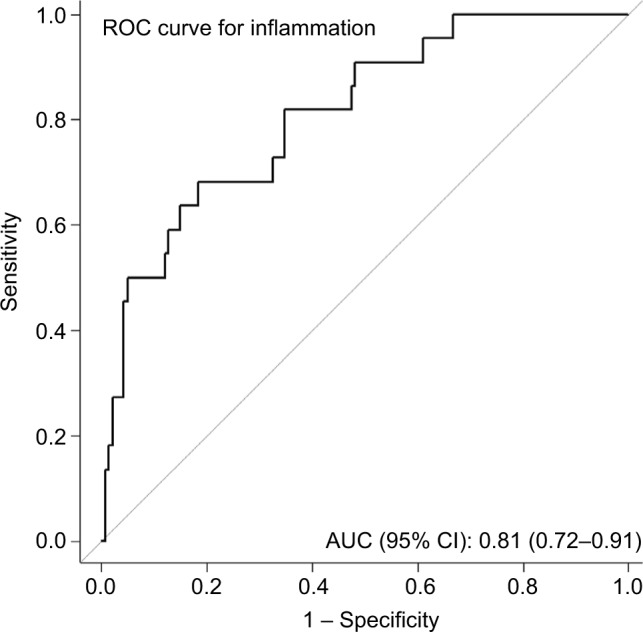
Overall, 163 patients with CHB were included. Serum CK18-Asp396 levels were determined by enzyme-linked immunosorbent assay (ELISA), and results were related to steatosis grade, histological activity index, inflammation score, and METAVIR fibrosis grade as well as to viral load, serum levels of liver enzymes, and albumin. Receiver operating characteristic analysis was used to evaluate the diagnostic performance of serum CK18-Asp396 levels for assessing disease activity.
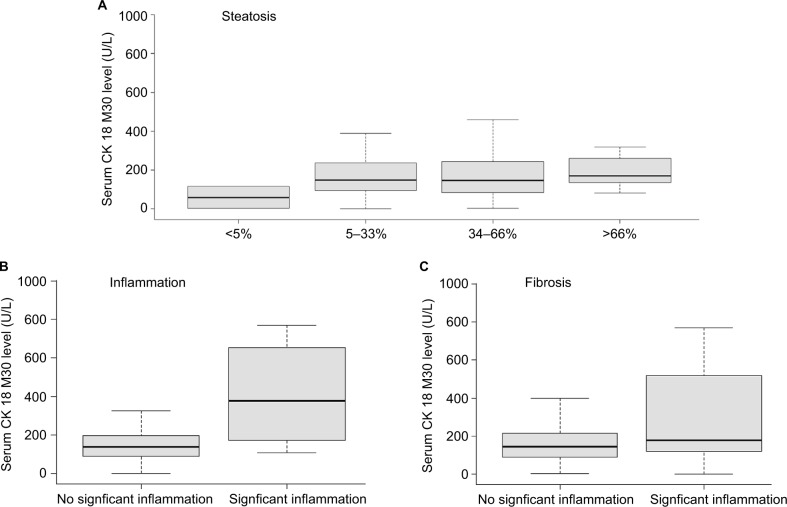
A higher level of serum CK 18 concentrations was found in patients with significant inflammation vs no significant inflammation (378.5 [interquartile range {IQR}: 173.2-629.6] vs 137.3 [87.5-197.7], < 0.05; approximately threefold increase) and in patients with significant fibrosis vs no significant fibrosis (177.8 [IQR: 120.8-519.1] vs 142.7 [IQR: 88.8-214.4], < 0.05; 1.25-fold increase). There was no differential CK 18 level by degree of steatosis. CK 18 was an independent predictor of significant inflammation with an 82% specificity and a 94% negative predictive value. We found the strongest correlation of CK 18 with alanine aminotransferase and aspartate aminotransferase (both = 0.52; < 0.001), but less with albumin ( = -0.24; < 0.05) and viral load (log) ( = 0.19; < 0.05).
CHB appears to be accompanied by continuous high levels of hepatocyte apoptosis as judged from serum CK 18, suggesting that elimination of the infected compartment constitutes a defensive strategy against disease. Accordingly, CK 18 works as an independent predictor of significant inflammation with a high specificity.
半胱天冬酶切割的细胞角蛋白18(CK18-Asp396)是一种潜在的在肝病临床中有用的生物标志物,因为它在细胞凋亡过程中从肝细胞释放出来。在本研究中,我们调查了慢性乙型肝炎(CHB)患者血清CK18-Asp396水平。
总共纳入了163例CHB患者。通过酶联免疫吸附测定(ELISA)测定血清CK18-Asp396水平,并将结果与脂肪变性分级、组织学活动指数、炎症评分、METAVIR纤维化分级以及病毒载量、肝酶血清水平和白蛋白相关联。采用受试者工作特征分析来评估血清CK18-Asp396水平对评估疾病活动的诊断性能。
与无明显炎症的患者相比,有明显炎症的患者血清CK18浓度更高(378.5[四分位数间距{IQR}:173.2 - 629.6]对137.3[87.5 - 197.7],<0.05;约增加三倍),与无明显纤维化的患者相比,有明显纤维化的患者血清CK18浓度更高(177.8[IQR:120.8 - 519.1]对142.7[IQR:88.8 - 214.4],<0.05;增加1.25倍)。CK18水平在不同程度的脂肪变性中无差异。CK18是明显炎症的独立预测因子,特异性为82%,阴性预测值为94%。我们发现CK18与丙氨酸氨基转移酶和天冬氨酸氨基转移酶的相关性最强(两者均为=0.52;<0.001),但与白蛋白(= - 0.24;<0.05)和病毒载量(对数)(=0.19;<0.05)的相关性较弱。
从血清CK18判断,CHB似乎伴有持续高水平的肝细胞凋亡,这表明清除受感染区域是一种对抗疾病的防御策略。因此,CK18作为明显炎症的独立预测因子,具有较高的特异性。