Wang Ping, Qin Danian, Wang Yu-Feng
School of Basic Medical Sciences, Harbin Medical UniversityHarbin, China.
Department of Physiology, Shantou UniversityShantou, China.
Front Mol Neurosci. 2017 Aug 15;10:262. doi: 10.3389/fnmol.2017.00262. eCollection 2017.
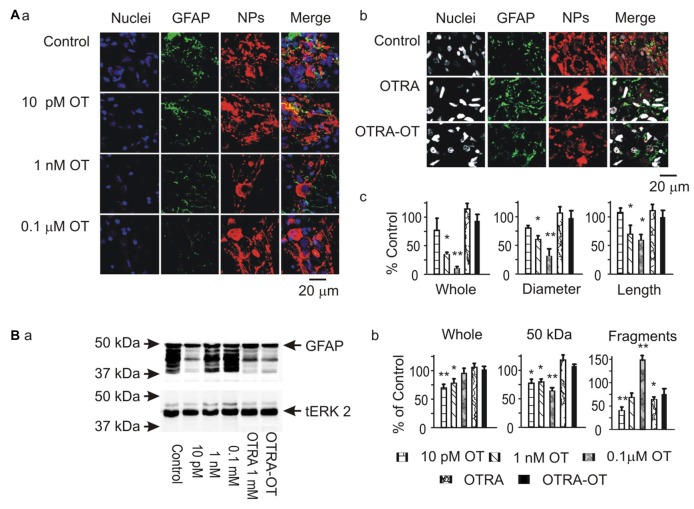
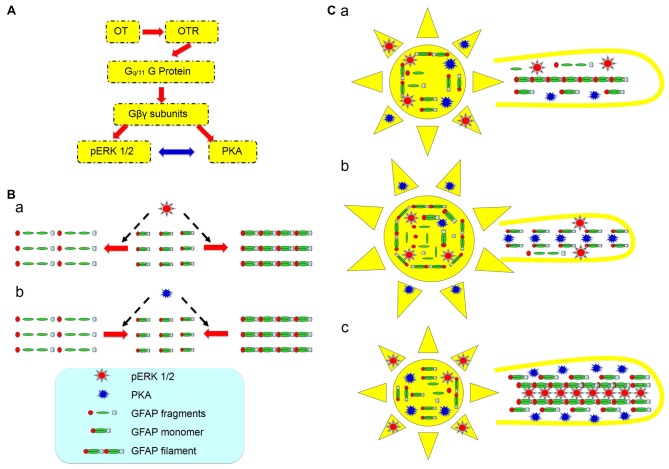
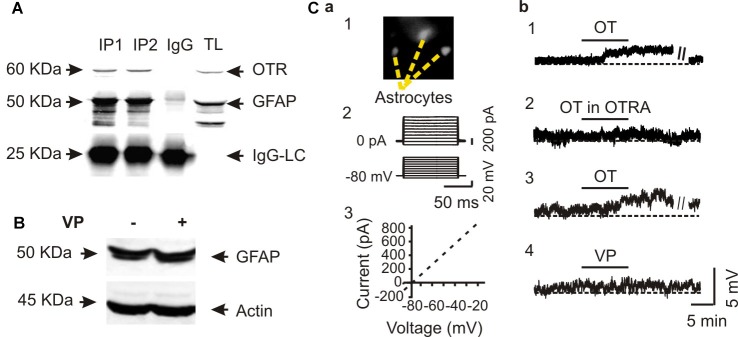
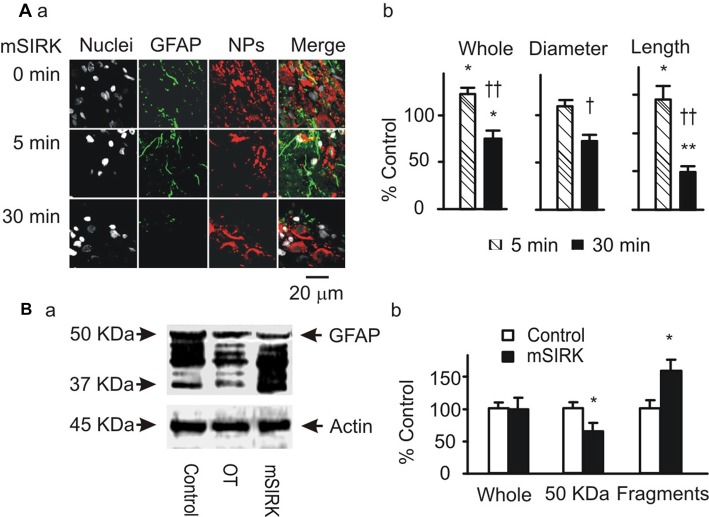
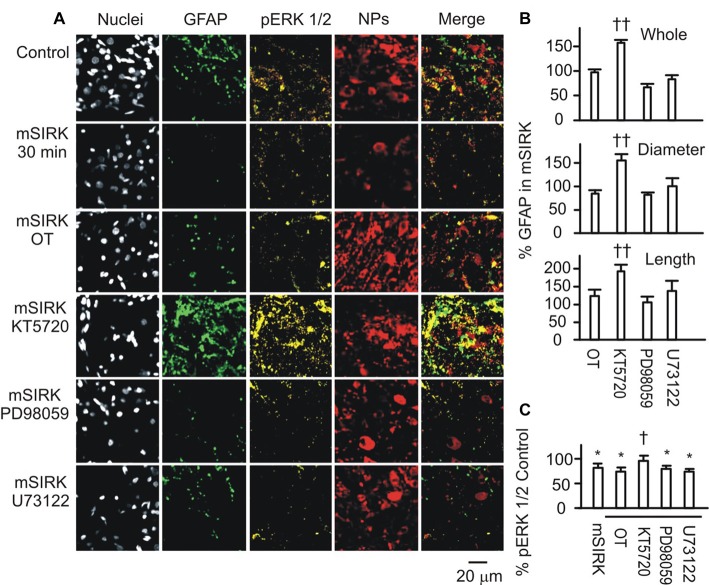
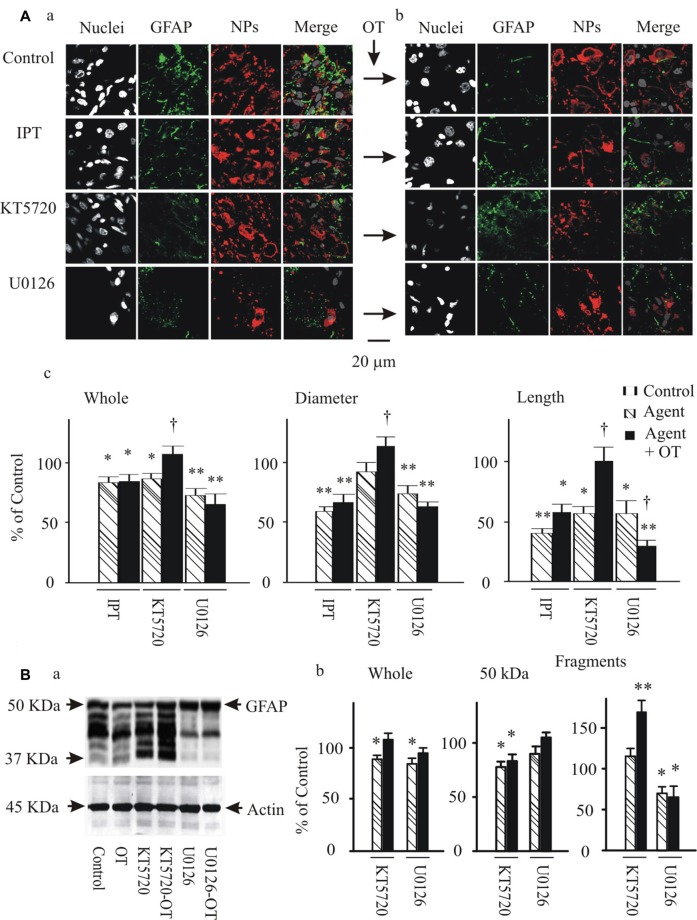
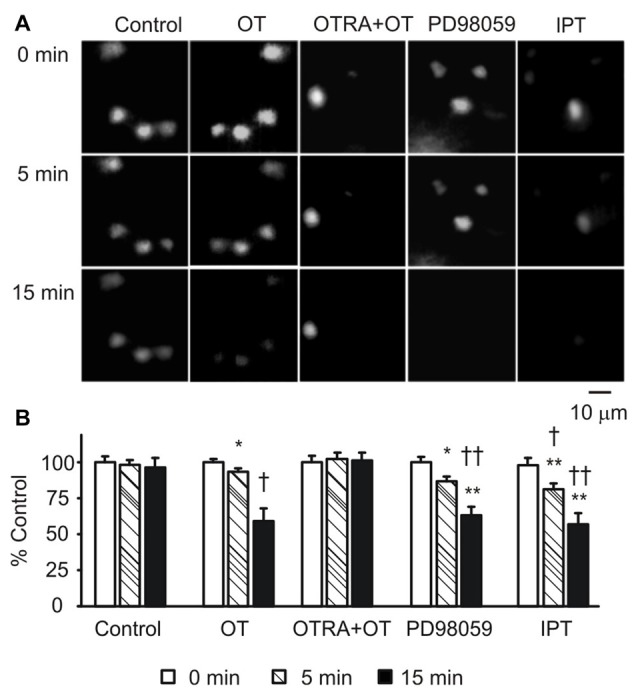
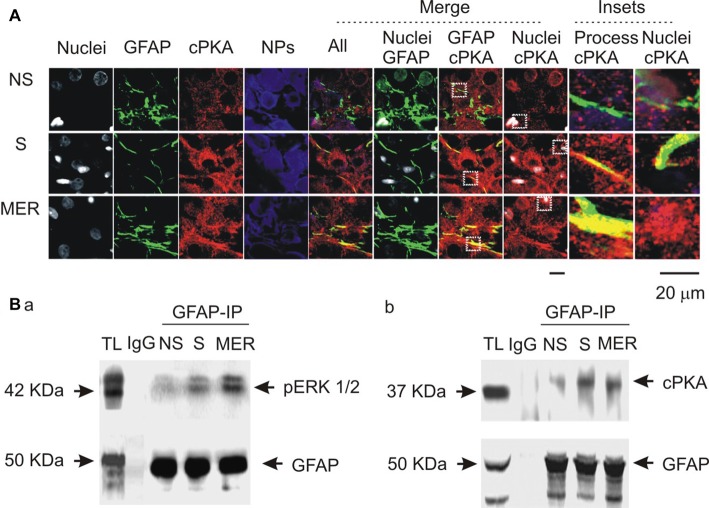
The importance of astrocytes to normal brain functions and neurological diseases has been extensively recognized; however, cellular mechanisms underlying functional and structural plasticities of astrocytes remain poorly understood. Oxytocin (OT) is a neuropeptide that can rapidly change astrocytic plasticity in association with lactation, as indicated in the expression of glial fibrillary acidic protein (GFAP) in the supraoptic nucleus (SON). Here, we used OT-evoked changes in GFAP expression in astrocytes of male rat SON as a model to explore the cellular mechanisms underlying GFAP plasticity. The results showed that OT significantly reduced the expression of GFAP filaments and proteins in SON astrocytes in brain slices. In lysates of the SON, OT receptors (OTRs) were co-immunoprecipitated with GFAP; vasopressin (VP), a neuropeptide structurally similar to OT, did not significantly change GFAP protein level; OT-evoked depolarization of astrocyte membrane potential was sensitive to a selective OTR antagonist (OTRA) but not to tetanus toxin, a blocker of synaptic transmission. The effects of OT on GFAP expression and on astrocyte uptake of Bauer-Peptide, an astrocyte-specific dye, were mimicked by isoproterenol (IPT; β-adrenoceptor agonist), U0126 or PD98059, inhibitors of extracellular signal-regulated protein kinase (ERK) 1/2 kinase and blocked by the OTRA or KT5720, a protein kinase A (PKA) inhibitor. The effect of OT on GFAP expressions and its association with these kinases were simulated by mSIRK, an activator of Gβγ subunits. Finally, suckling increased astrocytic expression of the catalytic subunit of PKA (cPKA) at astrocytic processes while increasing the molecular associations of GFAP with cPKA and phosphorylated ERK (pERK) 1/2. Upon the occurrence of the milk-ejection reflex, spatial co-localization of the cPKA with GFAP filaments further increased, which was accompanied with increased molecular association of GFAP with pERK 1/2 but not with cPKA. Thus, OT-elicited GFAP plasticity is achieved by sequential activation of ERK 1/2 and PKA via OTR signaling pathway in an antagonistic but coordinated manner.
星形胶质细胞对正常脑功能和神经疾病的重要性已得到广泛认可;然而,星形胶质细胞功能和结构可塑性的细胞机制仍知之甚少。催产素(OT)是一种神经肽,如视上核(SON)中胶质纤维酸性蛋白(GFAP)的表达所示,它可在哺乳期迅速改变星形胶质细胞的可塑性。在此,我们以OT引起的雄性大鼠SON星形胶质细胞中GFAP表达变化为模型,探讨GFAP可塑性的细胞机制。结果表明,OT显著降低了脑片中SON星形胶质细胞中GFAP丝和蛋白的表达。在SON的裂解物中,OT受体(OTRs)与GFAP进行了共免疫沉淀;血管加压素(VP),一种结构与OT相似的神经肽,并未显著改变GFAP蛋白水平;OT引起的星形胶质细胞膜电位去极化对选择性OTR拮抗剂(OTRA)敏感,但对破伤风毒素(一种突触传递阻滞剂)不敏感。异丙肾上腺素(IPT;β-肾上腺素能受体激动剂)、U0126或PD98059(细胞外信号调节蛋白激酶(ERK)1/2激酶抑制剂)模拟了OT对GFAP表达以及对星形胶质细胞摄取星形胶质细胞特异性染料鲍尔肽的影响,而这些影响被OTRA或KT5720(一种蛋白激酶A(PKA)抑制剂)阻断。mSIRK(一种Gβγ亚基激活剂)模拟了OT对GFAP表达及其与这些激酶关联的影响。最后,哺乳增加了星形胶质细胞突起处PKA催化亚基(cPKA)的星形胶质细胞表达,同时增加了GFAP与cPKA和磷酸化ERK(pERK)1/2的分子关联。在喷乳反射发生时,cPKA与GFAP丝的空间共定位进一步增加,同时伴随着GFAP与pERK 1/2而非cPKA分子关联的增加。因此,OT引发的GFAP可塑性是通过OTR信号通路以拮抗但协调的方式依次激活ERK 1/2和PKA来实现的。