Gu Yunfu, Wang Yingyan, Lu Sheng'e, Xiang Quanju, Yu Xiumei, Zhao Ke, Zou Likou, Chen Qiang, Tu Shihua, Zhang Xiaoping
Department of Microbiology, College of Resource Science and Technology, Sichuan Agricultural UniversityChengdu, China.
Soil and Fertilizer Institute, Sichuan Academy of Agricultural SciencesChengdu, China.
Front Microbiol. 2017 Aug 15;8:1516. doi: 10.3389/fmicb.2017.01516. eCollection 2017.
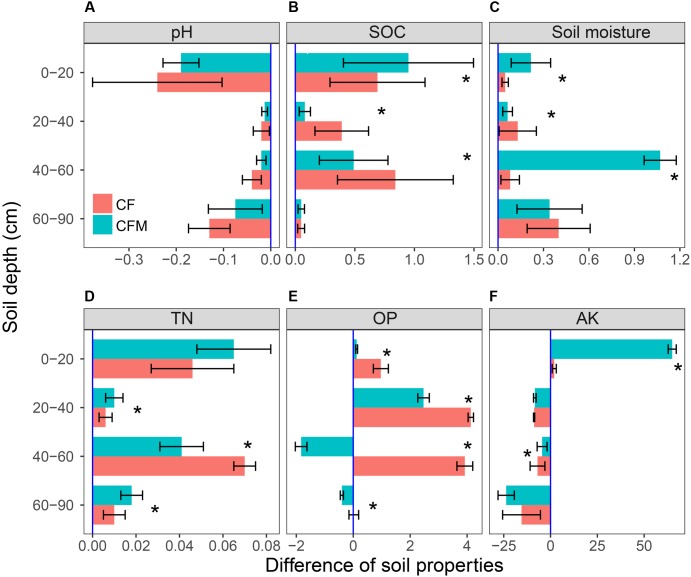
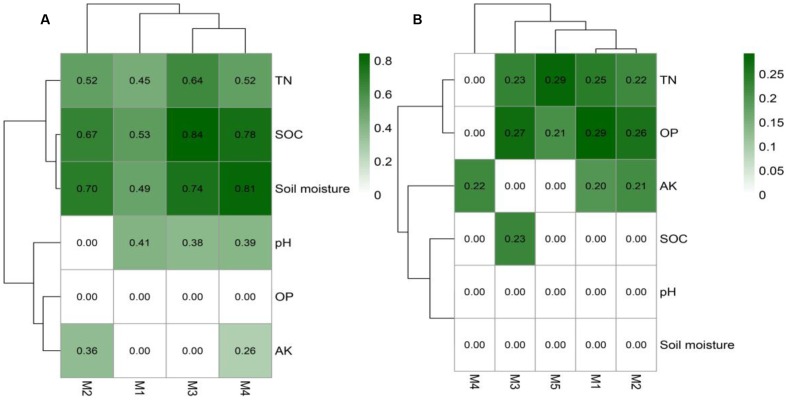
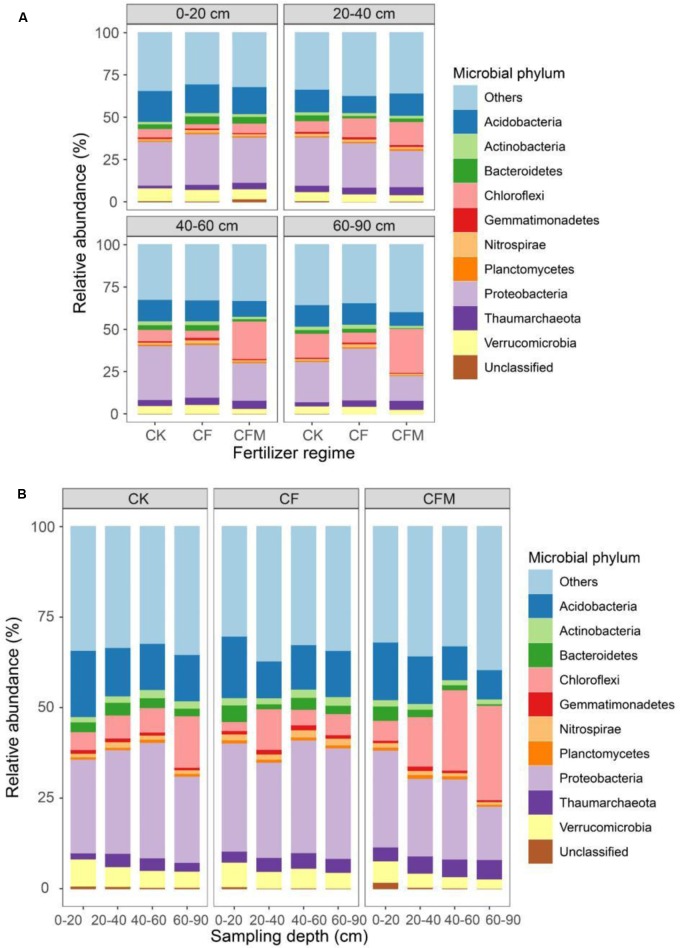
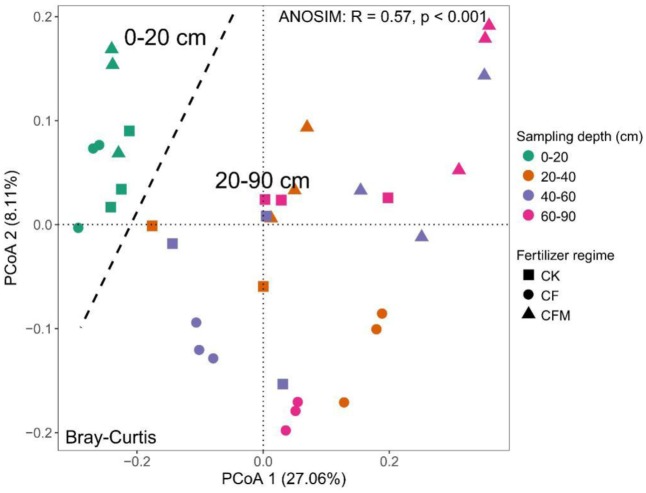
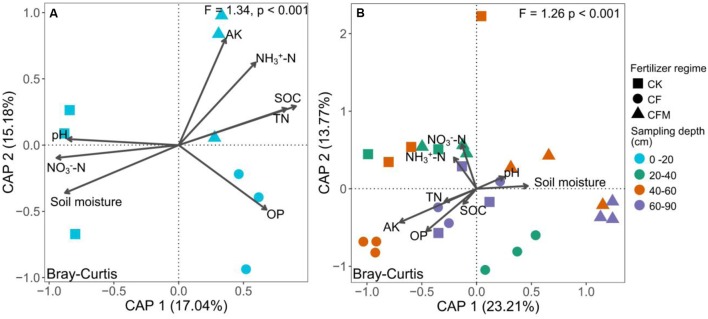
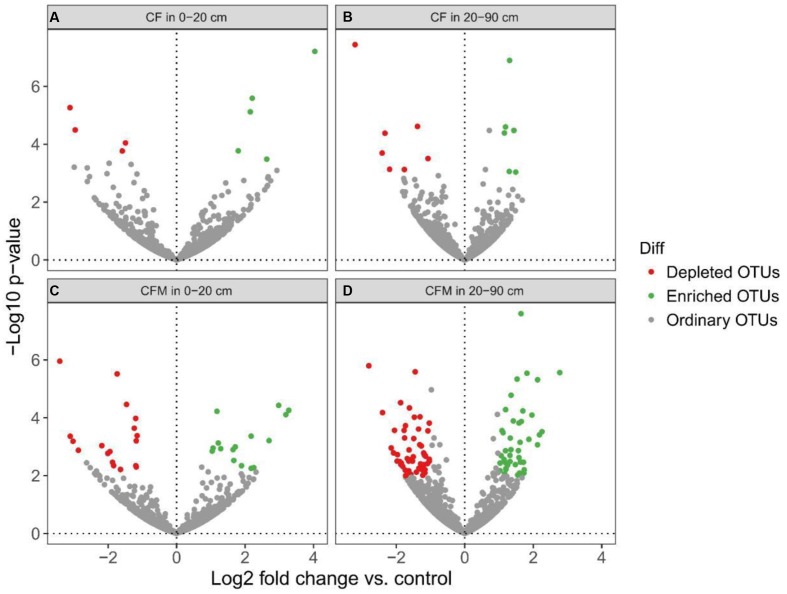
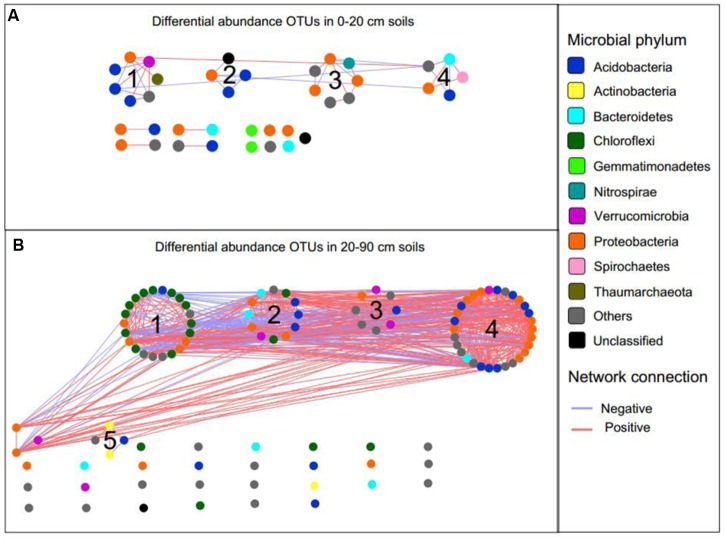
Soil microbes provide important ecosystem services. Though the effects of changes in nutrient availability due to fertilization on the soil microbial communities in the topsoil (tilled layer, 0-20 cm) have been extensively explored, the effects on communities and their associations with soil nutrients in the subsoil (below 20 cm) which is rarely impacted by tillage are still unclear. 16S rRNA gene amplicon sequencing was used to investigate bacterial and archaeal communities in a Pup-Calric-Entisol soil treated for 32 years with chemical fertilizer (CF) and CF combined with farmyard manure (CFM), and to reveal links between soil properties and specific bacterial and archaeal taxa in both the top- and subsoil. The results showed that both CF and CFM treatments increased soil organic carbon (SOC), soil moisture (MO) and total nitrogen (TN) while decreased the nitrateN content through the profile. Fertilizer applications also increased Olsen phosphorus (OP) content in most soil layers. Microbial communities in the topsoil were significantly different from those in subsoil. Compared to the CF treatment, taxa such as , , and several members of in topsoil and Subdivision 3 , , and in subsoil were substantially more abundant in CFM. A co-occurrence based network analysis demonstrated that SOC and OP were the most important soil parameters that positively correlated with specific bacterial and archaeal taxa in topsoil and subsoil, respectively. was identified as the keystone genus in the topsoil, while genera and were identified as the keystone taxa in subsoil. The taxa identified above are involved in the decomposition of complex organic compounds and soil carbon, nitrogen, and phosphorus transformations. This study revealed that the spatial variability of soil properties due to long-term fertilization strongly shapes the bacterial and archaeal community composition and their interactions at both high and low taxonomic levels across the whole soil profile.
土壤微生物提供重要的生态系统服务。尽管施肥导致的养分有效性变化对表土(耕作层,0 - 20厘米)土壤微生物群落的影响已得到广泛研究,但对很少受耕作影响的底土(20厘米以下)群落及其与土壤养分的关联影响仍不清楚。利用16S rRNA基因扩增子测序研究了在施用化肥(CF)和化肥与农家肥结合(CFM)处理32年的淡色钙层土中细菌和古菌群落,并揭示了表土和底土中土壤性质与特定细菌和古菌类群之间的联系。结果表明,CF和CFM处理均增加了土壤有机碳(SOC)、土壤湿度(MO)和总氮(TN),同时降低了整个剖面的硝态氮含量。施肥还增加了大多数土壤层的 Olsen 磷(OP)含量。表土中的微生物群落与底土中的显著不同。与CF处理相比,CFM处理下表土中的 、 、 属的几个成员以及底土中的第3亚群 、 、 的丰度显著更高。基于共现的网络分析表明,SOC和OP分别是与表土和底土中特定细菌和古菌类群呈正相关的最重要土壤参数。 被确定为表土中的关键属,而 属和 属被确定为底土中的关键类群。上述类群参与复杂有机化合物的分解以及土壤碳、氮和磷的转化。本研究表明,长期施肥导致的土壤性质空间变异性强烈影响了整个土壤剖面中高、低分类水平上细菌和古菌群落的组成及其相互作用。