Morales Paula, Goya Pilar, Jagerovic Nadine, Hernandez-Folgado Laura
Instituto de Química Médica, Consejo Superior de Investigaciones Científicas, Madrid, Spain.
Cannabis Cannabinoid Res. 2016 Jan 1;1(1):22-30. doi: 10.1089/can.2015.0005. eCollection 2016.
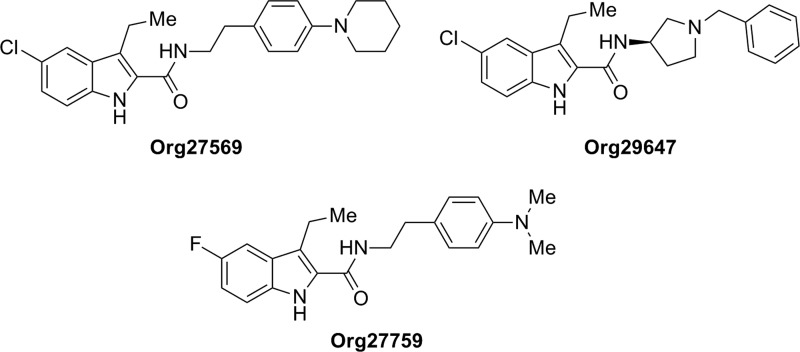
In 2005, the first evidence of an allosteric binding site at the CBR was provided by the identification of three indoles of the company Organon that were allosteric enhancers of agonist binding affinity and, functionally, allosteric inhibitors of agonist activity. Since then, structure-activity relationships of indoles as CBR modulators have been reported. Targeting the allosteric site on CBR, new families structurally based on urea and on 3-phenyltropane analogs of cocaine have been discovered as CBR-negative allosteric modulators (NAMs), respectively, by Prosidion and by the Research Triangle Park. Endogenous allosteric ligands of different nature have been identified more recently. Thus, the therapeutic neuroprotection application of lipoxin A4, an arachidonic acid derivative, as an allosteric enhancer of CBR activity has been confirmed . It was also the case of the steroid hormone, pregnenolone, whose negative allosteric effects on -tetrahydrocannabinol (-THC) were reproduced in a behavioral tetrad model and in food intake and memory impairment assays. Curiously, the peroxisome proliferator-activated receptor-γ agonist fenofibrate or polypeptides such as pepcan-12 have been shown to act on the endocannabinoid system through CBR allosteric modulation. The mechanistic bases of the effects of the phytocannabinoid cannabidiol (CBD) are still not fully explained. However, there is evidence that CBD behaves as an NAM of -THC- and 2-AG. Allosteric modulation at CBR offers new opportunities for therapeutic applications. Therefore, further understanding of the chemical features required for allosteric modulation as well as their orthosteric probe dependence may broaden novel approaches for fine-tuning the signaling pathways of the CBR.
2005年,欧加农公司鉴定出的三种吲哚提供了首个关于大麻素受体(CBR)变构结合位点的证据,这些吲哚是激动剂结合亲和力的变构增强剂,在功能上则是激动剂活性的变构抑制剂。从那时起,已有关于吲哚作为CBR调节剂的构效关系的报道。通过普罗西迪翁公司以及三角研究园分别发现,以尿素和可卡因的3-苯基托烷类似物为结构基础的新家族作为CBR负性变构调节剂(NAMs)作用于CBR的变构位点。最近还鉴定出了不同性质的内源性变构配体。因此,花生四烯酸衍生物脂氧素A4作为CBR活性的变构增强剂在治疗性神经保护中的应用已得到证实。甾体激素孕烯醇酮也是如此,其对四氢大麻酚(-THC)的负性变构作用在行为四重模型以及食物摄入和记忆损伤试验中得到了重现。奇怪的是,过氧化物酶体增殖物激活受体-γ激动剂非诺贝特或多肽如pepcan-12已被证明可通过CBR变构调节作用于内源性大麻素系统。植物大麻素大麻二酚(CBD)作用的机制基础仍未完全阐明。然而,有证据表明CBD表现为-THC和2-花生四烯酸甘油(2-AG)的NAM。CBR的变构调节为治疗应用提供了新机会。因此,进一步了解变构调节所需的化学特征及其对正构探针的依赖性,可能会拓宽微调CBR信号通路的新方法。