McPartland John M, MacDonald Christa, Young Michelle, Grant Phillip S, Furkert Daniel P, Glass Michelle
GW Pharmaceuticals, Salisbury, United Kingdom.
Department of Family Medicine, University of Vermont, Burlington, Vermont.
Cannabis Cannabinoid Res. 2017 May 1;2(1):87-95. doi: 10.1089/can.2016.0032. eCollection 2017.
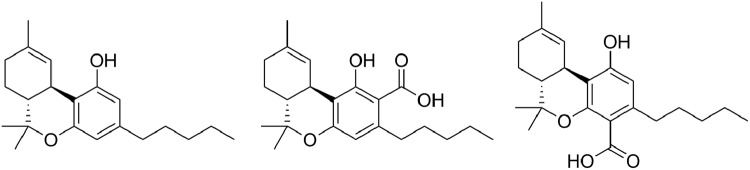
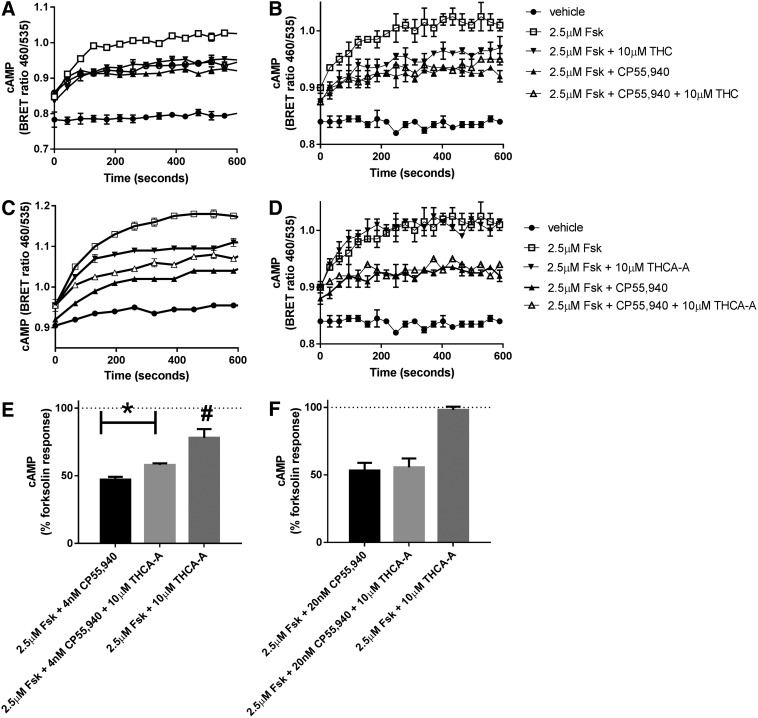
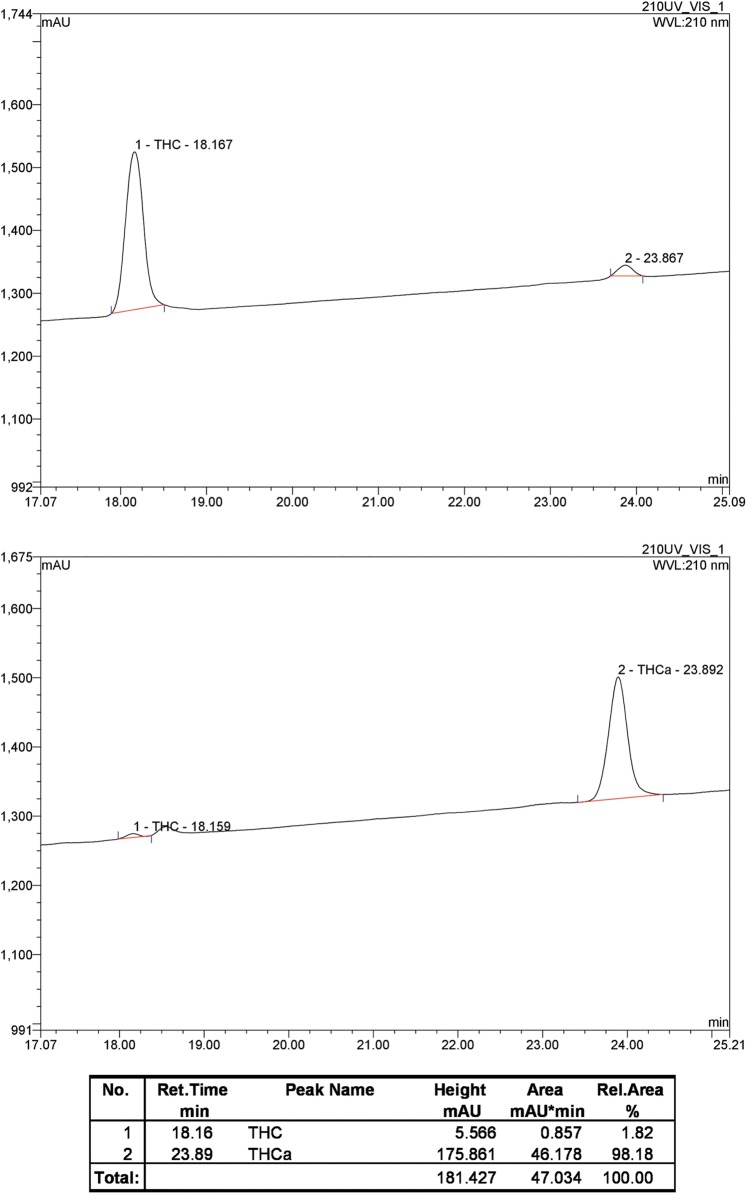
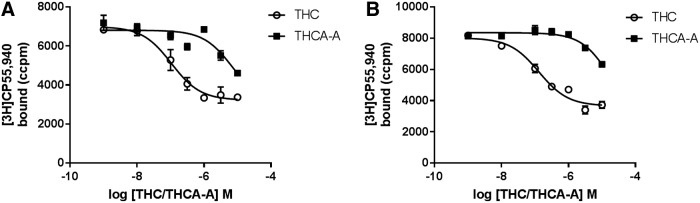
biosynthesizes Δ-tetrahydrocannabinolic acid (THCA-A), which decarboxylates into Δ-tetrahydrocannabinol (THC). There is growing interest in the therapeutic use of THCA-A, but its clinical application may be hampered by instability. THCA-A lacks cannabimimetic effects; we hypothesize that it has little binding affinity at cannabinoid receptor 1 (CB). Purity of certified reference standards were tested with high performance liquid chromatography (HPLC). Binding affinity of THCA-A and THC at human (h) CB and hCB was measured in competition binding assays, using transfected HEK cells and [H]CP55,940. Efficacy at hCB and hCB was measured in a cyclic adenosine monophosphase (cAMP) assay, using a Bioluminescence Resonance Energy Transfer (BRET) biosensor. The THCA-A reagent contained 2% THC. THCA-A displayed small but measurable binding at both hCB and hCB, equating to approximate K values of 3.1μM and 12.5μM, respectively. THC showed 62-fold greater affinity at hCB and 125-fold greater affinity at hCB. In efficacy tests, THCA-A (10μM) slightly inhibited forskolin-stimulated cAMP at hCB, suggestive of weak agonist activity, and no measurable efficacy at hCB. The presence of THC in our THCA-A certified standard agrees with decarboxylation kinetics (literature reviewed herein), which indicate contamination with THC is nearly unavoidable. THCA-A binding at 10μM approximated THC binding at 200nM. We therefore suspect some of our THCA-A binding curve was artifact-from its inevitable decarboxylation into THC-and the binding affinity of THCA-A is even weaker than our estimated values. We conclude that THCA-A has little affinity or efficacy at CB or CB.
生物合成Δ-四氢大麻酚酸(THCA-A),其脱羧后生成Δ-四氢大麻酚(THC)。人们对THCA-A的治疗用途越来越感兴趣,但其临床应用可能因不稳定性而受到阻碍。THCA-A缺乏大麻模拟效应;我们假设它在大麻素受体1(CB)上的结合亲和力很低。使用高效液相色谱(HPLC)测试了认证参考标准品的纯度。在竞争结合试验中,使用转染的HEK细胞和[H]CP55,940测量了THCA-A和THC在人(h)CB和hCB上的结合亲和力。使用生物发光共振能量转移(BRET)生物传感器,在环磷酸腺苷(cAMP)试验中测量了在hCB和hCB上的效力。THCA-A试剂含有2%的THC。THCA-A在hCB和hCB上均显示出小但可测量的结合,其近似K值分别为3.1μM和12.5μM。THC在hCB上的亲和力高62倍,在hCB上的亲和力高至125倍。在效力测试中,THCA-A(10μM)在hCB上对福司可林刺激的cAMP有轻微抑制作用,提示有弱激动剂活性,而在hCB上无可测量的效力。我们的THCA-A认证标准品中存在THC与脱羧动力学(本文综述的文献)一致,这表明被THC污染几乎不可避免。10μM时THCA-A的结合近似于200nM时THC的结合。因此,我们怀疑我们的一些THCA-A结合曲线是假象——源于其不可避免地脱羧成THC——并且THCA-A的结合亲和力甚至比我们估计的值还要弱。我们得出结论,THCA-A在CB或CB上几乎没有亲和力或效力。