Morsica Giulia, Bagaglio Sabrina, Spagnuolo Vincenzo, Castagna Antonella, Di Serio Clelia, Galli Andrea, Della Torre Liviana, Andolina Andrea, Pramov Alexander, Uberti-Foppa Caterina
Division of Infectious Diseases, IRCCS, Ospedale San Raffaele, Milan, Italy.
Vita-Salute San Raffaele University, Milan, Italy.
PLoS One. 2017 Sep 1;12(9):e0184128. doi: 10.1371/journal.pone.0184128. eCollection 2017.
Antibodies against hepatitis B core antigen (anti-HBc) are found in 14-44% of patients with HIV infection, but it is still unclear whether hepatitis B virus (HBV) vaccination should be recommended for HIV-positive subjects with isolated anti-HBc (IAHBc). We examined the rate of anamnestic and primary responses (ARs and PRs) and associated factors in a group of HIV-infected patients with an IAHBc profile.
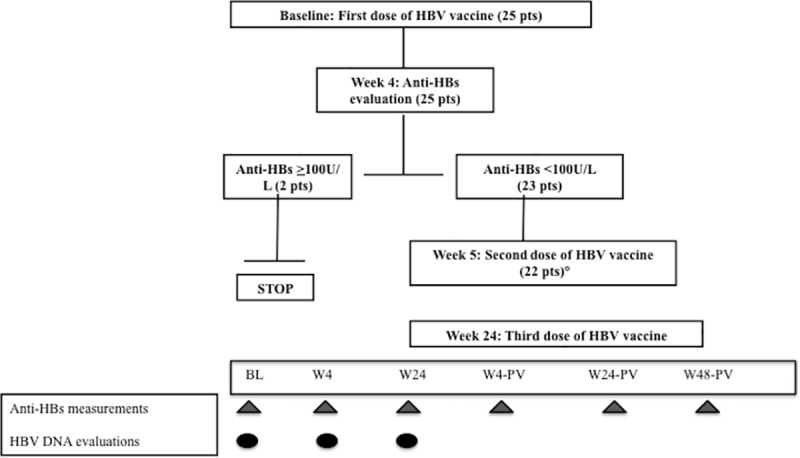
This prospective study recruited 25 HIV-positive patients with anti-HBc alone who were vaccinated against HBV infection. Those without an AR (anti-hepatitis B envelope antigen [anti-HBs] levels of <10 U/L) or who were hypo-responsiveness (anti-HBs levels of >10 but <100 U/L) four weeks after the first dose of vaccine underwent a full course of vaccinations. Their clinical and virological data, including the presence of occult hepatitis B infection (OBI), were evaluated in accordance with the vaccination schedule.
Six of the 25 patients (24%) showed an AR, four of whom had anti-HBs levels of <100 U/L. Ten of 19 (52.6%) remaining patients became seroprotected after the third dose. OBI was detected in four of the six patients with an AR, two of the 10 patients with a PR, and none of the nine patients who did not respond. Multivariate analysis showed that an AR was associated with the presence of OBI (P = 0.0162), and a PR was associated with HCV antibody status. (P = 0.0191).
Our data suggest that testing for anti-HBc alone may not be a reliable means of assessing protection from HBV infection in HIV-positive patients. OBI-positive patients may benefit from a single vaccine dose. Anti-HCV serostatus may affect PRs.
在14% - 44%的HIV感染患者中可检测到抗乙肝核心抗原抗体(抗-HBc),但对于单纯抗-HBc(IAHBc)的HIV阳性受试者是否应推荐接种乙肝病毒(HBV)疫苗仍不明确。我们研究了一组IAHBc型HIV感染患者的回忆反应和初次反应率(ARs和PRs)及相关因素。
这项前瞻性研究招募了25例仅抗-HBc阳性的HIV阳性患者,对其进行HBV感染疫苗接种。首剂疫苗接种四周后无回忆反应(抗乙肝表面抗原[抗-HBs]水平<10 U/L)或反应低下(抗-HBs水平>10但<100 U/L)的患者接受全程疫苗接种。根据疫苗接种计划评估他们的临床和病毒学数据,包括隐匿性乙肝感染(OBI)情况。
25例患者中有6例(24%)出现回忆反应,其中4例抗-HBs水平<100 U/L。其余19例患者中有10例(52.6%)在第三剂疫苗接种后获得血清保护。6例有回忆反应的患者中有4例检测到OBI,10例有初次反应的患者中有2例检测到OBI,9例无反应的患者中未检测到OBI。多因素分析显示,回忆反应与OBI的存在相关(P = 0.0162),初次反应与丙肝抗体状态相关(P = 0.0191)。
我们的数据表明,仅检测抗-HBc可能不是评估HIV阳性患者对HBV感染保护情况的可靠方法。OBI阳性患者可能从单剂疫苗接种中获益。抗-HCV血清状态可能影响初次反应。