Strom Tobin, Harrison Louis B, Giuliano Anna R, Schell Michael J, Eschrich Steven A, Berglund Anders, Fulp William, Thapa Ram, Coppola Domenico, Kim Sungjune, Frakes Jessica, Foekens John, Mulé James J, Torres-Roca Javier F
Department of Radiation Oncology, H. Lee Moffitt Cancer Center and Research Institute, Tampa, FL, USA.
Center for Infection Research in Cancer, H. Lee Moffitt Cancer Center and Research Institute, Tampa, FL, USA.
Eur J Cancer. 2017 Oct;84:304-314. doi: 10.1016/j.ejca.2017.08.001. Epub 2017 Aug 29.
Our goal was to determine whether tumour radiosensitivity is associated with activation of the immune system across all tumour types as measured by two gene expression signatures (GESs).
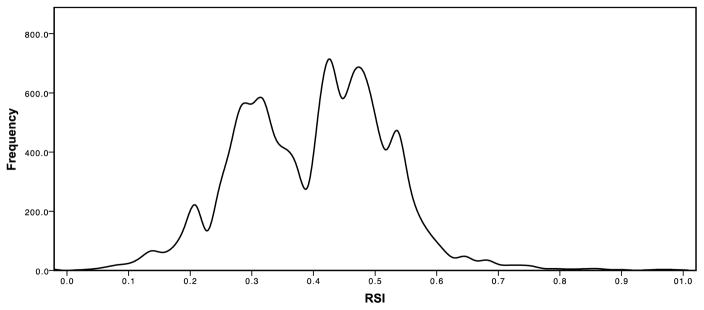
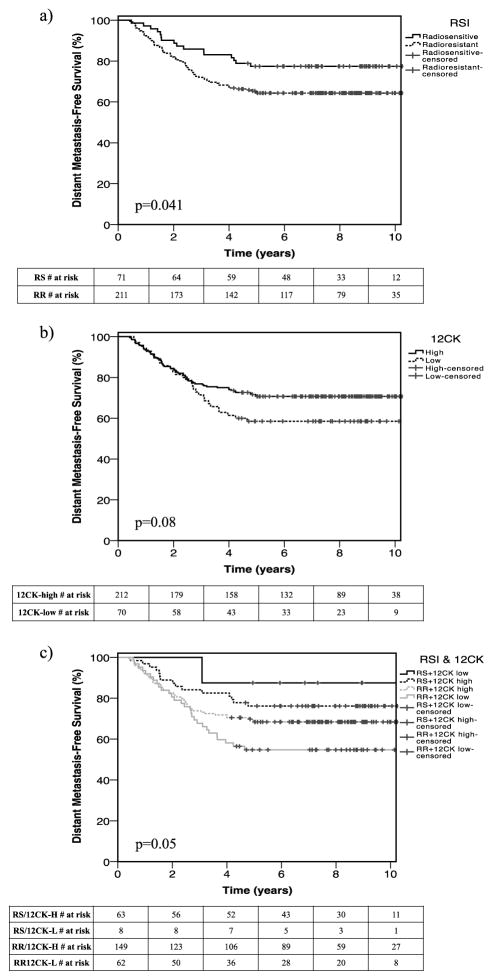
We identified 10,240 genomically profiled distinct solid primary tumours with gene expression analysis available from an institutional de-identified database. Two separate GESs were included in the analysis, the radiosensitivity index (RSI) GES (a 10-gene GES as a measure of radiosensitivity) and the 12-chemokine (12-CK) signature (a 12-gene GES as a measure of immune activation). We tested whether the RSI and 12-CK were associated with each other across all tumour samples and, in an exploratory analysis, their prognostic significance in predicting distant metastasis-free survival (DMFS) among a well-characterised, independent cohort of 282 early-stage breast cancer cases treated with surgery and post-operative radiation alone without systemic therapy. The lower the RSI score, the higher the tumour radiosensitivity; whereas, the higher the 12-CK score the higher the immune activation.
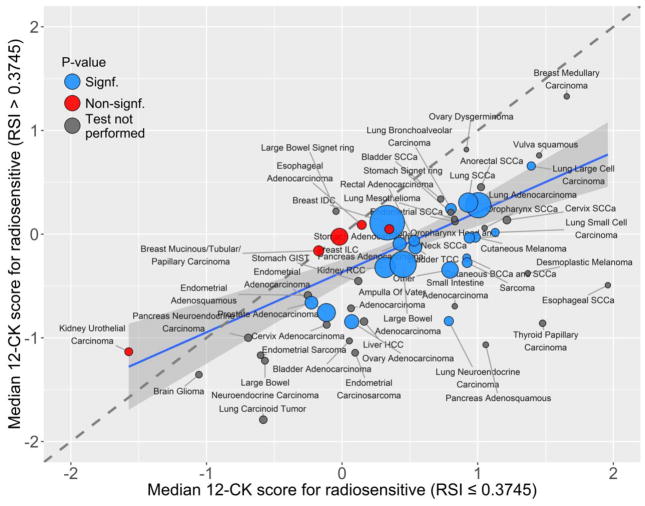
Using an RSI cut-point of ≤0.3745, RSI-low tumours (n = 4,291, 41.9%) had a significantly higher median 12-CK GES value (0.54 [-0.136, 1.095]) compared with RSI-high tumours (-0.17 [-0.82, 0.42]; p < 0.001) across all tumour samples, indicating that radiosensitivity is associated with immune activation. In an exploratory analysis of early-stage breast cancer cases, a multivariable model with patient age, RSI and 12-CK provided a strong composite model for DMFS (p = 0.02), with RSI (hazard ratio [HR] 0.63 [95% confidence interval 0.36, 1.09]) and 12-CK (HR 0.66 [0.41, 1.04]) each providing comparable contributions.
Tumour radiosensitivity is associated with immune activation as measured by the two GESs.
我们的目标是通过两种基因表达特征(GES)来确定肿瘤放射敏感性是否与所有肿瘤类型的免疫系统激活相关。
我们从一个机构去识别化数据库中,通过基因表达分析确定了10240个具有基因组特征的不同实体原发性肿瘤。分析中纳入了两个独立的GES,放射敏感性指数(RSI)GES(一个由10个基因组成的GES,作为放射敏感性的度量)和12-趋化因子(12-CK)特征(一个由12个基因组成的GES,作为免疫激活的度量)。我们测试了RSI和12-CK在所有肿瘤样本中是否相互关联,并在一项探索性分析中,检验了它们在预测282例仅接受手术和术后放疗而未接受全身治疗的特征明确的独立早期乳腺癌病例的无远处转移生存期(DMFS)方面的预后意义。RSI分数越低,肿瘤放射敏感性越高;而12-CK分数越高,免疫激活越高。
使用RSI切点≤0.3745,在所有肿瘤样本中,RSI低的肿瘤(n = 4291,41.9%)的12-CK GES中值(0.54 [-0.136, 1.095])显著高于RSI高的肿瘤(-0.17 [-0.82, 0.42];p < 0.001),表明放射敏感性与免疫激活相关。在早期乳腺癌病例的探索性分析中,一个包含患者年龄、RSI和12-CK的多变量模型为DMFS提供了一个强大的综合模型(p = 0.02),RSI(风险比[HR] 为0.63 [95%置信区间0.36, 1.09])和12-CK(HR为0.66 [0.41, 1.04])各自提供了相当的贡献。
通过这两种GES测量,肿瘤放射敏感性与免疫激活相关。