Department of Bioinformatics, H Lee Moffitt Cancer Center, Tampa, Florida 33612, USA.
Clin Cancer Res. 2012 Sep 15;18(18):5134-43. doi: 10.1158/1078-0432.CCR-12-0891. Epub 2012 Jul 25.
Previously, we developed a radiosensitivity molecular signature [radiosensitivity index (RSI)] that was clinically validated in 3 independent datasets (rectal, esophageal, and head and neck) in 118 patients. Here, we test RSI in radiotherapy (RT)-treated breast cancer patients.
RSI was tested in 2 previously published breast cancer datasets. Patients were treated at the Karolinska University Hospital (n = 159) and Erasmus Medical Center (n = 344). RSI was applied as previously described.
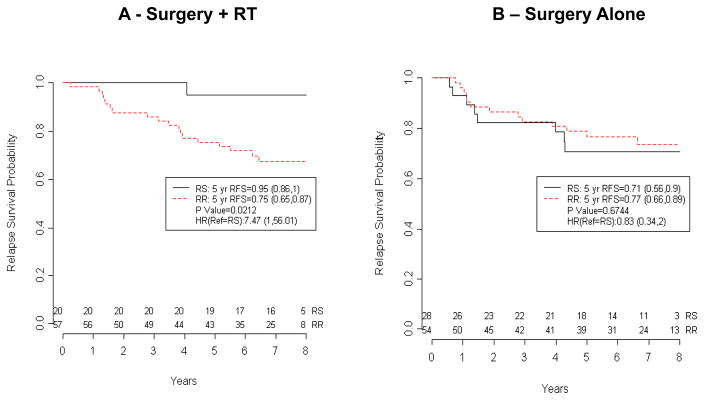
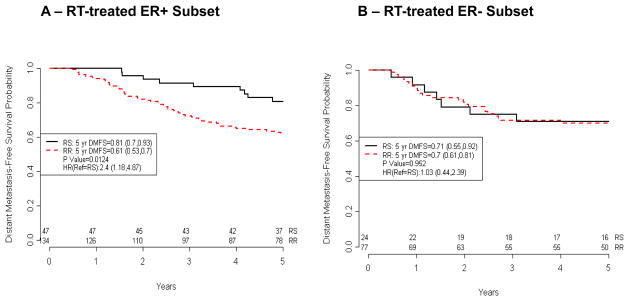
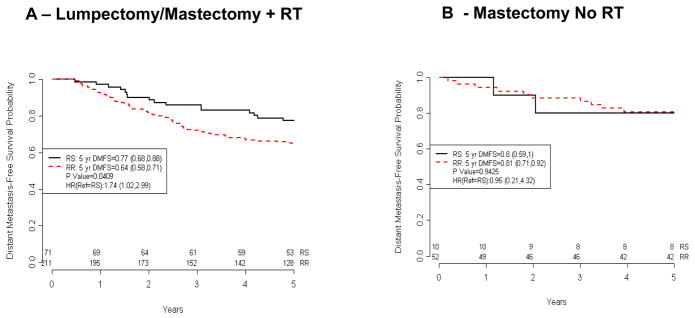
We tested RSI in RT-treated patients (Karolinska). Patients predicted to be radiosensitive (RS) had an improved 5-year relapse-free survival when compared with radioresistant (RR) patients (95% vs. 75%, P = 0.0212), but there was no difference between RS/RR patients treated without RT (71% vs. 77%, P = 0.6744), consistent with RSI being RT-specific (interaction term RSI × RT, P = 0.05). Similarly, in the Erasmus dataset, RT-treated RS patients had an improved 5-year distant metastasis-free survival over RR patients (77% vs. 64%, P = 0.0409), but no difference was observed in patients treated without RT (RS vs. RR, 80% vs. 81%, P = 0.9425). Multivariable analysis showed RSI is the strongest variable in RT-treated patients (Karolinska, HR = 5.53, P = 0.0987, Erasmus, HR = 1.64, P = 0.0758) and in backward selection (removal α of 0.10), RSI was the only variable remaining in the final model. Finally, RSI is an independent predictor of outcome in RT-treated ER(+) patients (Erasmus, multivariable analysis, HR = 2.64, P = 0.0085).
RSI is validated in 2 independent breast cancer datasets totaling 503 patients. Including prior data, RSI is validated in 5 independent cohorts (621 patients) and represents, to our knowledge, the most extensively validated molecular signature in radiation oncology.
此前,我们开发了一种放射敏感性分子标志物[放射敏感性指数(RSI)],并在 3 个独立数据集(直肠、食管和头颈部)的 118 名患者中进行了临床验证。在此,我们在接受放射治疗(RT)的乳腺癌患者中测试 RSI。
我们在两个先前发表的乳腺癌数据集中测试了 RSI。患者在卡罗林斯卡大学医院(n = 159)和伊拉斯谟医疗中心(n = 344)接受治疗。RSI 是按照之前的描述进行应用的。
我们在接受 RT 治疗的患者(卡罗林斯卡)中测试了 RSI。与放射性抵抗(RR)患者相比,预测为放射敏感(RS)的患者 5 年无复发生存率得到改善(95%比 75%,P = 0.0212),但在未接受 RT 治疗的 RS/RR 患者中没有差异(71%比 77%,P = 0.6744),这与 RSI 是 RT 特异性的一致(RSI×RT 交互项,P = 0.05)。同样,在伊拉斯谟数据集,接受 RT 治疗的 RS 患者的 5 年远处无转移生存率优于 RR 患者(77%比 64%,P = 0.0409),但在未接受 RT 治疗的患者中没有差异(RS 比 RR,80%比 81%,P = 0.9425)。多变量分析显示,RSI 是 RT 治疗患者(卡罗林斯卡,HR = 5.53,P = 0.0987;伊拉斯谟,HR = 1.64,P = 0.0758)中最强的变量,并且在向后选择(去除 α = 0.10)中,RSI 是最终模型中唯一保留的变量。最后,RSI 是 RT 治疗的 ER(+)患者结局的独立预测因子(伊拉斯谟,多变量分析,HR = 2.64,P = 0.0085)。
RSI 在 2 个独立的乳腺癌数据集(共 503 名患者)中得到验证。包括先前的数据,RSI 在 5 个独立队列(621 名患者)中得到验证,据我们所知,它是放射肿瘤学中得到最广泛验证的分子标志物。