Department of Medicine, University of Ottawa, Ottawa, ON, Canada.
Bruyère Research Institute (BRI), Ottawa, ON, Canada.
Drugs. 2017 Oct;77(15):1623-1643. doi: 10.1007/s40265-017-0804-3.
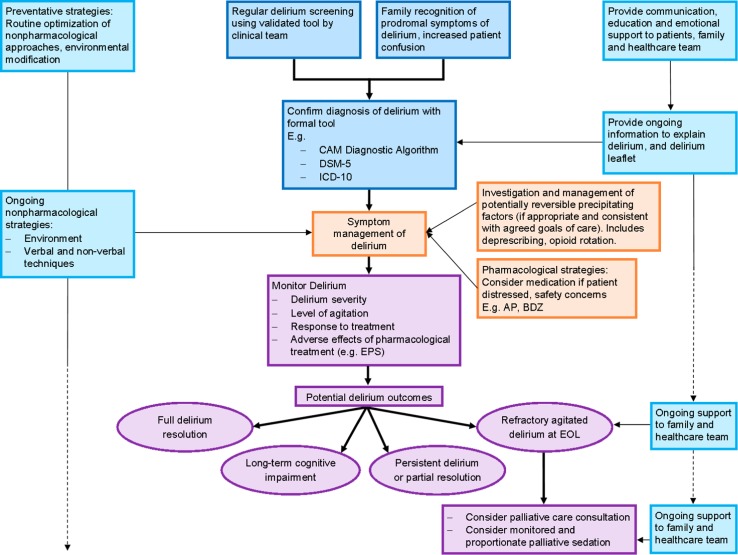
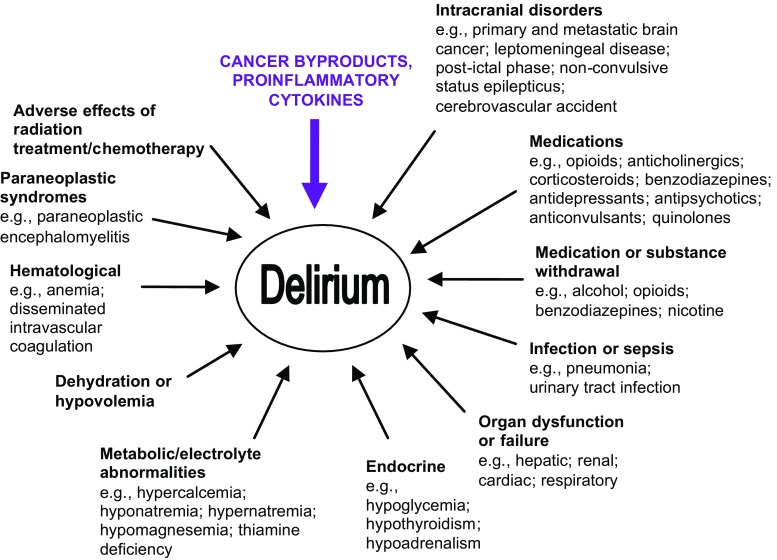
Delirium is a neurocognitive syndrome arising from acute global brain dysfunction, and is prevalent in up to 42% of patients admitted to palliative care inpatient units. The symptoms of delirium and its associated communicative impediment invariably generate high levels of patient and family distress. Furthermore, delirium is associated with significant patient morbidity and increased mortality in many patient populations, especially palliative care where refractory delirium is common in the dying phase. As the clinical diagnosis of delirium is frequently missed by the healthcare team, the case for regular screening is arguably very compelling. Depending on its precipitating factors, a delirium episode is often reversible, especially in the earlier stages of a life-threatening illness. Until recently, antipsychotics have played a pivotal role in delirium management, but this role now requires critical re-evaluation in light of recent research that failed to demonstrate their efficacy in mild- to moderate-severity delirium occurring in palliative care patients. Non-pharmacological strategies for the management of delirium play a fundamental role and should be optimized through the collective efforts of the whole interprofessional team. Refractory agitated delirium in the last days or weeks of life may require the use of pharmacological sedation to ameliorate the distress of patients, which is invariably juxtaposed with increasing distress of family members. Further evaluation of multicomponent strategies for delirium prevention and treatment in the palliative care patient population is urgently required.
谵妄是一种由急性全脑功能障碍引起的神经认知综合征,在入住姑息治疗住院病房的患者中,高达 42%的患者患有谵妄。谵妄的症状及其相关的交流障碍不可避免地给患者和家属带来高度的痛苦。此外,在许多患者群体中,谵妄与患者发病率显著增加和死亡率增加有关,特别是在姑息治疗中,临终阶段经常出现难治性谵妄。由于医疗团队经常错过谵妄的临床诊断,因此定期进行筛查的理由可以说是非常充分的。根据诱发因素的不同,谵妄发作通常是可以逆转的,尤其是在危及生命的疾病的早期阶段。直到最近,抗精神病药在谵妄管理中发挥了关键作用,但鉴于最近的研究未能证明它们在姑息治疗患者中轻度至中度严重程度的谵妄中的疗效,这种作用现在需要进行批判性评估。非药物治疗策略在谵妄管理中起着至关重要的作用,应通过整个多专业团队的共同努力进行优化。在生命的最后几天或几周出现难治性激越性谵妄时,可能需要使用药物镇静来减轻患者的痛苦,这不可避免地会给家属带来更大的痛苦。迫切需要进一步评估姑息治疗患者人群中预防和治疗谵妄的多组分策略。