Key Laboratory of Food Nutrition and Safety, Ministry of Education of China, Tianjin University of Science and Technology, Tianjin 300457, China.
Sensors (Basel). 2017 Aug 30;17(9):1984. doi: 10.3390/s17091984.
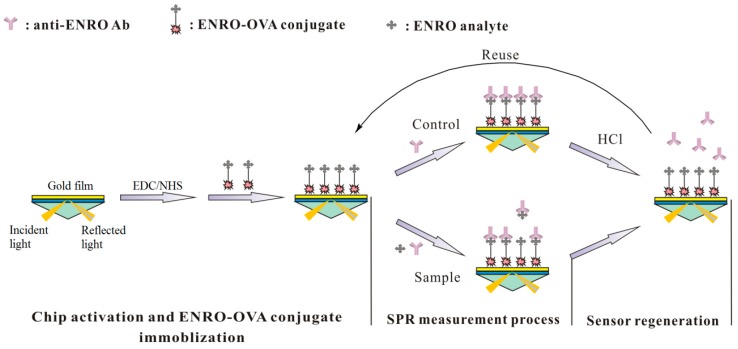
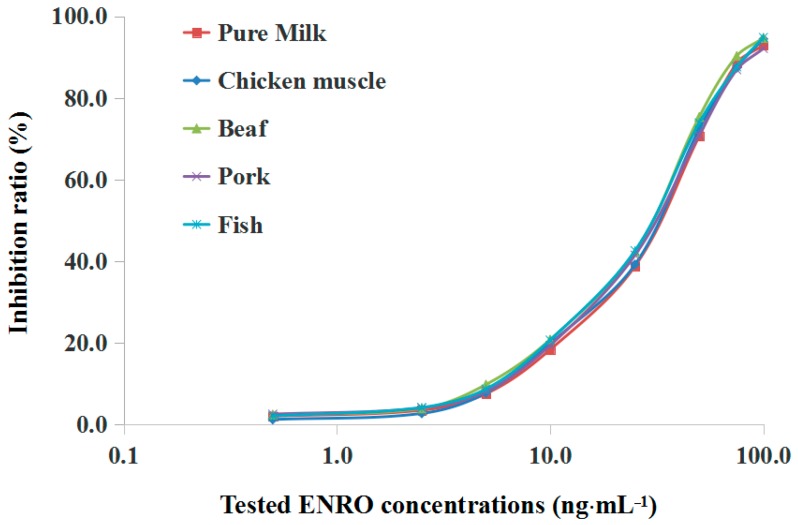
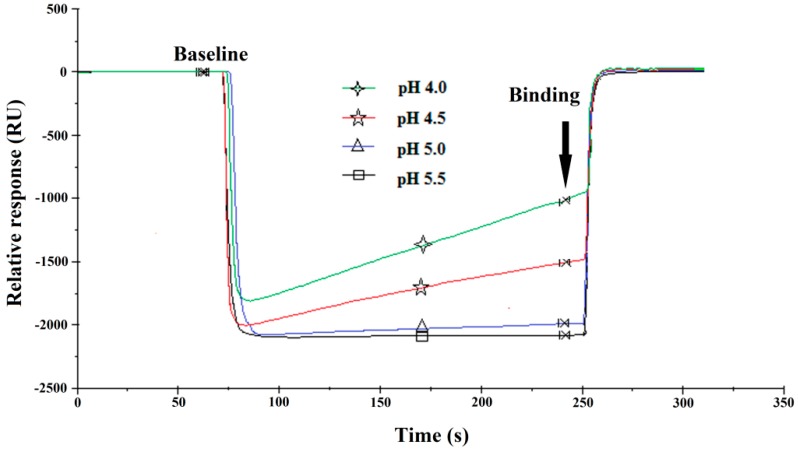
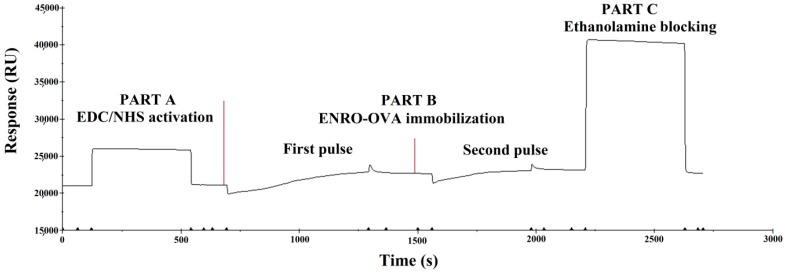
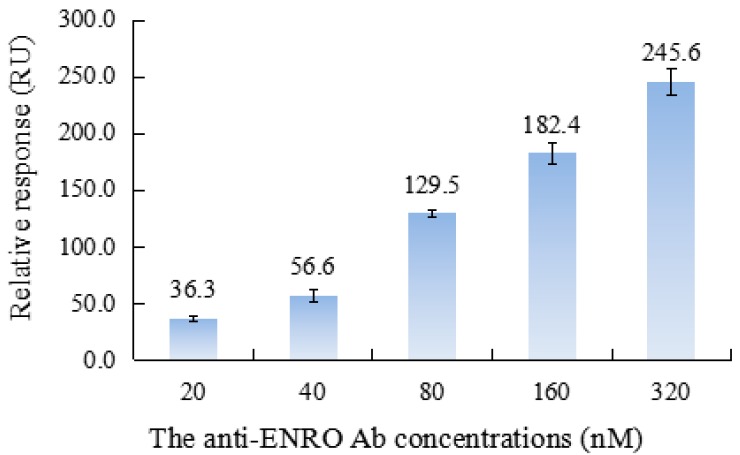
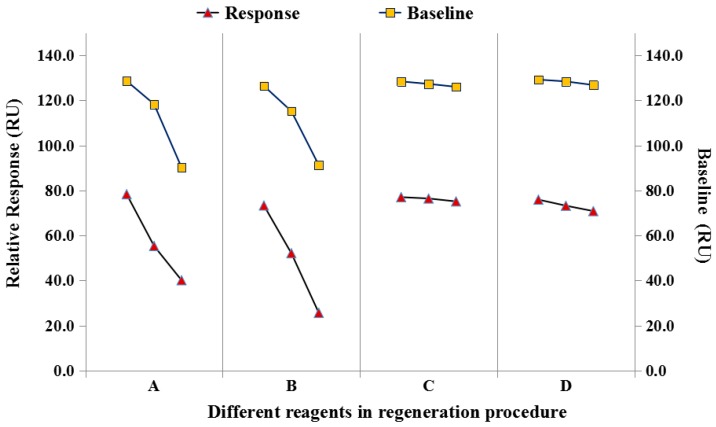
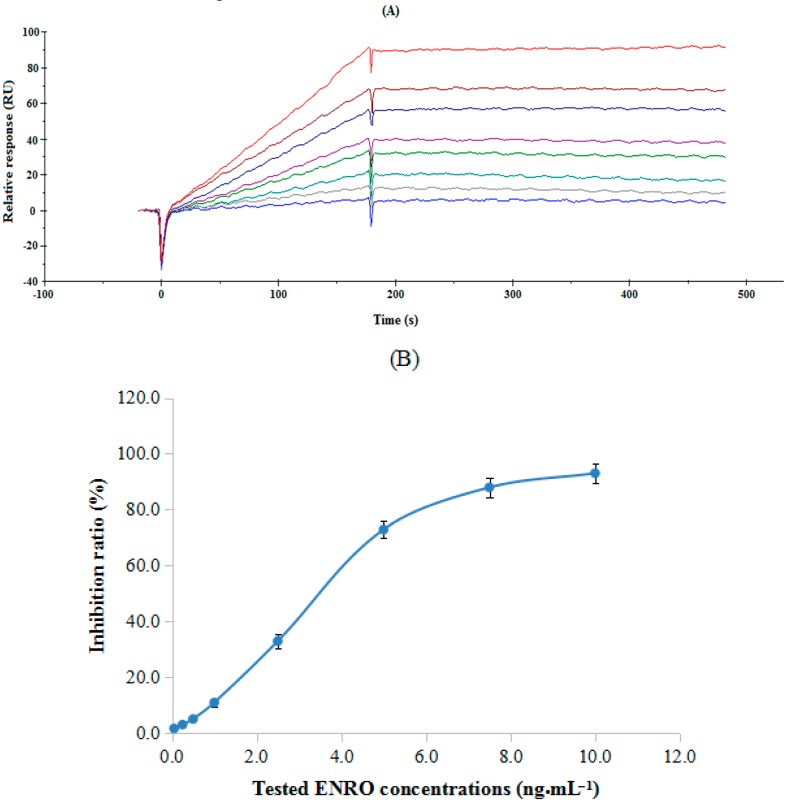
This study describes the development of a reproducible and label-free surface plasmon resonance (SPR) immunosensor and its application in the detection of harmful enrofloxacin (ENRO) in animal-derived foods. The experimental parameters for the immunosensor construction and regeneration, including the pH value (4.5), concentration for coating ENRO-ovalbumin conjugate (ENRO-OVA) (100 μg·mL), concentration of anti-ENRO antibody (80 nM) and regeneration solution (0.1 mol·L HCl) were evaluated in detail. With the optimized parameters, the proposed SPR immunosensor obtained a good linear response to ENRO with high sensitivity (IC: 3.8 ng·mL) and low detection limit (IC: 1.2 ng·mL). The proposed SPR immunosensor was further validated to have favorable performances for ENRO residue detection in typical animal-derived foods after a simple matrix pretreatment procedure, as well as acceptable accuracy (recovery: 84.3-96.6%), precision (relative standard deviation (n = 3): 1.8-4.6%), and sensitivity (IC ≤ 8.4 ng·mL). Each SPR chip for analysis can be reused at least 100 times with good stability and the analysis cycle containing the steps of sample uploading/chip regeneration/baseline recovery can be completed within 6 min (one cycle) and auto-operated by a predetermined program. These results demonstrated that the proposed SPR immunosensor provided an effective strategy for accurate, sensitive, and rapid detection for ENRO residue, which has great potential for routine analysis of large numbers of samples for measuring different types of compounds.
本研究描述了一种可重现且无需标记的表面等离子体共振(SPR)免疫传感器的开发及其在动物源性食品中有害恩诺沙星(ENRO)检测中的应用。详细评估了免疫传感器构建和再生的实验参数,包括 pH 值(4.5)、包被 ENRO-卵清蛋白结合物(ENRO-OVA)的浓度(100μg·mL)、抗 ENRO 抗体的浓度(80nM)和再生溶液(0.1mol·L HCl)。使用优化的参数,所提出的 SPR 免疫传感器对 ENRO 具有良好的线性响应,具有高灵敏度(IC:3.8ng·mL)和低检测限(IC:1.2ng·mL)。在经过简单的基质预处理程序后,该提议的 SPR 免疫传感器进一步验证了在典型动物源性食品中对 ENRO 残留检测具有良好的性能,并且具有可接受的准确性(回收率:84.3-96.6%)、精密度(相对标准偏差(n = 3):1.8-4.6%)和灵敏度(IC≤8.4ng·mL)。每个用于分析的 SPR 芯片至少可以重复使用 100 次,具有良好的稳定性,并且包含样品上传/芯片再生/基线恢复步骤的分析周期可以在 6 分钟(一个周期)内完成,并由预定程序自动操作。这些结果表明,所提出的 SPR 免疫传感器为 ENRO 残留的准确、灵敏和快速检测提供了一种有效的策略,对于常规分析大量样品以测量不同类型的化合物具有很大的潜力。