Nikonova Anna, Esfahani Khashayar, Chausse Guillaume, Probst Stephan, Petrogiannis-Haliotis Tina, Knecht Hans, Gyger Genevieve
McGill University, Jewish General Hospital, Division of Hematology, Department of Medicine, Montreal, QC, Canada.
McGill University, Jewish General Hospital, Department of Nuclear Medicine, Montreal, QC, Canada.
Case Rep Oncol. 2017 Jul 11;10(2):613-619. doi: 10.1159/000477658. eCollection 2017 May-Aug.
Erdheim-Chester disease (ECD) is a rare non-Langerhans cell histiocytosis disorder that utilizes the RAS-RAF-MEK-ERK pathway. It has a highly variable clinical presentation, where virtually any organ can be involved, thus having the potential of posing a great diagnostic challenge. Over half of the reported cases have the BRAF V600E mutation and have shown a remarkable response to vemurafenib.
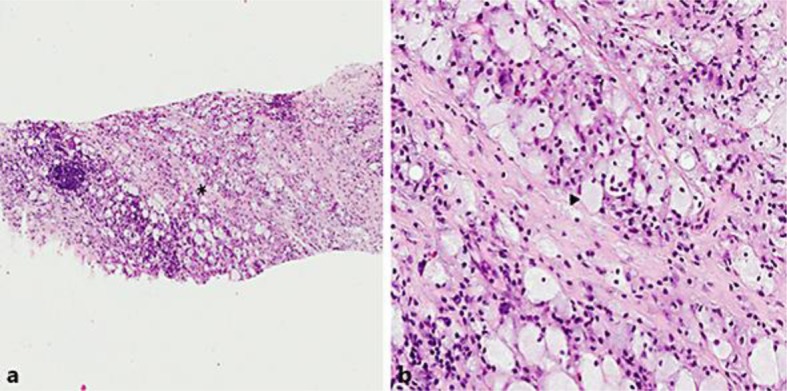
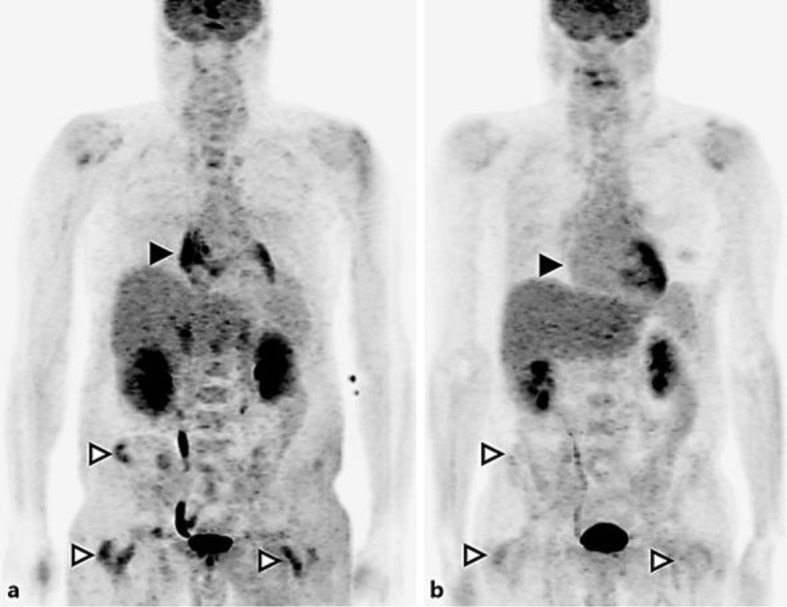
We describe herein a patient with a history of stroke-like symptoms and retroperitoneal fibrosis that on initial pathology raised the possibility of IgG4-related disease. However, the patient was refractory to high-dose steroids and progressed further, developing an epicardial soft tissue mass and recurrent neurological symptoms. Integration of the above findings with new information at another hospital about a radiological history of symmetrical lower extremities long bone lesions raised the differential diagnosis of ECD. Molecular analysis of formalin-fixed paraffin-embedded tissue of both of the patient's retroperitoneal biopsies (the second one of which had shown a small focus of foamy histiocytes, CD68+/CD1a-) was positive for BRAF mutation, confirming the diagnosis of ECD. The patient demonstrated a dramatic and sustained metabolic response to vemurafenib on follow-up positron emission tomography scans.
This case highlights the need for developing a high index of suspicion for presentations of retroperitoneal fibrosis that represent IgG4-related disease but fail to respond to steroids. When unusual multisystem involvement occurs, one should consider a diagnosis of a rare histiocytosis. Vemurafenib appears to be an effective treatment for even advanced cases of both ECD and Langerhans histiocytosis bearing the BRAF V600E mutation.
Erdheim-Chester病(ECD)是一种罕见的非朗格汉斯细胞组织细胞增多症,它利用RAS-RAF-MEK-ERK信号通路。其临床表现高度可变,几乎任何器官都可能受累,因此可能带来巨大的诊断挑战。超过半数的报告病例存在BRAF V600E突变,且对维莫非尼表现出显著反应。
我们在此描述一名有类似中风症状和腹膜后纤维化病史的患者,其初始病理检查结果提示可能为IgG4相关疾病。然而,该患者对高剂量类固醇治疗无效且病情进一步进展,出现了心外膜软组织肿块和反复的神经症状。将上述发现与另一家医院提供的关于双侧下肢长骨对称性病变放射学病史的新信息相结合,使ECD成为鉴别诊断之一。对患者两次腹膜后活检的福尔马林固定石蜡包埋组织进行分子分析(第二次活检显示有一小片泡沫状组织细胞,CD68+/CD1a-),BRAF突变呈阳性,从而确诊为ECD。在后续的正电子发射断层扫描中,该患者对维莫非尼表现出显著且持续的代谢反应。
本病例强调,对于表现为IgG4相关疾病但对类固醇治疗无反应的腹膜后纤维化,需要提高警惕。当出现不寻常的多系统受累情况时,应考虑罕见组织细胞增多症的诊断。维莫非尼似乎是治疗伴有BRAF V600E突变的晚期ECD和朗格汉斯组织细胞增多症的有效药物。