Brandão Rafael Augusto Castro Santiago, Martins Warley Carvalho da Silva, Arantes Aluízio Augusto, Gusmão Sebastião Nataniel Silva, Perrin Gilles, Barrey Cédric
Department of Surgery, Universidade Federal de Minas Gerais, Belo Horizonte, Minas Gerais, Brazil.
Neurological and Neurosurgical Clinic, Santa Casa de Misericórdia de Belo Horizonte, Belo Horizonte, Minas Gerais, Brazil.
Surg Neurol Int. 2017 Aug 14;8:191. doi: 10.4103/sni.sni_113_17. eCollection 2017.
Titanium and polyetheretherketone (PEEK) implants have been used in spinal surgery with low rejection rates. Compared to titanium, PEEK has many advantages, including a density more similar to that of bone, radiolucency, and a lack of artifacts in computed tomography (CT) and magnetic resonance imaging (MRI). In this study, we evaluated the effectiveness of PEEK cages as an alternative to titanium for bone fusion after fractures of the thoracolumbar spine. We also propose a classification to the impaction index.
We evaluated 77 patients with fractures of the thoracic or lumbar spine who were treated by anterior fixation with titanium cages (TeCorp®) in 46 (59.7%) patients or PEEK (Verte-stak®) in 31 (40.3%) patients from 2006 to 2012 (Neurological Hospital of Lyon).
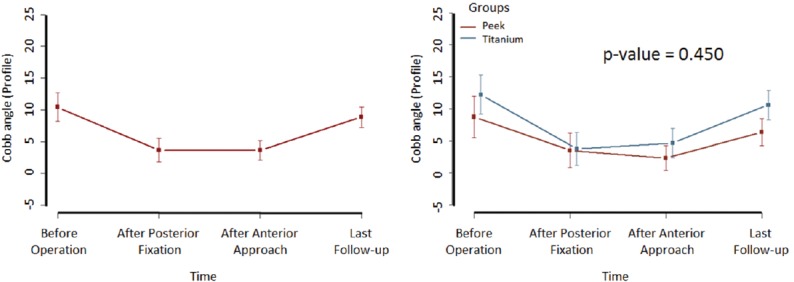
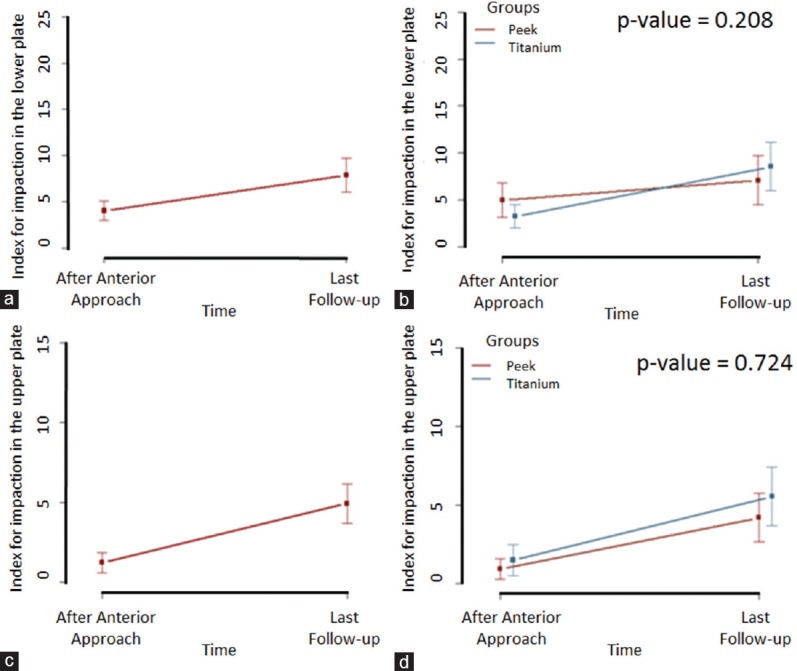
The titanium group achieved 100% fusion, and the PEEK group achieved 96.3% fusion. The titanium systems correlated with higher impact stress directed toward the lower and upper plateaus of the fused vertebrae; there were no nonunions for those treated with titanium group. Nevertheless, there was only one in the PEEK group. There was no significant difference in the pain scale outcomes for patients with ±10 degrees of the sagittal angle. Statistically, it is not possible to associate the variation of sagittal alignment or the impaction with symptoms of pain. The complication rate related to the implantation of cages was low.
Titanium and PEEK are thus equally effective options for the reconstruction of the anterior column. PEEK is advantageous because its radiolucency facilitates the visualization of bone bridges.
钛和聚醚醚酮(PEEK)植入物已用于脊柱手术,排斥率较低。与钛相比,PEEK有许多优点,包括密度更接近骨密度、射线可透过性以及在计算机断层扫描(CT)和磁共振成像(MRI)中无伪影。在本研究中,我们评估了PEEK椎间融合器作为胸腰椎骨折后骨融合替代钛植入物的有效性。我们还提出了一种撞击指数分类方法。
我们评估了77例胸腰椎骨折患者,这些患者在2006年至2012年期间(里昂神经医院)接受了前路固定治疗,其中46例(59.7%)患者使用钛椎间融合器(TeCorp®),31例(40.3%)患者使用PEEK椎间融合器(Verte-stak®)。
钛组融合率达100%,PEEK组融合率达96.3%。钛植入系统与指向融合椎体上下平台的更高撞击应力相关;钛组治疗的患者无骨不连情况。然而,PEEK组仅有1例骨不连。矢状角±10度的患者在疼痛量表结果上无显著差异。从统计学角度来看,矢状位排列的变化或撞击与疼痛症状之间不存在关联。与椎间融合器植入相关的并发症发生率较低。
因此,钛和PEEK在前柱重建中同样有效。PEEK的优势在于其射线可透过性便于观察骨桥。