Thiel Cora S, Huge Andreas, Hauschild Swantje, Tauber Svantje, Lauber Beatrice A, Polzer Jennifer, Paulsen Katrin, Lier Hartwin, Engelmann Frank, Schmitz Burkhard, Schütte Andreas, Layer Liliana E, Ullrich Oliver
Institute of Anatomy, Faculty of Medicine, University of Zurich, Winterthurerstrasse 190, CH-8057 Zurich, Switzerland.
Department of Machine Design, Engineering Design and Product Development, Institute of Mechanical Engineering, Otto-von-Guericke-University Magdeburg, Universitätsplatz 2, D-39106 Magdeburg, Germany.
NPJ Microgravity. 2017 Aug 31;3:22. doi: 10.1038/s41526-017-0028-6. eCollection 2017.
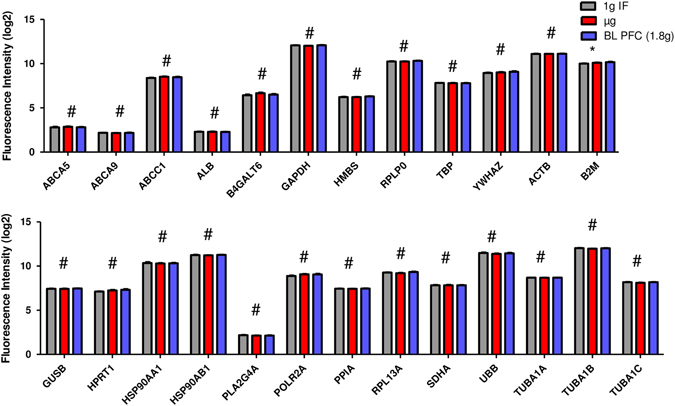
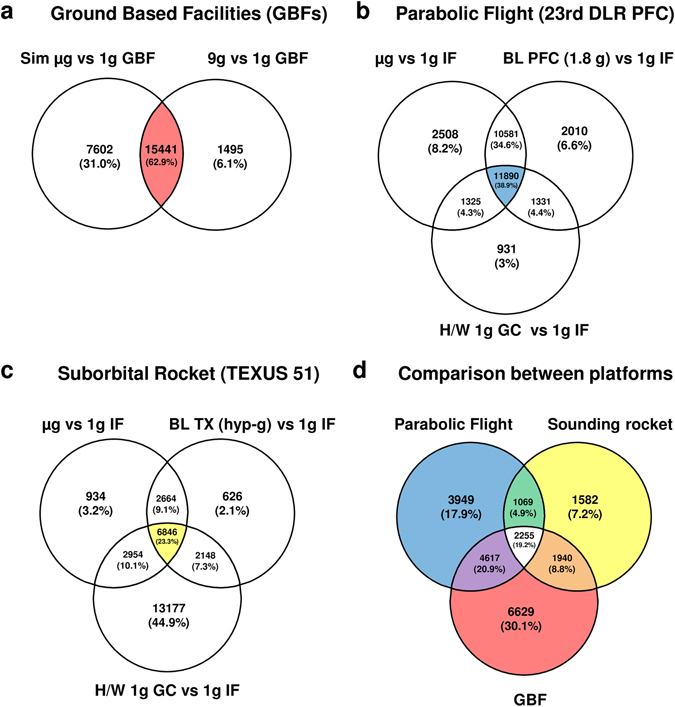
In the last decades, a plethora of in vitro studies with living human cells contributed a vast amount of knowledge about cellular and molecular effects of microgravity. Previous studies focused mostly on the identification of gravity-responsive genes, whereas a multi-platform analysis at an integrative level, which specifically evaluates the extent and robustness of transcriptional response to an altered gravity environment was not performed so far. Therefore, we investigated the stability of gene expression response in non-activated human Jurkat T lymphocytic cells in different gravity environments through the combination of parabolic flights with a suborbital ballistic rocket and 2D clinostat and centrifuge experiments, using strict controls for excluding all possible other factors of influence. We revealed an overall high stability of gene expression in microgravity and identified olfactory gene expression in the chromosomal region 11p15.4 as particularly robust to altered gravity. We identified that classical reference genes , , , , and were stably expressed in all tested gravity conditions and platforms, while and were also known to be stably expressed in U937 cells in all gravity conditions. In summary, 10-20% of all transcripts remained totally unchanged in any gravitational environment tested (between 10 and 9 g), 20-40% remained unchanged in microgravity (between 10 and 10 g) and 97-99% were not significantly altered in microgravity if strict exclusion criteria were applied. Therefore, we suppose a high stability of gene expression in microgravity. Comparison with other stressors suggests that microgravity alters gene expression homeostasis not stronger than other environmental factors.
在过去几十年里,大量使用活的人类细胞进行的体外研究积累了关于微重力对细胞和分子影响的大量知识。以往的研究主要集中在重力响应基因的鉴定上,而到目前为止,尚未进行在整合水平上的多平台分析,该分析专门评估转录对重力环境改变的响应程度和稳健性。因此,我们通过将抛物线飞行与亚轨道弹道火箭以及二维回转器和离心机实验相结合,在严格控制以排除所有其他可能影响因素的情况下,研究了不同重力环境下未激活的人类 Jurkat T 淋巴细胞中基因表达响应的稳定性。我们揭示了微重力下基因表达的总体高度稳定性,并确定染色体区域 11p15.4 中的嗅觉基因表达对重力改变特别稳健。我们发现经典参考基因 、 、 、 和 在所有测试的重力条件和平台中均稳定表达,而 和 也已知在所有重力条件下的 U937 细胞中稳定表达。总之,在任何测试的重力环境(10 到 9 g 之间)中,所有转录本的 10 - 20% 完全保持不变,在微重力(10 到 10 g 之间)中 20 - 40% 保持不变,如果应用严格的排除标准,在微重力中 97 - 99% 没有显著变化。因此,我们推测微重力下基因表达具有高度稳定性。与其他应激源的比较表明,微重力对基因表达稳态的改变不比其他环境因素更强。