Cortez-Pinto Helena, Borralho Paula, Machado Jorge, Lopes Maria T, Gato Inês V, Santos António M, Guerreiro António S
Gastroenterology and Hepatology Department, Centro Hospitalar Lisboa Norte, Lisbon, Portugal.
Nutrition Laboratory, Faculdade de Medicina de Lisboa, Lisbon, Portugal.
GE Port J Gastroenterol. 2016 Mar 31;23(3):132-141. doi: 10.1016/j.jpge.2016.01.004. eCollection 2016 May-Jun.
Gut microbiota may play a role in non-alcoholic steatohepatitis (NASH). Previous studies showed that prebiotics and probiotics might halt the progression of steatohepatitis.
To clarify the potential effect of Synbiotic 2000Forte (Synb) in preventing or ameliorating diet induced steatohepatitis, particularly in fibrosis progression and how this intervention correlates with gut microbiota composition and endotoxinemia.
Twenty-seven C57BL/6 mice were divided into three groups: chow diet (CD, n = 7); high-fat choline deficient diet (HFCD, n = 10) and HFCD diet supplemented with Synbiotic 2000Forte (four probiotic strains and four prebiotics mixture) (HFCD + Synb, n = 10). At 6 and 18 weeks, blood samples (lipopolysaccharides assay - LPS), cecal feaces (gut microbiota) and liver tissue (histology) were collected for analysis.
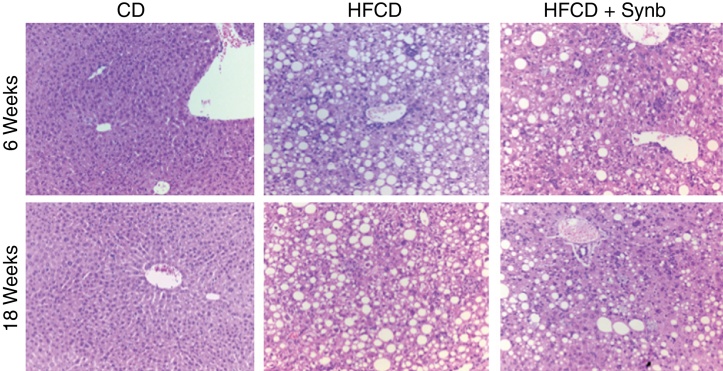
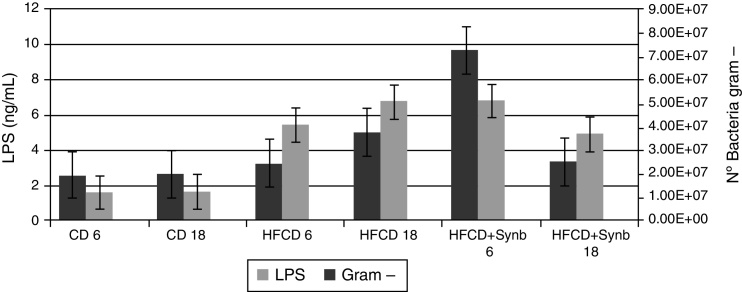
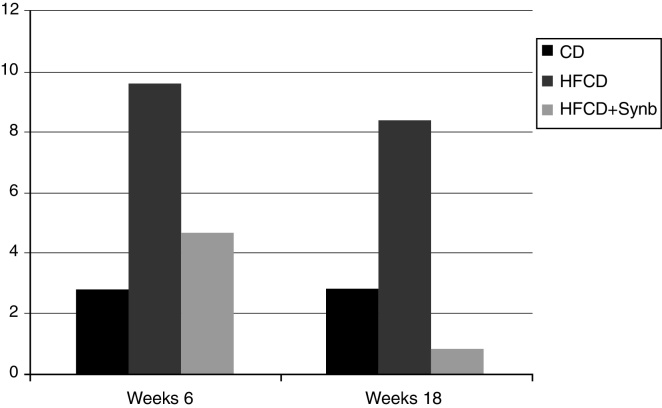
Both HCFD diet mice developed steatohepatitis with ballooning at 6 and 18 weeks, opposite to CD. Comparison of histological scores in HFCD and HFCD + Synb, at 6 and 18 weeks showed no significant difference regarding steatosis, inflammation, or ballooning. Evaluating fibrosis with Sirius Red, and degree of smooth-muscle cell activation, HFCD mice had significantly more fibrosis; addition of Synb significantly reduced fibrosis at 6 weeks and 18 weeks. Serum endotoxin levels were similarly increased in HFCD and HFCD + Synb at week 6; however at week 18 HFCD + Synb had significantly lower endotoxin levels than HFCD. Gut microbiota of HFCD vs CD, showed no significant differences regarding the phyla and , either at 6 or 18 weeks; increased at 6 week (3.3) and 18 week (7.5), while the addition of Synb resulted in a decrease at week 18 (-3.90). markedly increase at week 18 (10.0), but less so with the addition of Synb (5.2).
Synbiotic 2000Forte is able to modulate the mouse gut microbiota reducing the degree of fibrosis while simultaneously decreasing endotoxemia.
肠道微生物群可能在非酒精性脂肪性肝炎(NASH)中发挥作用。先前的研究表明,益生元和益生菌可能会阻止脂肪性肝炎的进展。
阐明复合益生菌制剂2000Forte(Synb)在预防或改善饮食诱导的脂肪性肝炎方面的潜在作用,特别是在纤维化进展方面,以及这种干预与肠道微生物群组成和内毒素血症之间的关系。
将27只C57BL/6小鼠分为三组:正常饮食组(CD,n = 7);高脂胆碱缺乏饮食组(HFCD,n = 10)和补充复合益生菌制剂2000Forte(四种益生菌菌株和四种益生元混合物)的HFCD饮食组(HFCD + Synb,n = 10)。在第6周和第18周,采集血液样本(脂多糖测定 - LPS)、盲肠粪便(肠道微生物群)和肝脏组织(组织学)进行分析。
与CD组相反,两种HFCD饮食组小鼠在第6周和第18周均出现了伴有气球样变的脂肪性肝炎。在第6周和第18周,HFCD组和HFCD + Synb组的组织学评分在脂肪变性、炎症或气球样变方面无显著差异。用天狼星红评估纤维化和平滑肌细胞活化程度,HFCD组小鼠的纤维化程度明显更高;添加Synb在第6周和第18周显著降低了纤维化程度。在第6周时,HFCD组和HFCD + Synb组的血清内毒素水平同样升高;然而在第18周时,HFCD + Synb组的内毒素水平明显低于HFCD组。HFCD组与CD组的肠道微生物群在第6周或第18周时,在门 和 方面无显著差异; 在第6周(3.3)和第18周(7.5)增加,而添加Synb导致在第18周时下降(-3.90)。 在第18周时显著增加(10.0),但添加Synb后增加较少(5.2)。
复合益生菌制剂2000Forte能够调节小鼠肠道微生物群,降低纤维化程度,同时降低内毒素血症。