School of Medicine, University of Nottingham, Queens Medical Centre, Nottingham, NG7 2UH, England.
Nottingham University Hospitals NHS Trust, Queens Medical Centre, Nottingham, NG7 2UH, England.
BMC Health Serv Res. 2017 Sep 5;17(1):624. doi: 10.1186/s12913-017-2579-3.
Hospital discharge summaries are a key communication tool ensuring continuity of care between primary and secondary care. Incomplete or untimely communication of information increases risk of hospital readmission and associated complications. The aim of this study was to evaluate whether the introduction of a new electronic discharge system (NewEDS) was associated with improvements in the completeness and timeliness of discharge information, in Nottingham University Hospitals NHS Trust, England.
A before and after longitudinal study design was used. Data were collected using the gold standard auditing tool from the Royal College of Physicians (RCP). This tool contains a checklist of 57 items grouped into seven categories, 28 of which are classified as mandatory by RCP. Percentage completeness (out of the 28 mandatory items) was considered to be the primary outcome measure. Data from 773 patients discharged directly from the acute medical unit over eight-week long time periods (four before and four after the change to the NewEDS) from August 2010 to May 2012 were extracted and evaluated. Results were summarised by effect size on completeness before and after changeover to NewEDS respectively. The primary outcome variable was represented with percentage of completeness score and a non-parametric technique was used to compare pre-NewEDS and post-NewEDS scores.
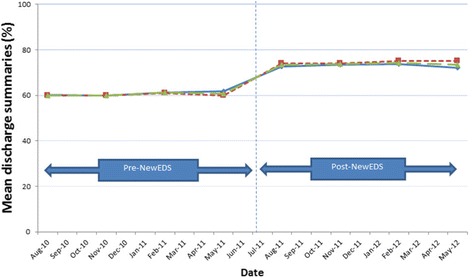
The changeover to the NewEDS resulted in an increased completeness of discharge summaries from 60.7% to 75.0% (p < 0.001) and the proportion of summaries created under 24 h from discharge increased significantly from 78.0% to 93.0% (p < 0.001). Furthermore, five of the seven grouped checklist categories also showed significant improvements in levels of completeness (p < 0.001), although there were reduced levels of completeness for three items (p < 0.001).
The introduction of a NewEDS was associated with a significant improvement in the completeness and timeliness of hospital discharge communication.
医院出院总结是确保初级保健和二级保健之间护理连续性的重要沟通工具。信息传递不完整或不及时会增加再次住院和相关并发症的风险。本研究的目的是评估在英格兰诺丁汉大学医院 NHS 信托基金中引入新的电子出院系统(NewEDS)是否与改善出院信息的完整性和及时性有关。
采用前后纵向研究设计。使用来自皇家内科医师学院(RCP)的黄金标准审核工具收集数据。该工具包含一个 57 项清单,分为七个类别,其中 28 项被 RCP 列为强制性项目。完整性百分比(28 项强制性项目中的百分比)被认为是主要的测量结果。从 2010 年 8 月至 2012 年 5 月,在八周的时间内,从急性内科病房直接出院的 773 名患者的数据(在切换到 NewEDS 之前和之后各有四个时间段)被提取并进行评估。分别总结切换到 NewEDS 前后的完整性效果大小。主要结果变量表示为完整性得分的百分比,并使用非参数技术比较切换到 NewEDS 前后的得分。
切换到 NewEDS 后,出院总结的完整性从 60.7%增加到 75.0%(p<0.001),并且出院后 24 小时内生成的总结比例从 78.0%显著增加到 93.0%(p<0.001)。此外,七个清单类别中有五个在完整性水平上也显示出显著改善(p<0.001),尽管有三个项目的完整性水平降低(p<0.001)。
引入 NewEDS 与医院出院沟通的完整性和及时性的显著改善相关。