• 文献检索
  • 文档翻译
  • 深度研究
  • 学术资讯
  • Suppr Zotero 插件Zotero 插件
  • 邀请有礼
  • 套餐&价格
  • 历史记录
应用&插件
Suppr Zotero 插件Zotero 插件浏览器插件Mac 客户端Windows 客户端微信小程序
定价
高级版会员购买积分包购买API积分包
服务
文献检索文档翻译深度研究API 文档MCP 服务
关于我们
关于 Suppr公司介绍联系我们用户协议隐私条款
关注我们

Suppr 超能文献

核心技术专利:CN118964589B侵权必究
粤ICP备2023148730 号-1Suppr @ 2026

文献检索

告别复杂PubMed语法,用中文像聊天一样搜索,搜遍4000万医学文献。AI智能推荐,让科研检索更轻松。

立即免费搜索

文件翻译

保留排版,准确专业,支持PDF/Word/PPT等文件格式,支持 12+语言互译。

免费翻译文档

深度研究

AI帮你快速写综述,25分钟生成高质量综述,智能提取关键信息,辅助科研写作。

立即免费体验

孟加拉国银足白蛉(双翅目:毛蠓科)沙蝇的控制:一项整群随机对照试验。

Control of Phlebotomus argentipes (Diptera: Psychodidae) sand fly in Bangladesh: A cluster randomized controlled trial.

作者信息

Chowdhury Rajib, Faria Shyla, Huda M Mamun, Chowdhury Vashkar, Maheswary Narayan Prosad, Mondal Dinesh, Akhter Shireen, Akter Sakila, Khan Rajaul Karim, Nabi Shah Golam, Kroeger Axel, Argaw Daniel, Alvar Jorge, Dash Aditya Prasad, Banu Qamar

机构信息

National Institute of Preventive and Social Medicine (NIPSOM), Mohakhali, Dhaka, Bangladesh.

International Centre for Diarrhoea Disease Research, Bangladesh (icddr,b), Dhaka, Bangladesh.

出版信息

PLoS Negl Trop Dis. 2017 Sep 5;11(9):e0005890. doi: 10.1371/journal.pntd.0005890. eCollection 2017 Sep.

DOI:10.1371/journal.pntd.0005890
PMID:28873425
原文链接:https://pmc.ncbi.nlm.nih.gov/articles/PMC5600390/
Abstract

BACKGROUND

A number of studies on visceral leishmaniasis (VL) vector control have been conducted during the past decade, sometimes came to very different conclusion. The present study on a large sample investigated different options which are partially unexplored including: (1) indoor residual spraying (IRS) with alpha cypermethrin 5WP; (2) long lasting insecticide impregnated bed-net (LLIN); (3) impregnation of local bed-nets with slow release insecticide K-O TAB 1-2-3 (KOTAB); (4) insecticide spraying in potential breeding sites outside of house using chlorpyrifos 20EC (OUT) and different combinations of the above.

METHODS

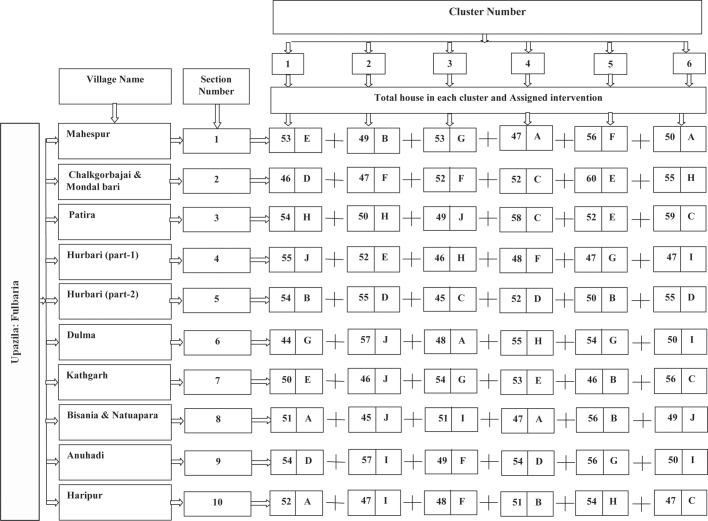
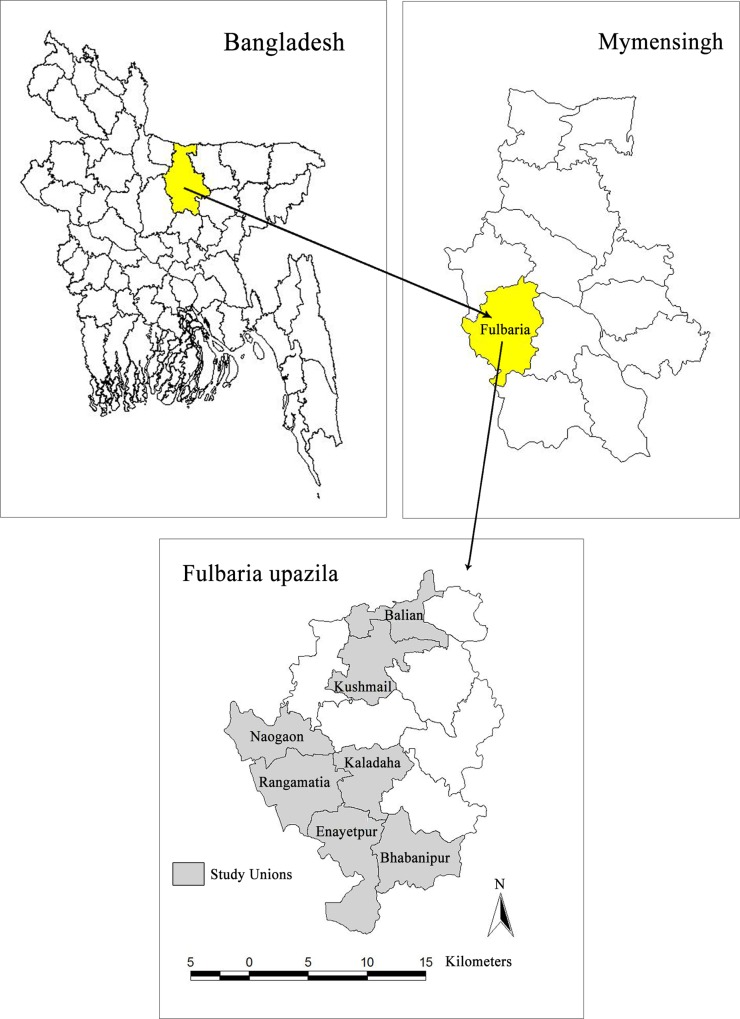
The study was a cluster randomized controlled trial where 3089 houses from 11 villages were divided into 10 sections, each section with 6 clusters and each cluster having approximately 50 houses. Based on vector density (males plus females) during baseline survey, the 60 clusters were categorized into 3 groups: (1) high, (2) medium and (3) low. Each group had 20 clusters. From these three groups, 6 clusters (about 300 households) were randomly selected for each type of intervention and control arms. Vector density was measured before and 2, 4, 5, 7, 11, 14, 15, 18 and 22 months after intervention using CDC light traps. The impact of interventions was measured by using the difference-in-differences regression model.

RESULTS

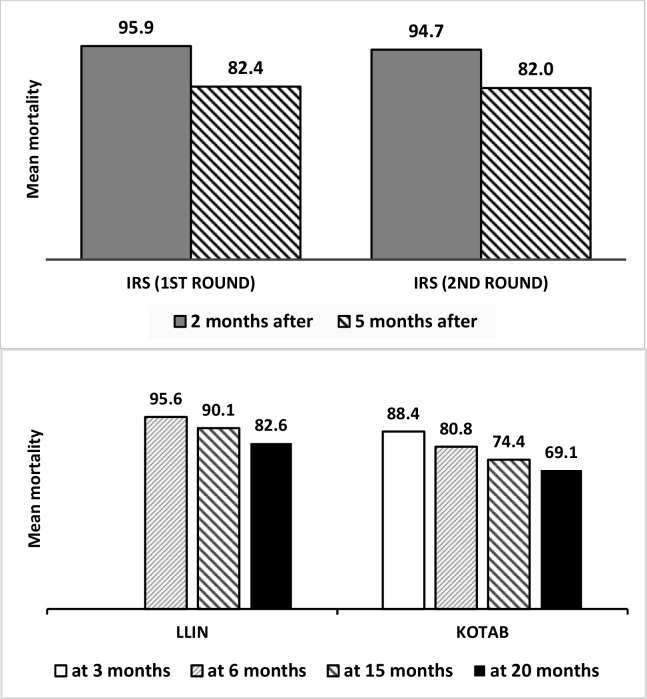
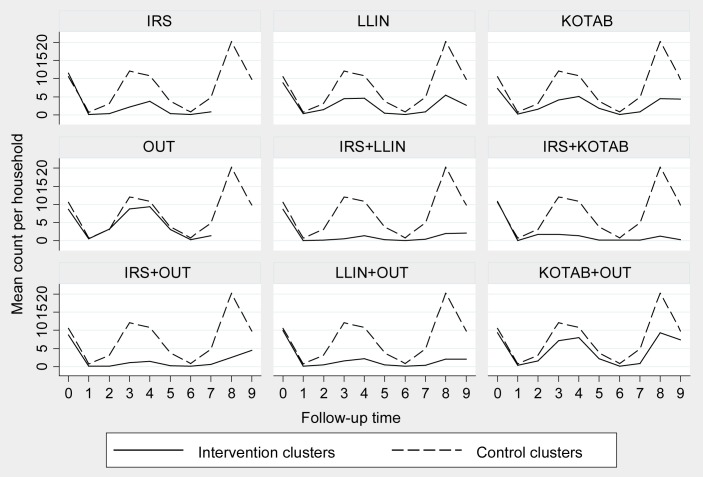
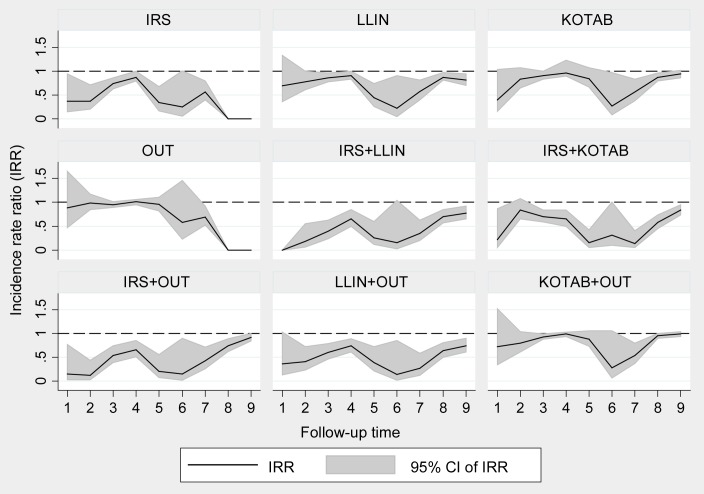
A total of 17,434 sand flies were collected at baseline and during the surveys conducted over 9 months following the baseline measurements. At baseline, the average P. argentipes density per household was 10.6 (SD = 11.5) in the control arm and 7.3 (SD = 8.46) to 11.5 (SD = 20.2) in intervention arms. The intervention results presented as the range of percent reductions of sand flies (males plus females) and rate ratios in 9 measurements over 22 months. Among single type interventions, the effect of IRS with 2 rounds of spraying (applied by the research team) ranged from 13% to 75% reduction of P. argentipes density compared to the control arm (rate-ratio [RR] ranged from 0.25 to 0.87). LLINs caused a vector reduction of 9% to 78% (RR, 0.22 to 0.91). KOTAB reduced vectors by 4% to 73% (RR, 0.27 to 0.96). The combination of LLIN and OUT led to a vector reduction of 26% to 86% (RR, 0.14 to 0.74). The reduction for the combination of IRS and OUT was 8% to 88% (RR, 0.12 to 0.92). IRS and LLIN combined resulted in a vector reduction of 13% to 85% (RR, 0.15 to 0.77). The IRS and KOTAB combination reduced vector densities by 16% to 86% (RR, 0.14 to 0.84). Some intermediate measurements for KOTAB alone and for IRS plus LLIN; and IRS plus KOTAB were not statistically significant. The bioassays on sprayed surfaces or netting materials showed favourable results (>80% mortality) for 22 months (IRS tested for 12 months). In the KOTAB, a gradual decline was observed after 6 months.

CONCLUSIONS

LLIN and OUT was the best combination to reduce VL vector densities for 22 months or longer. Operationally, this is much easier to apply than IRS. A cost analysis of the preferred tools will follow. The relationship between vector density (males plus females) and leishmaniasis incidence should be investigated, and this will require estimates of the Entomological Inoculation Rate.

摘要

背景

在过去十年中,已经开展了多项关于内脏利什曼病(VL)病媒控制的研究,有时得出的结论差异很大。本研究对大量样本进行调查,探讨了一些尚未充分研究的不同方法,包括:(1)使用5%高效氯氰菊酯可湿性粉剂进行室内滞留喷洒(IRS);(2)长效杀虫剂浸渍蚊帐(LLIN);(3)用缓释杀虫剂K-O TAB 1-2-3(KOTAB)浸渍当地蚊帐;(4)使用20%毒死蜱乳油(OUT)对房屋外潜在孳生地进行杀虫剂喷洒以及上述方法的不同组合。

方法

本研究为整群随机对照试验,来自11个村庄的3089所房屋被分为10个区,每个区有6个群组,每个群组约有50所房屋。根据基线调查期间的病媒密度(雄性加雌性),将60个群组分为3组:(1)高密度组,(2)中密度组,(3)低密度组。每组有20个群组。从这三组中,为每种干预措施和对照组随机选择6个群组(约300户家庭)。使用疾控中心诱蚊灯在干预前以及干预后2、4、5、7、11、14、15、18和22个月测量病媒密度。采用双重差分回归模型测量干预措施的效果。

结果

在基线时以及基线测量后的9个月调查期间,共收集到17434只白蛉。在基线时,对照组每户平均银足白蛉密度为10.6(标准差 = 11.5),干预组为7.3(标准差 = 8.46)至11.5(标准差 = 20.2)。干预结果以22个月内9次测量中白蛉(雄性加雌性)减少百分比范围和率比表示。在单一类型干预措施中,研究团队进行两轮喷洒的IRS使银足白蛉密度相比对照组降低了13%至75%(率比范围为0.25至0.87)。LLIN使病媒减少了9%至78%(率比,0.22至0.91)。KOTAB使病媒减少了4%至73%(率比, 0.27至0.96)。LLIN和OUT的组合使病媒减少了26%至86%(率比,0.14至0.74)。IRS和OUT的组合减少了8%至88%(率比,0.12至0.92)。IRS和LLIN联合使用使病媒减少了13%至85%(率比,0.15至0.77)。IRS和KOTAB组合使病媒密度降低了16%至86%(率比,0.14至0.84)。单独使用KOTAB以及IRS加LLIN;和IRS加KOTAB的一些中间测量结果无统计学意义。对喷洒表面或蚊帐材料的生物测定显示,在22个月内效果良好(死亡率>80%)(IRS测试了12个月)。在KOTAB中,6个月后观察到逐渐下降。

结论

LLIN和OUT是在22个月或更长时间内降低VL病媒密度的最佳组合。在实际操作中,这比IRS更容易应用。接下来将对首选工具进行成本分析。应研究病媒密度(雄性加雌性)与利什曼病发病率之间的关系,这将需要对昆虫接种率进行估计。
https://cdn.ncbi.nlm.nih.gov/pmc/blobs/5077/5600390/c72382e5173e/pntd.0005890.g005.jpg
https://cdn.ncbi.nlm.nih.gov/pmc/blobs/5077/5600390/2bfe969b8b8f/pntd.0005890.g001.jpg
https://cdn.ncbi.nlm.nih.gov/pmc/blobs/5077/5600390/08b38d208e5d/pntd.0005890.g002.jpg
https://cdn.ncbi.nlm.nih.gov/pmc/blobs/5077/5600390/390ba8473bf5/pntd.0005890.g003.jpg
https://cdn.ncbi.nlm.nih.gov/pmc/blobs/5077/5600390/661d5013524b/pntd.0005890.g004.jpg
https://cdn.ncbi.nlm.nih.gov/pmc/blobs/5077/5600390/c72382e5173e/pntd.0005890.g005.jpg
https://cdn.ncbi.nlm.nih.gov/pmc/blobs/5077/5600390/2bfe969b8b8f/pntd.0005890.g001.jpg
https://cdn.ncbi.nlm.nih.gov/pmc/blobs/5077/5600390/08b38d208e5d/pntd.0005890.g002.jpg
https://cdn.ncbi.nlm.nih.gov/pmc/blobs/5077/5600390/390ba8473bf5/pntd.0005890.g003.jpg
https://cdn.ncbi.nlm.nih.gov/pmc/blobs/5077/5600390/661d5013524b/pntd.0005890.g004.jpg
https://cdn.ncbi.nlm.nih.gov/pmc/blobs/5077/5600390/c72382e5173e/pntd.0005890.g005.jpg

相似文献

1
Control of Phlebotomus argentipes (Diptera: Psychodidae) sand fly in Bangladesh: A cluster randomized controlled trial.孟加拉国银足白蛉(双翅目:毛蠓科)沙蝇的控制:一项整群随机对照试验。
PLoS Negl Trop Dis. 2017 Sep 5;11(9):e0005890. doi: 10.1371/journal.pntd.0005890. eCollection 2017 Sep.
2
Chemical and environmental vector control as a contribution to the elimination of visceral leishmaniasis on the Indian subcontinent: cluster randomized controlled trials in Bangladesh, India and Nepal.化学与环境病媒控制对印度次大陆消除内脏利什曼病的贡献:孟加拉国、印度和尼泊尔的整群随机对照试验
BMC Med. 2009 Oct 5;7:54. doi: 10.1186/1741-7015-7-54.
3
Effect of insecticide-treated bed nets on visceral leishmaniasis incidence in Bangladesh. A retrospective cohort analysis.杀虫剂处理过的蚊帐对孟加拉国内脏利什曼病发病率的影响。回顾性队列分析。
PLoS Negl Trop Dis. 2019 Sep 16;13(9):e0007724. doi: 10.1371/journal.pntd.0007724. eCollection 2019 Sep.
4
Indoor residual spraying for kala-azar vector control in Bangladesh: A continuing challenge.孟加拉国的利什曼病病媒控制的室内残留喷洒:持续存在的挑战。
PLoS Negl Trop Dis. 2018 Oct 1;12(10):e0006846. doi: 10.1371/journal.pntd.0006846. eCollection 2018 Oct.
5
Assessing the combined effects of household type and insecticide effectiveness for kala-azar vector control using indoor residual spraying: a case study from North Bihar, India.评估室内滞留喷洒在控制黑热病病媒方面的家庭类型和杀虫剂有效性的综合效果:来自印度比哈尔邦北部的案例研究。
Parasit Vectors. 2019 Aug 22;12(1):409. doi: 10.1186/s13071-019-3670-x.
6
Impact of IRS: Four-years of entomological surveillance of the Indian Visceral Leishmaniases elimination programme.IRS 的影响:印度内脏利什曼病消除规划四年的昆虫学监测。
PLoS Negl Trop Dis. 2021 Aug 9;15(8):e0009101. doi: 10.1371/journal.pntd.0009101. eCollection 2021 Aug.
7
Comparative study of kala-azar vector control measures in eastern Nepal.尼泊尔东部黑热病媒介控制措施的对比研究。
Acta Trop. 2010 Feb;113(2):162-6. doi: 10.1016/j.actatropica.2009.10.012. Epub 2009 Oct 30.
8
Susceptibility of field-collected Phlebotomus argentipes (Diptera: Psychodidae) sand flies from Bangladesh and Nepal to different insecticides.从孟加拉国和尼泊尔采集的白蛉(双翅目:长角亚目)对不同杀虫剂的敏感性。
Parasit Vectors. 2018 Jun 4;11(1):336. doi: 10.1186/s13071-018-2913-6.
9
Long-Term Efficacy of Insecticidal Wall Painting for Controlling Visceral Leishmaniasis Vectors in Bangladesh.孟加拉国杀虫壁绘控制内脏利什曼病媒介的长期效果。
Am J Trop Med Hyg. 2023 Sep 18;109(5):1022-1027. doi: 10.4269/ajtmh.22-0809. Print 2023 Nov 1.
10
Effect of village-wide use of long-lasting insecticidal nets on visceral Leishmaniasis vectors in India and Nepal: a cluster randomized trial.印度和尼泊尔大规模使用长效驱虫蚊帐对内脏利什曼病传播媒介的影响:一项集群随机试验。
PLoS Negl Trop Dis. 2010 Jan 26;4(1):e587. doi: 10.1371/journal.pntd.0000587.

引用本文的文献

1
Impact of Vgsc-1014 mutations on the feeding pattern of Phlebotomus argentipes.电压门控钠通道-1014突变对银足白蛉进食模式的影响。
PLoS One. 2025 May 28;20(5):e0323802. doi: 10.1371/journal.pone.0323802. eCollection 2025.
2
A comprehensive review of biological and genetic control approaches for leishmaniasis vector sand flies; emphasis towards promoting tools for integrated vector management.利什曼病媒介白蛉的生物学和遗传控制方法综合综述;重点在于推广综合媒介管理工具。
PLoS Negl Trop Dis. 2025 Jan 27;19(1):e0012795. doi: 10.1371/journal.pntd.0012795. eCollection 2025 Jan.
3
Assessing insecticide susceptibility, diagnostic dose and time for the sand fly Phlebotomus argentipes, the vector of visceral leishmaniasis in India, using the CDC bottle bioassay.

本文引用的文献

1
History of Kala-Azar in India.印度黑热病的历史。
Ind Med Gaz. 1947 May;82(5):281-286.
2
Entomological efficacy of durable wall lining with reduced wall surface coverage for strengthening visceral leishmaniasis vector control in Bangladesh, India and Nepal.在孟加拉国、印度和尼泊尔,通过减少墙面覆盖面积的耐用墙面衬里来加强内脏利什曼病病媒控制的昆虫学效果。
BMC Infect Dis. 2016 Oct 6;16(1):539. doi: 10.1186/s12879-016-1881-8.
3
Efficacy, Safety and Cost of Insecticide Treated Wall Lining, Insecticide Treated Bed Nets and Indoor Wall Wash with Lime for Visceral Leishmaniasis Vector Control in the Indian Sub-continent: A Multi-country Cluster Randomized Controlled Trial.
评估印度内脏利什曼病传播媒介——白蛉属(Phlebotomus argentipes)的杀虫剂敏感性、诊断剂量和时间,采用 CDC 瓶生物测定法。
PLoS Negl Trop Dis. 2023 May 10;17(5):e0011276. doi: 10.1371/journal.pntd.0011276. eCollection 2023 May.
4
Indoor residual spraying for the control of visceral leishmaniasis: A systematic review.室内残留喷洒控制内脏利什曼病:系统评价。
PLoS Negl Trop Dis. 2022 May 19;16(5):e0010391. doi: 10.1371/journal.pntd.0010391. eCollection 2022 May.
5
Efficacy and community-effectiveness of insecticide treated nets for the control of visceral leishmaniasis: A systematic review.经杀虫剂处理的蚊帐控制内脏利什曼病的效果和社区效果:系统评价。
PLoS Negl Trop Dis. 2022 Mar 2;16(3):e0010196. doi: 10.1371/journal.pntd.0010196. eCollection 2022 Mar.
6
Chemical control and insecticide resistance status of sand fly vectors worldwide.世界范围内的沙蝇媒介的化学控制和抗药性状况。
PLoS Negl Trop Dis. 2021 Aug 12;15(8):e0009586. doi: 10.1371/journal.pntd.0009586. eCollection 2021 Aug.
7
Impact of IRS: Four-years of entomological surveillance of the Indian Visceral Leishmaniases elimination programme.IRS 的影响:印度内脏利什曼病消除规划四年的昆虫学监测。
PLoS Negl Trop Dis. 2021 Aug 9;15(8):e0009101. doi: 10.1371/journal.pntd.0009101. eCollection 2021 Aug.
8
PpSP32-like protein as a marker of human exposure to Phlebotomus argentipes in Leishmania donovani foci in Bangladesh.PpSP32 样蛋白可作为人感染白蛉在孟加拉国利什曼原虫病流行区暴露的标志物。
Int J Parasitol. 2021 Nov;51(12):1059-1068. doi: 10.1016/j.ijpara.2021.05.006. Epub 2021 Jul 15.
9
Effectiveness of vector control methods for the control of cutaneous and visceral leishmaniasis: A meta-review.控制皮肤和内脏利什曼病的病媒控制方法的有效性:荟萃评价。
PLoS Negl Trop Dis. 2021 May 13;15(5):e0009309. doi: 10.1371/journal.pntd.0009309. eCollection 2021 May.
10
Epidemiology of Post-Kala-azar Dermal Leishmaniasis.黑热病后皮肤利什曼病的流行病学
Indian J Dermatol. 2021 Jan-Feb;66(1):12-23. doi: 10.4103/ijd.IJD_651_20.
印度次大陆使用杀虫剂处理过的墙衬、杀虫剂处理过的蚊帐和石灰室内墙面清洗来控制内脏利什曼病病媒的效果、安全性和成本:一项多国整群随机对照试验
PLoS Negl Trop Dis. 2016 Aug 17;10(8):e0004932. doi: 10.1371/journal.pntd.0004932. eCollection 2016 Aug.
4
Implication of vector characteristics of Phlebotomus argentipes in the kala-azar elimination programme in the Indian sub-continent.印度次大陆银足白蛉的媒介特性在黑热病消除计划中的意义。
Pathog Glob Health. 2016 May;110(3):87-96. doi: 10.1080/20477724.2016.1180775.
5
Installation of insecticide-treated durable wall lining: evaluation of attachment materials and product durability under field conditions.安装经杀虫剂处理的耐用墙面衬里:在实地条件下对附着材料和产品耐久性的评估
Parasit Vectors. 2014 Nov 18;7:508. doi: 10.1186/s13071-014-0508-4.
6
How dengue vector Aedes albopictus (Diptera: Culicidae) survive during the dry season in Dhaka City, Bangladesh?登革热媒介白纹伊蚊(双翅目:蚊科)在孟加拉国达卡市的旱季如何生存?
J Vector Borne Dis. 2014 Sep;51(3):179-87.
7
How far are we from visceral leishmaniasis elimination in Bangladesh? An assessment of epidemiological surveillance data.我们距离在孟加拉国消除内脏利什曼病还有多远?对流行病学监测数据的评估。
PLoS Negl Trop Dis. 2014 Aug 21;8(8):e3020. doi: 10.1371/journal.pntd.0003020. eCollection 2014 Aug.
8
Insecticide substitutes for DDT to control mosquitoes may be causes of several diseases.用杀虫剂替代品滴滴涕来控制蚊子可能是几种疾病的病因。
Environ Sci Pollut Res Int. 2013 Apr;20(4):2064-9. doi: 10.1007/s11356-012-1145-0. Epub 2012 Sep 6.
9
Comparison of insecticide-treated nets and indoor residual spraying to control the vector of visceral leishmaniasis in Mymensingh District, Bangladesh.比较杀虫剂处理过的蚊帐和室内滞留喷洒在孟加拉国迈门辛地区控制内脏利什曼病传播媒介的效果。
Am J Trop Med Hyg. 2011 May;84(5):662-7. doi: 10.4269/ajtmh.2011.10-0682.
10
The Indian and Nepalese programmes of indoor residual spraying for the elimination of visceral leishmaniasis: performance and effectiveness.印度和尼泊尔通过室内滞留喷洒消除内脏利什曼病的项目:实施情况与成效
Ann Trop Med Parasitol. 2011 Jan;105(1):31-5. doi: 10.1179/136485911X12899838683124.