Heidelberg Institute of Global Health, University of Heidelberg, Heidelberg, Germany.
Instituto de Investigaciones, Centro Universitario de Zacapa, Universidad de San Carlos de Guatemala, Zacapa, Guatemala.
PLoS Negl Trop Dis. 2022 May 19;16(5):e0010391. doi: 10.1371/journal.pntd.0010391. eCollection 2022 May.
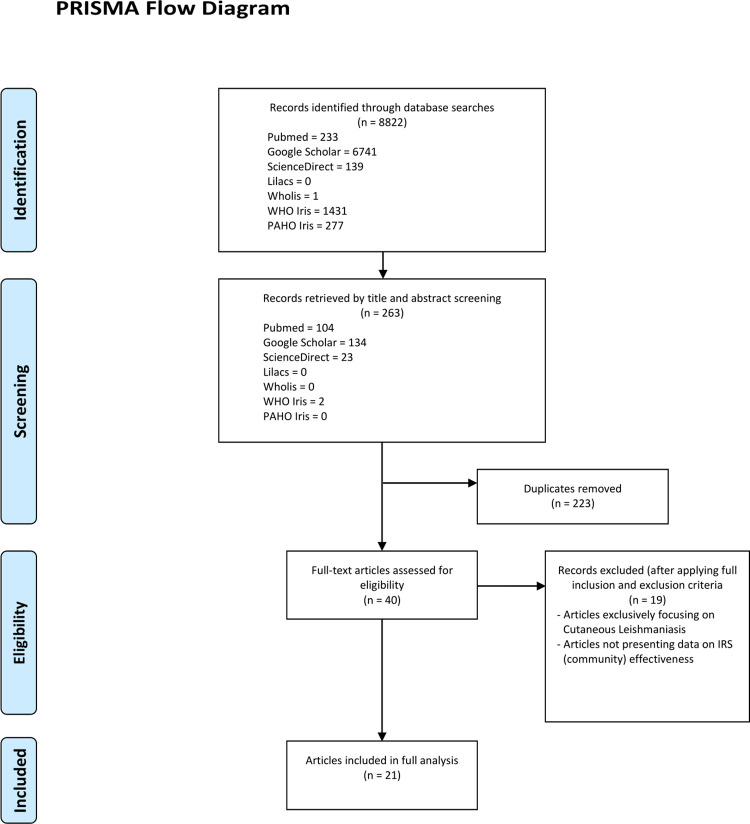
Indoor Residual Spraying (IRS) is one of the interventions to control the vectors of Visceral Leishmaniasis (VL). Different insecticides are used in affected countries, also in the Regional Initiative for the Elimination of VL in South-East Asia. This systematic review assesses all available studies analysing the effectiveness of IRS on the key vectors of VL. The systematic review followed PRISMA guidelines, with a broad search strategy, applied to seven key databases. Inclusion criteria were studies focusing on 1) Visceral leishmaniasis 2) Indoor Residual Spraying (IRS) or synonyms, and 3) all primary research methods. 21 studies were included, five cluster randomised controlled trials (cRCTs), one randomised controlled trial (RCT), 11 intervention studies, also included were three modelling studies and one survey. 19 out of 21 included studies were published between 2009 and 2020. 18 of the studies were conducted in the context of the Regional Initiative. Effects of IRS on vector populations are positive, confirmed in terms of effectiveness and by the availability of studies. Deltamethrin and alpha-Cypermethrin reduce total sandfly counts, and/or Phlebotomus argentipes counts by up to 95% with an effect of a minimum of one month. Prolonged effects are not regularly seen. DDT has been used in India only: whereas in the 1990s a good effect could be measured, this effect waned over time. Two intervention studies, embedded in larger programmes in 2019 and 2020, replaced DDT with alpha-Cypermethrin throughout the study. Combinations of different interventions are not systematically researched, however showing some promising results, for example for the combination of IRS and Temephos. Constant monitoring of insecticide resistancies and quality delivery of IRS are confirmed as key issues for programmes. No human transmission data are available to directly relate an effect of IRS-although modelling studies confirm the effect of IRS on human transmission. Concluding, IRS continues to be an effective intervention for Phlebotomus argentipes control. Delivery requires constant monitoring and quality assurance. Further studies need to assess IRS in different geographical areas affected by VL and combinations of interventions.
室内滞留喷洒(IRS)是控制内脏利什曼病(VL)病媒的干预措施之一。受影响的国家使用不同的杀虫剂,东南亚消除内脏利什曼病区域倡议也使用这些杀虫剂。本系统评价评估了所有分析 IRS 对 VL 主要病媒控制效果的可用研究。该系统评价遵循 PRISMA 指南,采用广泛的搜索策略,应用于七个关键数据库。纳入标准为专注于以下研究:1)内脏利什曼病;2)室内滞留喷洒(IRS)或同义词;3)所有主要研究方法。共纳入 21 项研究,其中 5 项为整群随机对照试验(cRCT),1 项随机对照试验(RCT),11 项干预研究,还包括 3 项建模研究和 1 项调查。21 项纳入研究中有 19 项发表于 2009 年至 2020 年期间。其中 18 项研究是在区域倡议的背景下进行的。IRS 对病媒种群的影响是积极的,这在有效性方面得到了证实,而且有大量的研究支持。溴氰菊酯和α-氯氰菊酯可将总沙蝇数量减少 95%,或减少 95%的致倦库蚊数量,且效果至少持续一个月。但通常不会观察到长期效果。滴滴涕仅在印度使用:尽管在 20 世纪 90 年代可以测量到良好的效果,但随着时间的推移,这种效果逐渐减弱。2019 年和 2020 年进行的两项干预研究在较大的项目中嵌入,整个研究期间用α-氯氰菊酯取代滴滴涕。尚未系统地研究不同干预措施的组合,但有些组合显示出有希望的结果,例如 IRS 和倍硫磷的组合。不断监测杀虫剂抗药性和 IRS 的高质量投放被确认为方案的关键问题。没有人类传播数据可直接将 IRS 的效果联系起来——尽管建模研究证实 IRS 对人类传播有影响。综上所述,IRS 仍然是控制致倦库蚊的有效干预措施。实施 IRS 需要持续监测和质量保证。需要进一步研究 IRS 在受 VL 影响的不同地理区域的效果以及干预措施的组合。