The Dr. Henry D. Janowitz Division of Gastroenterology, Icahn School of Medicine at Mount Sinai, New York, NY, USA.
Department of Oncological Sciences, Icahn School of Medicine at Mount Sinai, New York, NY, USA.
Gut Liver. 2018 Jan 15;12(1):38-45. doi: 10.5009/gnl17091.
BACKGROUND/AIMS: Although gastric cancer (GC) prevalence in the United States overall is low, there is significantly elevated risk in certain racial/ethnic groups. Providers caring for high-risk populations may not be fully aware of GC risk factors and may underestimate the potential for selective screening. Our aim was to identify knowledge gaps among healthcare providers with respect to GC.
An Internet-based survey was distributed to primary care providers (PCPs) and gastroenterologists in New York City, which included questions regarding provider demographics, practice environment, GC risk factors, , and screening practices. Three case vignettes were used to assess clinical management.
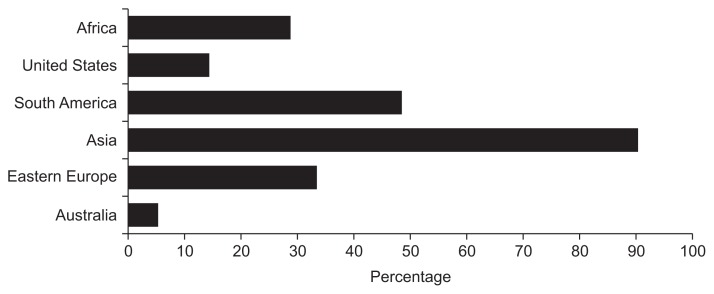
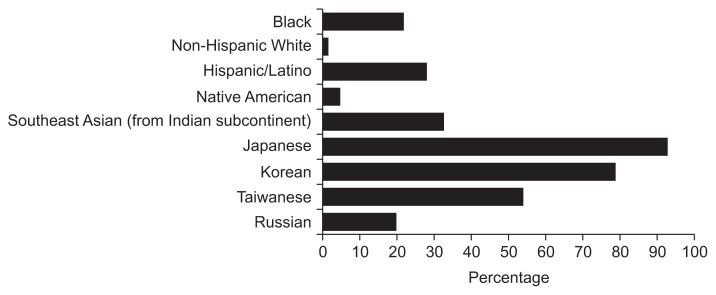
Of 151 included providers (111 PCPs, 40 gastroenterologists), most reported caring for a racially/ethnically diverse population and 58% recommended GC screening for select populations. Although >85% recommended against testing patients from regions where , a known carcinogen, is endemic, <50% were able to correctly identify non-Asian endemic regions. Minorities of respondents correctly identified Hispanic/Latino (29%), Black (22%), and Eastern European/Russian (19.7%) as additional higher-risk races/ethnicities. Vignette-based questions highlighted variability in the management of potentially higher-risk patients.
Despite caring for multiracial/ethnic populations, providers demonstrated deficiencies in identifying and managing patients with elevated GC risk. Focused educational efforts should be considered to address these deficiencies.
背景/目的:尽管美国整体的胃癌(GC)发病率较低,但某些种族/族裔群体的风险显著升高。照顾高危人群的医务人员可能不完全了解 GC 的风险因素,并可能低估选择性筛查的可能性。我们的目的是确定医疗保健提供者在 GC 方面的知识差距。
我们向纽约市的初级保健提供者(PCP)和胃肠病学家分发了一项基于互联网的调查,其中包括有关提供者人口统计学、实践环境、GC 风险因素、筛查实践的问题。使用三个病例简述来评估临床管理。
在 151 名纳入的提供者(111 名 PCP、40 名胃肠病学家)中,大多数报告照顾了种族/族裔多样化的人群,58%建议为特定人群进行 GC 筛查。尽管>85%的人建议不要对来自已知致癌物质流行地区的患者进行检测,但<50%的人能够正确识别非亚洲流行地区。少数受访者正确地将西班牙裔/拉丁裔(29%)、黑人(22%)和东欧/俄罗斯裔(19.7%)识别为其他更高危的种族/族裔。基于病例简述的问题突出了潜在高危患者管理方面的差异。
尽管照顾了多种族/族裔人群,但提供者在识别和管理 GC 风险升高的患者方面表现出不足。应考虑进行有针对性的教育努力来解决这些不足。